
Bollards… they are more than sticks in the ground! In fact, there is an actual code design basis for bollards (i.e. posts). There are six (6) CRITICAL METRICS for bollards, of which five (5) we can see and one (when done properly) is invisible to those of us who inhabit the surface of the earth. So what can we see with the EPA’s picture from their publication Accident Prevention and Response Manual for Anhydrous Ammonia Refrigeration System Operators (U.S. Environmental Protection Agency Region 7)…
See anything wrong with these “bollards” as shown in this picture?
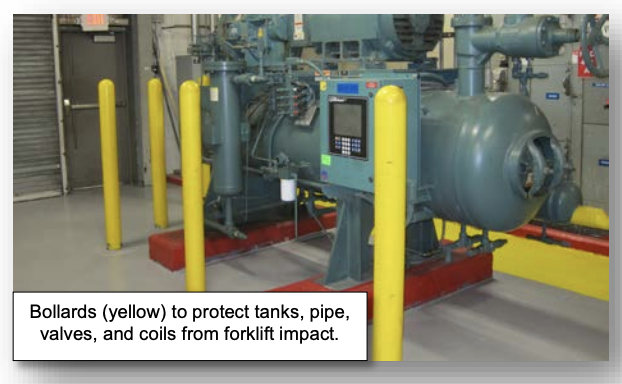
Using my favorite code, the IFC, we can find the “Vehicle Protection” requirements in SECTION 312 VEHICLE IMPACT PROTECTION, which states:
312.2 Posts. Guard posts shall comply with all of the following requirements:
- Constructed of steel not less than 4 inches (102 mm) in diameter and concrete filled.
- Spaced not more than 4 feet (1219 mm) between posts on center.
- Set not less than 3 feet (914 mm) deep in a concrete footing of not less than a 15-inch (381 mm) diameter.
- Set with the top of the posts not less than 3 feet (914 mm) above ground.
- Located not less than 3 feet (914 mm) from the protected object.
The first concern I have is their proximity to the compressor. As we can see in #5 above, the bollards are supposed to be 3′ above the ground AND 3′ away from the object they are intended to protect. This design criterion ensures that if a bollard is pushed all the way over, it does not come into contact with the object it is intended to protect. If the bollards are to be higher than 3′, but still 4″ in diameter (and concrete filled) we begin to call into question their actual strength, as it is assumed they are still only 3′ deep. And if we want them higher than 3′ for some special reason, we also need to move them out at least the same distance as they are in height. So if we want 4′ tall bollards, we need to at least install them 4′ from the object they intend to protect.
NOTE: I did work for a company that had their own bollard design and they required bollards in areas where forklifts operated to be 50″ (4’2″) from the object they intended to protect. This design criterion was based on the standard forklift tine(s) being 48″ long. In normal traffic areas, we used the 3′ High – 3′ Away design.
A bollard is ONLY AS GOOD as its foundation! It is difficult to see in the EPA picture, but in areas where the floor(s) is unfinished, it is quite easy to see if the boring the bollard sits in started as a 15″ diameter with the 4″ diameter post centered and then concrete filled. Too often we find a boring slightly larger than the posts and the post set and then sealed. It is hard to miss the evidence of a 15″ boring! If we look really close, the bollard on the corner in the pic above is not in a 15″ boring – assuming the post is 4″ diameter as required. Looks to be a 6″ floor boring, rather than the 15″.
What we can’t see is if the post sits 3′ deep in its foundation. Basically, we need to begin with a 4″ diameter pipe that is no less than 6′ in length. Bore a hole that is 15″ in diameter and 3′ deep. Set the posts and backfill with concrete. Once it has cured, we then fill the 4″ diameter post with concrete. And that folks is what we call a bollard.
This posting comes as a result of an audit client who used the EPA picture as evidence that their “bollards” meet the EPA requirements as their set up looks very similar to what is shown in EPA’s document. Unfortunately, they had their bollards so close to their compressor that when the forklift hit it, it pushed it over and left a rather large yellow mark on the big green compressor. Their bollards were less than 1′ from the compressor(s) due to limited space in the machinery room. This is a process that is just 3 years old. The plant is located in a state that has a fire/hazardous materials code adopted from the IFC and the state code reads word-for-word what IFC 312.2 says. So we had a long discussion about facility siting being incorporated into the design of the new machinery room and how their Purchase Order(s) tell the contractor that all city, county, and state laws and codes must be met in our work… sounds goods and reads good, if only it were the case. We also had a nice chat about the Incident Investigation Element and how they were minus one investigation that probably should have started within 48 hours of the forklift driver attempting to pain the compressor yellow one post at a time!
But it goes to show us, inches matter in our design basis for our safety systems! We have to quantify our “design basis” and as the old saying goes “measure twice – cut once”!