
Here we have three (3) chemical labels, each one very different from the other and all three have a different agency/organization that oversees their use. All three (3) are for the Category 3 Flammable Liquid Xylene, CAS# 1330-20-7. The question is…
Does it matter where/how these three (3) labels are used on containers of Xylene?
I say, yes – VERY MUCH so, but what do you say? In this article, I will explain my position and how these three very different labels are meant to be used and how they are often times used incorrectly.
 |
 |
 |
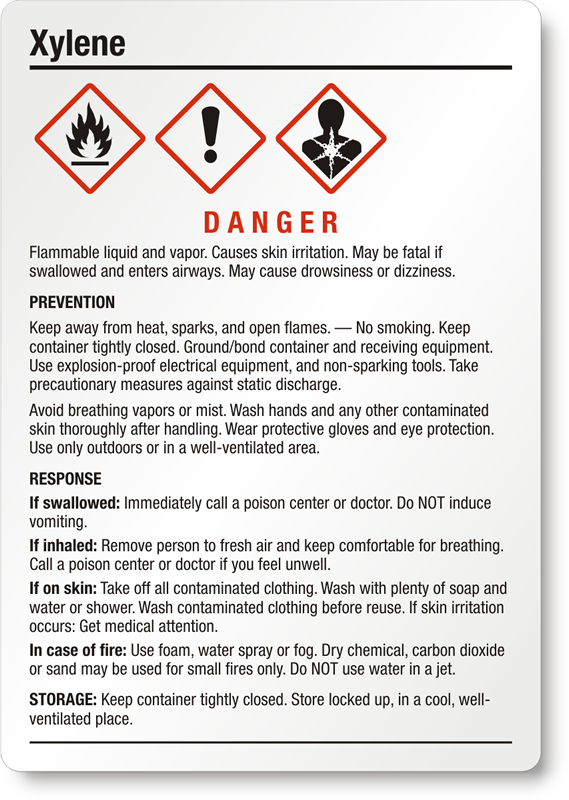
The first label is a GHS label for “Shipped Containers”.
We can find the requirements for this label in 1910.1200(f)(1).
1910.1200(f) Labels and other forms of warning—
1910.1200(f)(1) Labels on shipped containers. The chemical manufacturer, importer, or distributor shall ensure that each container of hazardous chemicals leaving the workplace is labeled, tagged, or marked. Hazards not otherwise classified do not have to be addressed on the container. Where the chemical manufacturer or importer is required to label, tag or mark the following information shall be provided:
1910.1200(f)(1)(i) Product identifier;
1910.1200(f)(1)(ii) Signal word;
1910.1200(f)(1)(iii) Hazard statement(s);
1910.1200(f)(1)(iv) Pictogram(s);
1910.1200(f)(1)(v) Precautionary statement(s); and,
1910.1200(f)(1)(vi) Name, address, and telephone number of the chemical manufacturer, importer, or other responsible party.
This GHS label would be found on smaller containers that are shipped to the workplace; containers such as drums and totes for example. A truck delivers four pallets of Xylene Drums to our facility. Each drum is REQUIRED to have this GHS Shipped Container Label.
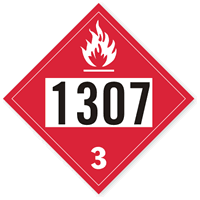
The next label we see is the DOT Placard.
This placard/label is used on BOTH bulk shipments of Xylene and as labels on smaller containers. Whether it is called a “Placard” or “Label” depends on how/where it is used on the shipment of Xylene. There are also variations of this placard, as some may not have the 4-digit UN number “1307” on it (as shown above), rather it may have the word “FLAMMABLE” where the UN number appears on our label above.
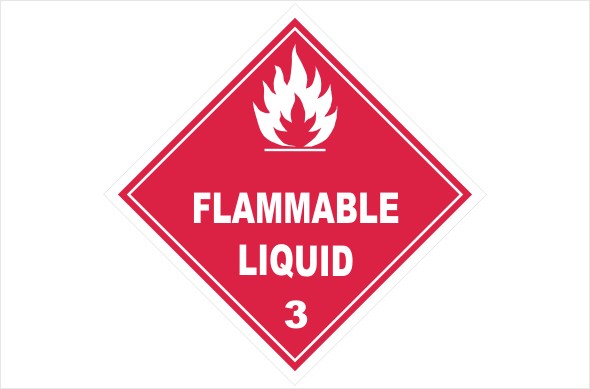
But there seems to be some confusion on the DOT Hazard CLASS and OSHA’s GHS Hazard CATEGORIES. As we can see, in the bottom of the placard there is the number “3” (see highlighted box below).
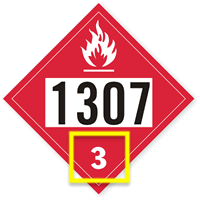
This number 3 represents the DOT Hazard CLASS for all Flammable and Combustible Liquids, as defined by DOT. It is NOT related to the GHS Hazard CATEGORY 3 for Flammable Liquids. It just happens to be that Xylene is a CAT 3 Flammable Liquid and DOT’s Hazard Class for Flammable Liquids is Class 3. We very easily could have a CAT 2 Flammable Liquid, such as Acetone, and it too would be shipped as a DOT Hazard Class 3 Flammable Liquid.
This placard is found on shipments of Xylene. Much like the example used above in the GHS Shipped Containers discussion, the drums of Xylene will have the GHS label and the truck/trailer would have this placard on all four (4) sides. This placard is regulated by DOT – NOT by OSHA. Although, if this label is formally included in the facility’s written HAZCOM program and training program, it could be used in the workplace as a form of labeling; however, alone it does NOT fully meet the need of HAZCOM Workplace labeling (1910.1200(f)(6)) but could be easily adapted.
It is not uncommon to find this DOT transportation placard all by itself on fixed/stationary storage tanks in the workplace. I am not quite sure how this got started, but standing alone, this DOT Placard does NOT provide us with enough information to meet 1910.1200(f)(6):
1910.1200(f)(6) Workplace labeling. Except as provided in paragraphs (f)(7) and (f)(8) of this section, the employer shall ensure that each container of hazardous chemicals in the workplace is labeled, tagged or marked with either:
1910.1200(f)(6)(i) The information specified under paragraphs (f)(1)(i) through (v) of this section for labels on shipped containers; or,
1910.1200(f)(6)(ii) Product identifier and words, pictures, symbols, or combination thereof, which provide at least general information regarding the hazards of the chemicals, and which, in conjunction with the other information immediately available to employees under the hazard communication program, will provide employees with the specific information regarding the physical and health hazards of the hazardous chemical.
1910.1200(f)(7) The employer may use signs, placards, process sheets, batch tickets, operating procedures, or other such written materials in lieu of affixing labels to individual stationary process containers, as long as the alternative method identifies the containers to which it is applicable and conveys the information required by paragraph (f)(6) of this section to be on a label. The employer shall ensure the written materials are readily accessible to the employees in their work area throughout each work shift.
The “Product identifier” is the part that comes into question. I have seen some sites that can read the 4-digit UN number and tell you off the top of their head(s) what chemical goes with what number. But that may not work for contractors and they too MUST be able to read our labels! I can assure you that if the placard shown below was used just like this:
that this placard would NOT meet (f)(6) requirements. If the facility had the name (e.g. product identifier) above or below this placard it would meet 1910.1200(f)(6)(ii). However, this label was created by DOT/PHMSA and is intended to be used on containers in transit.
Click Here (pdf) for a nice “cheat sheet” put out my PHMSA for these labels.
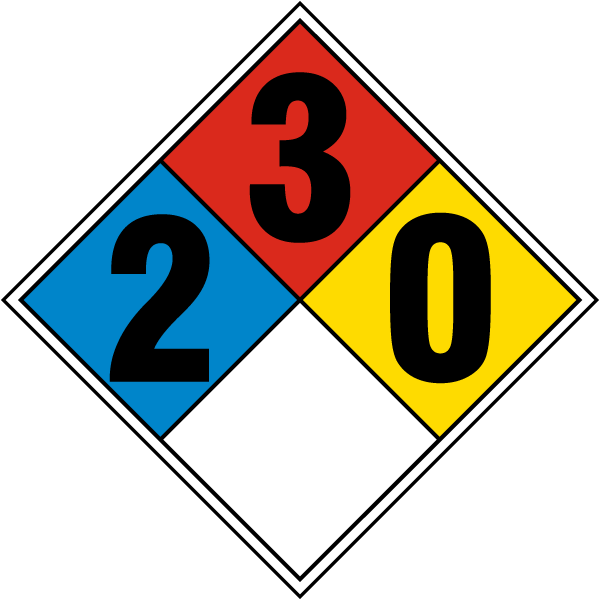
The last label is the NFPA 704 “Diamond”.
The diamond shown is indeed the one for Xylene and just like we discussed above, this label by itself does NOT comply with 1910.1200(f)(6). There are probably dozens of other flammable liquids that would have this 2-3-0 degree of hazard(s); for example, Toluene has the same degree of hazards for Health, Flammability, and Reactivity (2-3-0).
So this label also requires us to use some type of “product identifier” in conjunction with the color-coded, numbered label.
This label is still very much allowed by OSHA – it is a myth that this label and the HMIS labels are no longer allowed. This NFPA 704 label is used in two situations in the workplace:
- Stationary bulk storage tanks/process vessels
- Secondary portable containers
In both situations, we must include the chemicals name or some other “product identifier” that would allow us to cross-reference the chemical with its SDS. For example, the label shown below WOULD meet 1910.1200(f)(6)(ii) for a secondary container.

So there we have it, all three labels explained and their proper uses. Let’s hear your suggestions/concerns/challenges.