
A 47-year-old male employee was fatally injured when he became engulfed by sawdust after entering a dust collection silo. The company is a hardwood flooring manufacturer. On the day of the incident, the victim was cleaning the inside of a dust collection silo containing wood dust. The fire department had been called on to extinguish two different fires in the silo a few days prior to the incident; therefore, the wood dust was saturated with water and could not be processed through the conveyor and boiler. After the fires were completely extinguished, the decision was made to clean out the saturated wood dust. It was determined that the cleaning activity was part of a two-person team and was not a normal task for the employees. The employees had cleaned the silo for two days and the incident occurred on the third day. On the day of the incident, the victim used an aerial lift to access an opening 21 foot from the ground on the side of the silo and cleared the debris using high-pressure water.
The other employee began operating a front-end loader to move the wood dust that had been already been removed from the silo. The loader operator saw a cloud of dust appear from the side of the silo in the area where the aerial lift was positioned. The employee lowered the aerial lift to the ground to learn that the victim was not in the basket.
The investigation concluded that the victim exited the lift and entered the silo through the opening to clean. The victim’s cell phone contained videos of him inside the silo. The victim texted his wife a video of himself standing inside the silo on the afternoon of the incident. The video shows large amounts of wood dust stuck to the silo walls above where the victim was standing. While the victim was inside the silo, the saturated wood dust, which had collected on the walls of the silo, collapsed engulfing him. The employees were not given specific cleaning instructions but it was assumed by management that the employees would not enter the silo. Since the employees were not supposed to be entering the silo the employer did not require that the confined space entry procedures be utilized.
Citation(s) as Originally Issued
A complete inspection was conducted at the accident scene. Some of the items cited may not directly relate to the fatality.
Citation 1 Item 1, 1910.67(c)(2)(v) Each employee working from an aerial lift was not wearing a travel restraint system or personal fall arrest system with a lanyard attached to the boom or basket. In that one employee was operating/working from a genie brand aerial lift 21 ft. above the ground without utilizing any method of fall protection or position device.
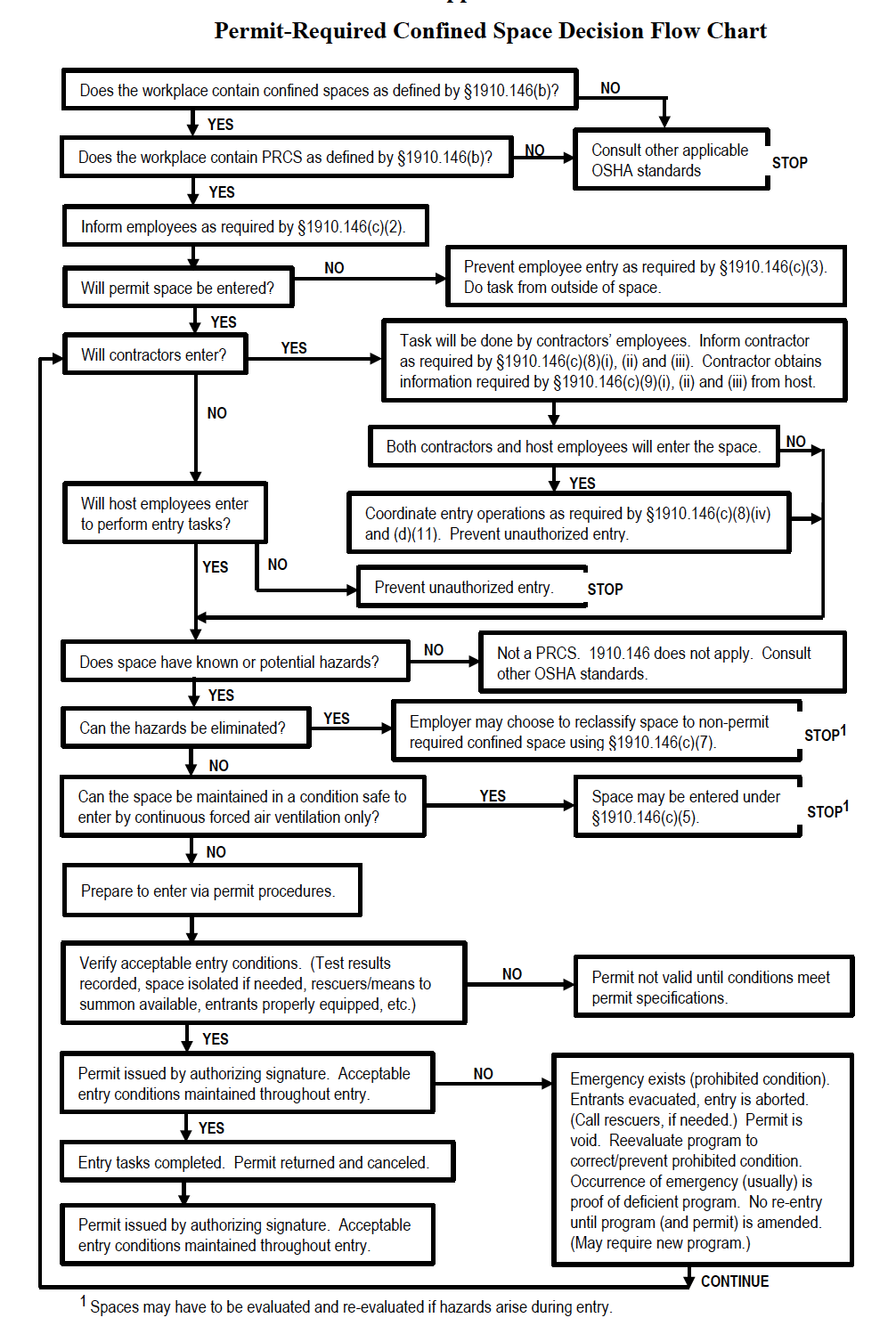
Citation 1 Item 2, 1910.146(d) and 1910.146(c)(3), Under the permit space program required by paragraph (c)(4) of this section the employer did not ensure that the requirements of (d)(1) through (d)(14) were met. In that, the employer failed to implement the means, procedures, and practices necessary for safe permit space entry operations prior to removing the access panel and instructing one employee to conduct cleaning activities of the interior of silo #2, an identified and documented permit-required confined space.
IN THE ALTERNATIVE: When the employer decided its employees would not enter permit spaces the employer did not take effective measures to prevent its employees from entering the permit spaces. In that, the employer failed to take effective measures to prevent one employee from entering silo #2 when the employee was instructed to conduct cleaning operations of the interior of the silo.
Citation 1 Item 3, 1910.146(d)(1): Under the permit-required confined space program required by 29 CFR 1910.146(c)(4), the employer did not implement the measures necessary to prevent unauthorized entry. In that, the employer failed to implement measures to prevent unauthorized entry prior to removing the access panel and instructing one employee to conduct cleaning activities of the interior of silo #2, an identified and documented permit-required confined space.
Citation 1 Item 4, 1910.146(d)(2) Under the permit-required confined space program required by 29 CFR l910.146(c)(4) the employer did not identify and evaluate the hazards of permit spaces before employees entered.In that the employer failed to evaluate and identify hazards located inside silo #2 prior to removing the access panel and instructing one employee to conduct cleaning activities of the interior of silo #2, an identified and documented permit-required confined pace.
Citation 1 Item 5, 1910.146(d)(4) The employer did not provide the equipment specified in paragraphs (d)(4)(i)-(d)(4)(ix) of this section at no cost to employees, did not maintain that equipment properly, and/or did not ensure that employees use that equipment properly. In that the employer failed to provide and/or ensure the proper use of necessary equipment prior to removing the access panel and instructing one employee to conduct cleaning activities of the interior of silo #2, an identified and documented permit-required confined space.
Citation 1 Item 6, 1910.146(d)(5)(i): Under the permit-required confined space program required by 29 CFR 1910.146(c)(4), the employer did not evaluate permit space conditions when entry operations were conducted by testing conditions in the permit space to determine if acceptable entry conditions existed before entry. In that the employer failed to test the conditions present inside silo #2 prior to removing the access panel and instructing one employee to conduct cleaning activities of the interior of silo #2, an identified and documented permit-required confined space.
Citation 1 Item 7, 1910.146(d)(6) Under the permit-required confined space program required by 29 CFR 1910.146(c)(4), the employer did not provide at least one attendant outside the permit space into which entry was authorized for the duration of entry operations.In that the employer failed to provide an attendant outside a permit space prior to removing the access panel and instructing one employee to conduct cleaning activities of the interior of silo #2, an identified and documented permit required confined space.
Citation 1 Item 8, 1910.146(d)(8) Under the permit-required confined space program required by 29 CFR 1910.146(c)(4), the employer did not designate the persons who were to have active roles in entry operations, identify the duties of each such employee, and/or did not provide each such employee with the training required by 29 CFR 1910.146(g). In that the employer failed to designate the individuals who were to have active roles in entry operations and their associated duties, prior to removing the access panel and instructing one employee to conduct cleaning activities of the interior of silo #2, an identified and documented permit-required confined space.
Citation 1 Item 9, 1910.146(d)(9) The employer did not develop and implement procedures for summoning rescue and emergency services, for rescuing entrants from permit spaces, for providing necessary emergency services to rescued employees, and/or for preventing unauthorized entry.ln that the employer failed to develop and implement procedures for summoning rescue and emergency services; for rescuing entrants from permit spaces; for providing necessary emergency services to rescued employees; and for preventing unauthorized entry prior to removing the access panel and instructing one employee to conduct cleaning activities of the interior of silo #2, an identified and documented permit-required confined space.
Citation 1 Item 10, 1910.146(d)(10) Under the permit-required confined space program required by 29 CFR 1910.146(c)(4), the employer did not develop and implement a system for the preparation, issuance, use, and cancellation of entry permits. In that, the employer failed to implement a system for the preparation, issuance, use, and cancellation of entry permits prior to removing the access panel and instructing one employee to conduct cleaning activities of the interior of silo #2, an identified and documented permit-required confined space.
Citation 1 Item 11, 1910.l46(k)(1)(i): The employer, who designated rescue and emergency services pursuant to paragraph (d)(9) of this section, did not evaluate a prospective rescuer’s ability to respond to a rescue summons in a timely manner. In that, the employer failed to evaluate the designated rescue services ability to be available and respond to rescue summons in a timely manner throughout a permit entry.

