
The objective of this project was to conduct refrigerant R-290 (propane) leak and ignition testing under whole room-scale conditions to develop data and insight into the risks associated with the use of Class A3 Refrigerants and to generate technical data to support revisions of relevant safety standards.

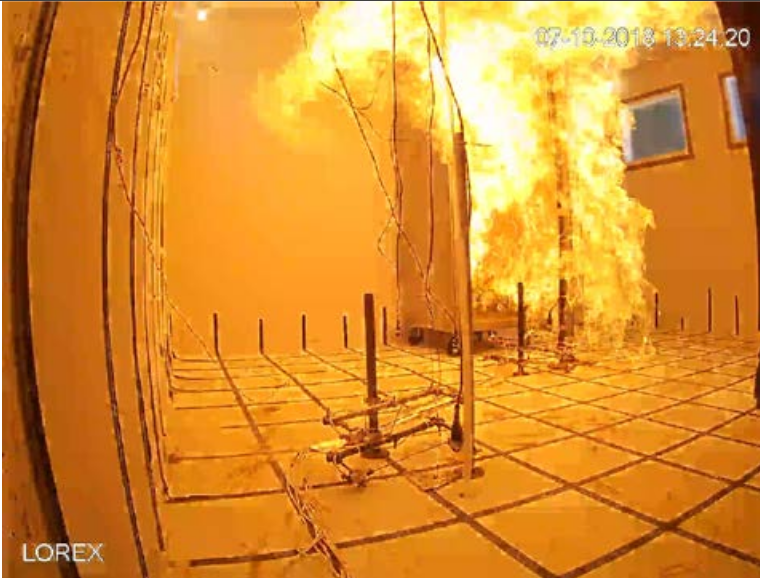
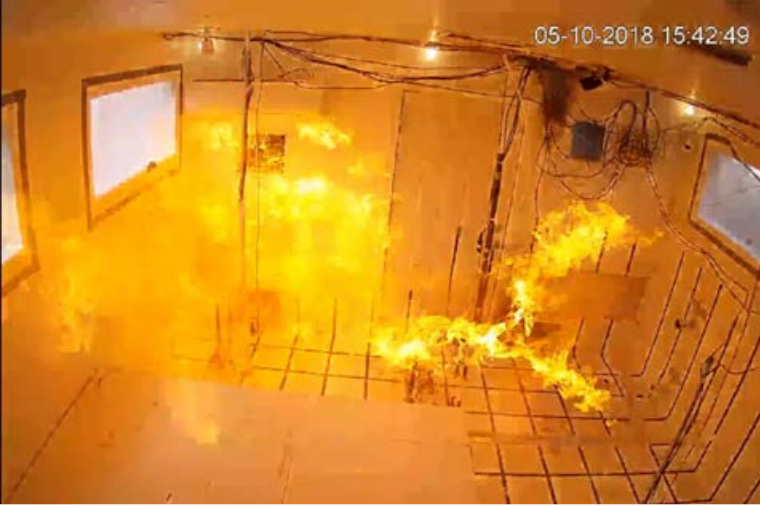
The entire project included parametric testing to investigate how key variables (refrigerant charge amount, release rate and height, etc.) influence the ‘ignition event’ under whole room-scale scenarios. It involved releasing liquid R-290 refrigerant into spaces with a variety of viable ignition sources present. The testing scenario simulated the following:
- Packaged Terminal Air Conditioner(PTAC)
- mini-split air conditioner(AC) in a typical motel room
- a single door reach-in cooler
- three-door reach-in cooler in a convenience store
All the tests were conducted by Underwriter’s Laboratories (UL) under the supervision of AHRTI and CARB. Tests were performed at the UL facility in Northbrook, IL.
AHRTI assembled a Project Monitoring Subcommittee (PMS) to design and guide the testing. The PMS consists of CARB staff, technical experts from the HVACR industry and representatives from relevant safety standards committees/working groups(WGs). The PMS designed the testing scenario according to the existing requirements or proposed requirements in the IEC Standards 60335-2-40 (for air-conditioning products) and IEC 60335-2-89 (for commercial refrigeration products), and their equivalent North American version published by UL.
However, there were some differences between the IEC standards and the testing scenario followed. For example, the air-conditioning equipment testing final discharge rates were based on the finding (documented in this report) that the mass flow rate of liquid propane is 49% of the R-32 liquid mass flow rate at the same saturation temperature and orifice size. These values were selected so that comparisons could be made between the A2L (such as the HFO-1234yf I have written about over the year) and A3 (i.e. propane) refrigerant tests in the 9007-01 and 9007-02 programs. As with the 9007-01 program, leak rates were almost always higher than the rate corresponding to a total loss of charge in four minutes that was generally considered by the IEC/UL 60335-2-40. Generally, this means the scenarios are more severe than they would have been with four-minute leaks. The reason of using a leak rate higher than what was considered in the standards was that the industry was trying to understand what the WORST-CASE SCENARIOS would be in terms of ignition event severity so that the industry can build resolutions upon it to effectively mitigate the risk. The R290 charge amounts used in the testing had their bases in either existing or proposed limits for A3 refrigerants. In the absence of recommended limits for A3 refrigerants, the formulas for A2L refrigerants were used on the assumption that limits for A3’s would follow the same formula. This approach allowed the project to assess safety factors for refrigerant charge quantity and mitigation criteria including mitigation response time and airflow rate for mixing and threshold for performing a certain safety test for commercial refrigerators.
Conclusions
According to the testing results, the following findings are recommended to the relevant standard committees for consideration. All the events that occurred in the testing were low probability events which were forced to occur to understand worse case scenarios and standards should take into account not only the severity of the ignitions that occurred during the testing but also the probability of those ignitions.
IEC/UL 60335-2-40
- Raising the current charge limit (114g for R290) per UL 2-40 should be carefully considered especially for floor or near floor mounted products.
- Any potential ignition sources should be avoided underneath installed units and near the projected area at floor level
- Airflow requirements as a mitigation method should be carefully considered in relation to sensor response times, the amount of refrigerant, and perhaps type of refrigerant (A2Ls vs A3s).
IEC/UL 60335-2-89
- The criteria used for requiring the door-opening test to be performed should be revisited. Empirical validation should guide the selection of criteria. The test also requires that the concentration of refrigerant not exceed 50% of LFL within five minutes of the door having been opened. Extending this time period may be another way that the test could be made more conservative; that is, extending the time period in which refrigerant could build up.
- Any potential ignition sources should be avoided around the unit at floor level.
- Additional mitigation requirement should be assessed to further allow higher charge, such as using fan circulation to dilute leaked refrigerant or shut-off valves to limit the leaked refrigerant quantity.
- The condenser fan being on had a positive effect in reducing the likelihood of an ignition event.
- This study and the National Fire Protection Association (NFPA) A3 study showed that external leaks that occur higher up in elevation on the cooler cabinet are much less likely to produce a flammable cloud near floor level.
The standards committees might consider having different requirements between condensing units high up on the cabinet and condensing units lower or at floor level. This assumes the condenser assembly is the highest probability leak location. However, this assumption needs to be confirmed from the field data. The testing was focused on understanding R290 ignition risk (in terms of the event severity) following either existing or proposed standards. It is not designed to address the probability of the refrigerant ignition event. Some tested ignition events represented the worst-case scenarios with a low probability of occurrence. Ignition sources were simultaneously placed where flammable mixtures were most likely to occur. Therefore, some low probability events were forced to occur. The requirements in safety standards should consider the combination of potential event severity and the probability of an ignition event. Therefore, the adoption of the test results to relevant standards will eventually rely on these committees because individual members have different acceptable thresholds for a harmful event severity and likelihood.
Future work should include a thorough evaluation of:
- Mitigation concepts using airflow circulation and ventilation and shut-off valves.
- The probabilistic distribution of real-world ignition sources in terms of ignition energy, quantity, spatial location throughout the room, and activation frequency.
- The probabilistic distribution of different refrigerant release scenarios, across a range of leak rates and total refrigerant charge, released.
- The unique and complex commercial kitchen applications should be studied for IEC/UL 60335-2-89 because there are typically several adjacent ignition sources and within a very crowded space.
- Risk assessment on ignition probability using existing market results. Many R290 units are in use around the world and real-world performance should be taken into account for existing systems.
CLICK HERE to download the entire report.