Another example of not understanding the chemical hazards in your CS/PRCS… This OSHA case shows us that “pits”, even those that would are not identified as a PRCS in a site evaluation can be deadly from the work we do inside them! When using a chemical that has a Vapor Density 3X’s that of air (1) inside a 10′ deep pit is creating both a FLAMMABLE ATM and in this case an Oxygen DEFICIENT ATM as well. But don’t worry, we know this, so we will use “respiratory protection” to protect us from the hazardous vapors and of course, I am betting there was not a qualified respiratory protection program administrator, as the respirator they selected was an Air-Purifying respirator. So many learnings in this simple incident…
At 1:50 p.m. on September 26, 2013, an employee was working in a dewatering pit and using lacquer thinner to prepare pipes for painting. The pit measured 8 feet by 5.5 feet and was 10 feet deep. A straight ladder was used to access the pit. The employee took a 1-gallon pail of lacquer thinner into the pit and used the thinner to prepare pipes for painting. The employee worked with thinner in the pit for more than one hour. The employee was found on the floor of the pit by coworker #1. Coworker #1 instructed coworker #2 to enter the pit and provide assistance.
Coworker #1 went upstairs to call emergency services because there was no reception in the basement. When coworker #1 returned, he found coworker #2 still standing inside the pit, but unresponsive. The employee succumbed while coworker #2 recovered. The fire department obtained an oxygen reading of 17% in the pit after ventilation and that the employee was overcome by toluene. The employee wore a filtering facepiece respirator.
NOTE: this occurred in 2013, before OSHA’s Construction standard on Confined Space was in place so I am not posting the old citations. CLICK HERE to see the case file.
This is also a perfect example of why we should NOT use OSHA minimums on atmospheric ranges. The O2 levels of 19.5% – 23.5% are WAY TOO broad of a range!
Remember, 1% of the atmosphere is equal to 10,000 ppm
So when the FD found that the O2 level inside the pit was 17%, this translates into 4% of the atmosphere that is SUPPOSE to be Oxygen is something else – in this case, it is Toluene. Toluene has an LEL of 1.2% and a UEL of 7.0% !!!!! This means that NOT ONLY was the worker(s) exposed to an Oxygen Deficient Atmosphere (@ 17%), but they were FIRST exposed to an explosive/flammable atmosphere. But without an ignition source capable of igniting the vapors the workers may be oblivious to this hazard WITHOUT proper atmospheric monitoring of the bottom of the pit. As the concentration of Toluene increased, it had to force out the “air” in the bottom of the pit. This “air” is 20.9% oxygen and 78% Nitrogen and 1% Argon with some traces of others. So as the toluene flashed off the pipe and it will do this really quickly as the worker was spreading it on purpose across piping, this created a larger surface area. The toluene vapors are 3X’s heavier than air so they stay in the bottom of the pit and continue to INCREASE in their concentration which is DECREASING the oxygen levels (as well as the N2 levels in the “air”).
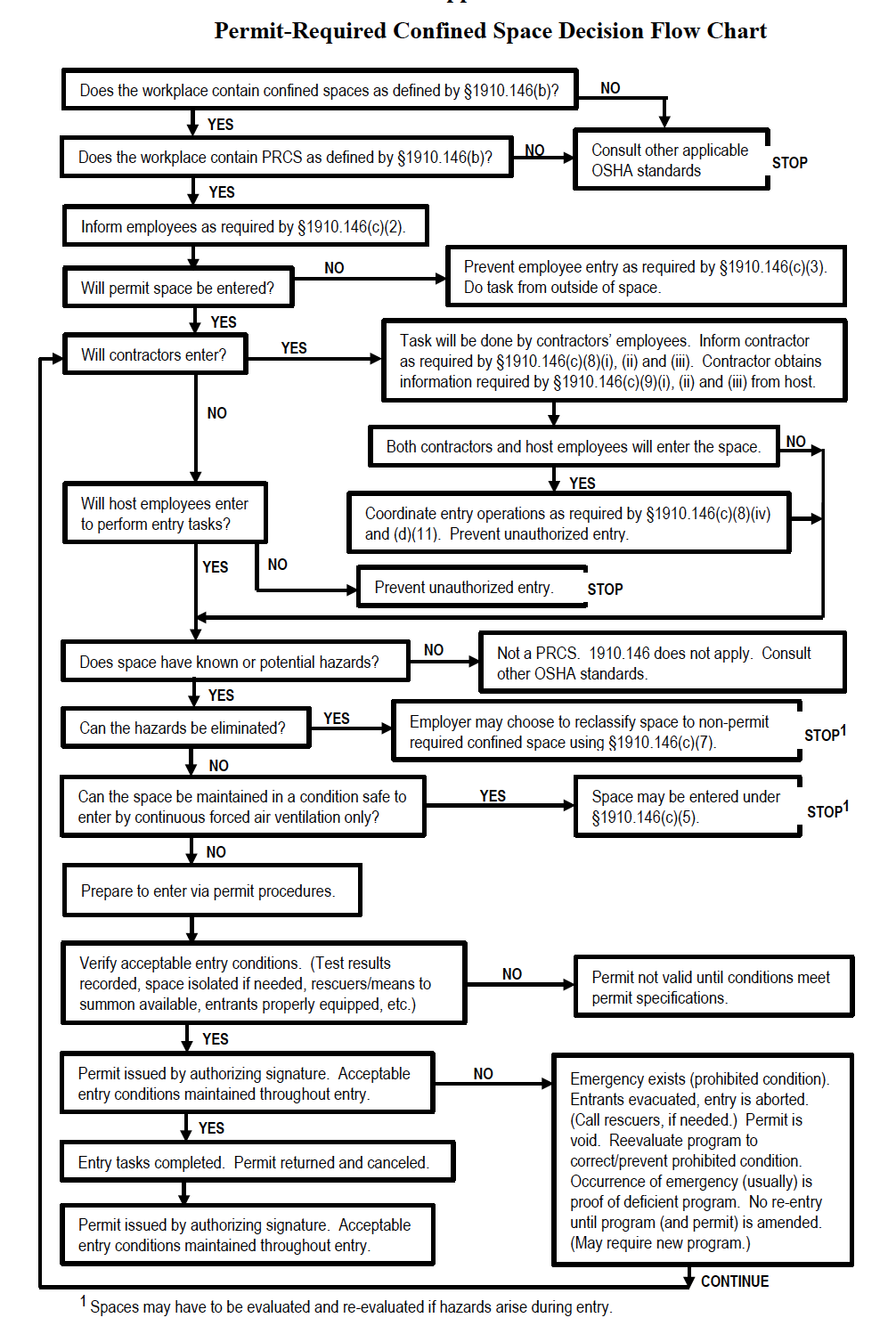
Lastly, if this toluene was the ONLY hazard in the pit that made the pit a PRCS, then the pit could be entered using 1910.146(c)(5) or 1926.1203(e), which is the method that requires FORCED-AIR Ventilation to “CONTROL” the toluene vapors from creating a HAZ ATM. But this poses a problem, as OSHA only recognizes FORCED-AIR Ventilation to “CONTROL” the toluene vapors. For me I would be doing BOTH FORCED-AIR Ventilation to “CONTROL” the toluene vapors AND LOCAL EXHAUST VENTILATION (LEV); the slang phrase I was always taught to us is the “PUSH-PULL method”… a clean source of FRESH AIR blowing into the space, but also LEV at the area where the gas/fume/vapor is being generated to remove it from the space. Sometimes we did not use LEV, but instead, set up two blowers (BOTH sized properly) and we “swept” the floor with fresh air going in on one side and another blower sucking out the air on the other side. The ductwork extended ALL the way to the bottom of the pit/tank (i.e. space) and the pick-up point on the exhaust was also at the bottom.
I hope this helps, it is hard to get into the deep technical items in a blog post, so if you have questions call, write, text me and I will help if I can. And I do NOT charge SAFTENG family members for calls, texts, e-mails and I will NEVER try and sell you anything, including my services.