I am guessing that maybe we should have had the “Top 11 Myths” rather than the “Top 10 Myths” in our presentation at Safety2019! I continue to get emails from folks who want to convince me that “ventilation is required for all entries into PRCSs”. I have even had a face-to-face discussion with an OSHA CSHO from a State Plan who informed that it was required for “ALL entries”. And as we should all do, when someone tells us something is required and we have questions we should ask them to provide their source for this “requirement”. 100% of these folks, including the State OSHA CSHO have cited the following:
1910.146(c)(5)(i)(B) The employer can demonstrate that continuous forced air ventilation alone is sufficient to maintain that permit space safe for entry;
This is what drives me crazy about our profession… NOT understanding the most basic requirements AND their application to a hazardous situation! The statement/requirement stated above is a DIRECT copy and paste from 1910.146 and we can find the same exact language in 1926.1203, but OSHA did add an EXTRA requirement in their newer Construction standard by also requiring…
and that, in the event the ventilation system stops working, entrants can exit the space safely
But when does this ventilation requirement apply? Does it apply to ALL entries into ALL PRCS’s? Absolutely NOT and here are the facts…
SPECIAL NOTE: for those of you who take the approach that “what can it hurt?”, log in and read the posts I have made over the years where we took a hazard from OUTSIDE the space and introduced INTO the space by IMPROPER/POORLY SET UP ventilation and the vast majority of these incidents, the ventilation was NOT necessary, but the Entry Supervisor also thought that “ventilation was required on all entries”.
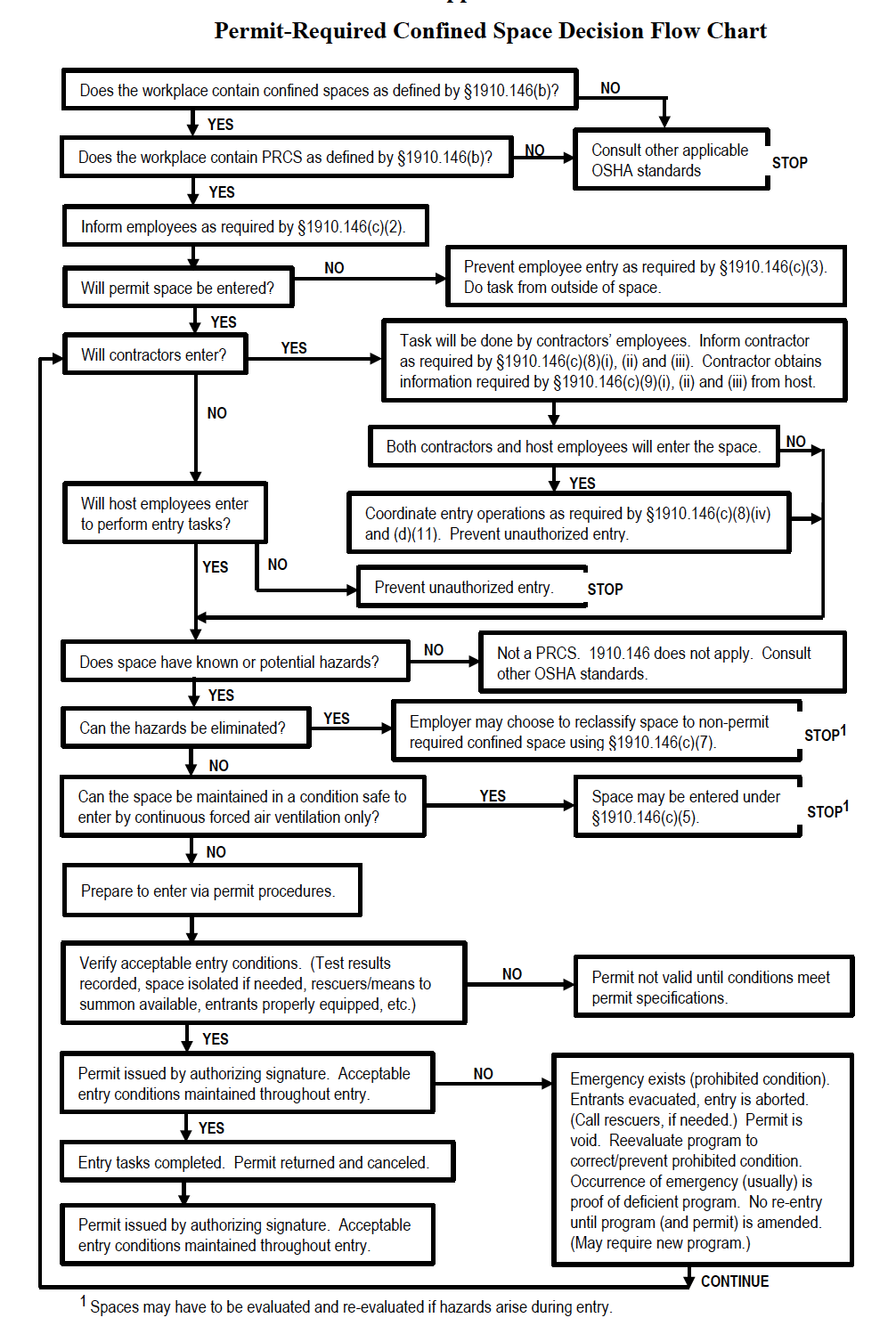
As I have written about many many many times, once our evaluation of the space has determined the Confined Space is a Permit-Required Confined Space (PRCS), OSHA has given us three (3) means/methods to enter that PRCS:
- 1910.146(c)(5) or 1926.1203(e) – called “Alternative Entry Method”
- 1910.146(c)(7) or 1926.1203(g) – called “Reclassification”
- 1910.146(d)-(k) or 1926.1204 – 1926.1211 – called “Permit-Entry”
PLEASE read my other post in the Permit-Required Confined Spaces section of SAFTENG, as I break all these entry methods down in detail.
So does OSHA require “ventilation” in ALL of these entry methods? Nope; actually the ONLY entry method that OSHA REQUIRES ventilation is when we enter using the “Alternative Entry Method” under 1910.146(c)(5) or 1926.1203(e). In fact, although OSHA would not cite us, if we come across ventilation being used when the entry is done under 1910.146(c)(7) or 1926.1203(g) (e.g. reclassification) they would have a lot of questions since that entry method can ONLY be used when there is NO HAZ ATM and there is NOT even the “potential” for a HAZ ATM… so why is ventilation being used????
1910.146(c)(5) and 1926.1203(e) are means to enter a PRCS when the ONLY hazard that made the space a PRCS is a HAZ ATM AND we can demonstrate that forced-air ventilation will CONTROL the HAZ ATM. PLEASE remember that “controlling” a HAZ ATM is NOT the same as “eliminating” the hazard, such as required under .146(c)(7) or .1203(g).
But the bottom line is that OSHA ONLY REQUIRES ventilation for entry when the entry is made into the PRCS using the “Alternative Entry” method (e.g. 1910.146(c)(5) and 1926.1203(e)).
I am IN NO WAY saying that ventilation can NOT be used on any entry; I am just stating that OSHA does not require it, except for when our entry method is the “Alternative Entry” method, 1910.146(c)(5) and 1926.1203(e). I have used forced-air ventilation on many of “permitted-entries” to reduce exposures and sometimes just for cooling the space on hot days!
But I have to stress when we use Forced-Air Ventilation, which by the way is the ONLY type of ventilation that OSHA recognizes for ventilating a PRCS, the ventilation can NOT create a hazard to the entrants!!!! Just taking some blower and some ductwork that looks like swiss cheese and stick it inside the manway – is NOT only a pathetic attempt at safety, it can actually convey a hazard that is present outside the space and convey it to inside the space. My PRCS ventilation course is 4-hours and I am almost guaranteed at least a dozen inquiries as to “why is a ventilation course 4 hours?” Those of you who come from an industry where entries are a weekly occurrence, ask yourself… how many times have you audited an entry with ventilation in place and the ventilation was done properly? There are four (4) keys to ventilating a PRCS:
- know the size of the space (cubic ft)
- know the size of the blower needed (CFM)
- know the gas/vapor/fume that we want to remove from the space (i.e vapor/gas density)
- understand where we need to INTRODUCE the area AND where the bad air will exit the space
If we do not know/understand these four pieces of data/principles of ventilating a PRCS, we will FAIL in our attempts and maybe making it easier to convey a hazard from outside the space to inside the space. And keep this in mind, the dose outside the space may be very diluted, but when we capture it and concentrate it as it goes through our blower and into a SMALLER SPACE, we may be creating a serious hazard inside a PRCS! SO PLEASE consider the need for ventilating your space and if ventilation is required or needed, be sure it is done CORRECTLY so as to be a safeguard and not a hazard.