7/7/2020 UPDATE: Found the OSHA Case where an evaporator fan motor bracket failed, causing the fan to fall onto the coil(s) and cause a NH3 release
6/30/2020 UPDATE: See my video of an NH3 Condenser Tube/Coil failure (Hydraulic Expansion) on my YouTube Channel
In 2012 I attempted to convince you that ammonia evaporative condensers are indeed Permit-Required Confined Spaces. I hope I was convincing enough that you now agree that ammonia evaporative condensers truly are PRCSs. But we left the “800-pound gorilla in the room” issue unanswered:
Do we have to evacuate the ammonia from the condenser coils before our entry?
Now it’s time to discuss our entry options into these PRCSs and how the ammonia in the coil(s) will play a role in each entry option.
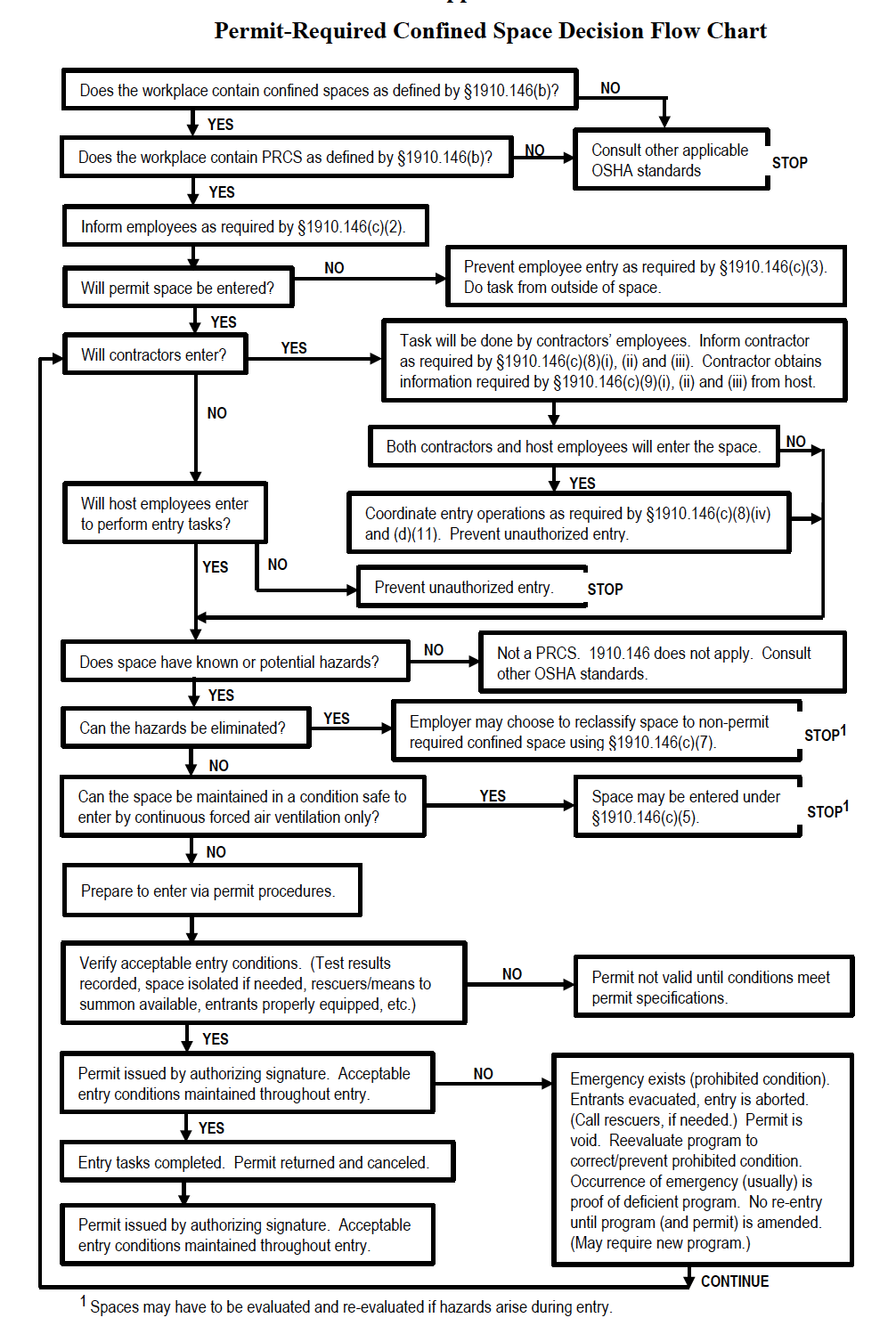
OSHA allows employers three (3) options for entering PRCSs. They are:
- Alternative Entry – 1910.146(c)(5) or 1926.1203(e)
- Reclassification – 1910.146(c)(7) or 1926.1203(g)
- FULL “permitted-entry” – 1910.146(d)-(k) or 1926.1204 – 1926.1211
So, let’s break down these entry methods as they relate to ammonia evaporative condensers. This article will touch on general industry and construction standard requirements.
“Alternative Entry” (1910.146(c)(5) or 1926.1203(e)
Using OSHA’s newer and more detailed Subpart AA (Confined Spaces in Construction) as our model, the criteria as to when “alternative entry” may be used is when the ONLY PRCS hazard the entrant would be exposed to is a hazardous atmosphere (including a potentially hazardous atmosphere). This hazardous atmosphere can be CONTROLLED using forced-air ventilation.
1926.1203(e) An employer may use the alternate procedures specified in paragraph (e)(2) of this section for entering a permit space only under the conditions set forth in paragraph (e)(1) of this section.
1926.1203(e)(1) An employer whose employees enter a permit space need not comply with §§ 1926.1204 through 1206 and §§ 1926.1208 through 1211, provided that all of the following conditions are met:
1926.1203(e)(1)(i) The employer can demonstrate that all physical hazards in the space are eliminated or isolated through engineering controls so that the only hazard posed by the permit space is an actual or potential hazardous atmosphere;
1926.1203(e)(1)(ii) The employer can demonstrate that continuous forced air ventilation alone is sufficient to maintain that permit space safe for entry, and that, in the event the ventilation system stops working, entrants can exit the space safely;
1926.1203(e)(1)(iii) The employer develops monitoring and inspection data that supports the demonstrations required by paragraphs (e)(1)(i) and (ii) of this section;
1926.1203(e)(1)(iv) If an initial entry of the permit space is necessary to obtain the data required by paragraph (e)(1)(iii) of this section, the entry is performed in compliance with §§ 1926.1204 through 1926.1211;
1926.1203(e)(1)(v) The determinations and supporting data required by paragraphs (e)(1)(i), (ii), and (iii) of this section are documented by the employer and are made available to each employee who enters the permit space under the terms of paragraph (e) of this section or to that employee’s authorized representative; and
1926.1203(e)(1)(vi) Entry into the permit space under the terms of paragraph (e)(1) of this section is performed in accordance with the requirements of paragraph (e)(2) of this section.
I should point out that the general industry standard 1910.146 is worded such that since its inception in 1993, 1910.146(c)(5) prohibited us from isolating the other hazards and then using ventilation to control the atmosphere, thus making (c)(5) a rare option to use in most industrial workplaces. But with OSHA’s Subpart AA (Confined Spaces in Construction) 1926.1201 – .1213, they clarified that a space could be isolated AND the atmosphere controlled when using the alternative entry method.
But this may not be as easy as it sounds, as the means we are allowed to ensure “all physical hazards in the space are eliminated or isolated through engineering controls” is limited to only positive means of energy isolation. OSHA defines the terms “isolate or isolation” as
the process by which employees in a confined space are completely protected against the release of energy and material into the space, and contact with a physical hazard, by such means as:
-
- Blanking or blinding;
- misaligning or removing sections of lines, pipes, or ducts;
- a double block and bleed system;
- lockout or tagout of all sources of energy;
- blocking or disconnecting all mechanical linkages; or
- placement of barriers to eliminate the potential for employee contact with a physical hazard.
The first four (4) are the energy isolation methods that would be most likely used in an industrial process such as a mechanical refrigeration process, but that is not to say that there are times when any of the six (6) methods could be utilized.
But this does not really address the ammonia in the condenser coils, as that ammonia is NOT present within the atmosphere of the space at the time of entry. Thus, we cannot establish ventilation needs without knowing the exposures within the space. The alternative entry method was envisioned to apply to a space such as a process vessel with an agitator. We can lock out the agitator, but due to the vessel’s age or the circumstances under which we need to enter the vessel, there is a hazardous atmosphere. This atmosphere is such that we can take FRESH AIR from a safe location and blow it into the space (e.g., forced-air ventilation) in such quantities that we can control the gas(s)/vapor(s) within the space to a “safe level” (e.g., for sure under the IDLH and preferably under the TLV). In other words, we are working with a known and present hazardous atmosphere – not a potentially hazardous atmosphere. PLEASE note there is a science to ventilation, and when using this entry method, ventilation is a CRITICAL PATH to safety and thus the ventilation should be approved by a “competent person.”
Competent person means one who is capable of identifying existing and predictable hazards in the surroundings or working conditions which are unsanitary, hazardous, or dangerous to employees, and who has the authorization to take prompt corrective measures to eliminate them.
So Alternative Entry – 1910.146(c)(5) or 1926.1203(e) is not an option intended for ammonia condensers which 99.9% of the time will not have a HAZ ATM in which we can set up forced-air ventilation to control it.
“Reclassification” – 1910.146(c)(7) or 1926.1203(g)
A more suitable option for ammonia condensers comes from 1910.146(c)(7) or 1926.1203(g), in which we “reclassify” the condenser from a PRCS to a Non-PRCS by ELIMINATING ALL hazards, including any potential for a HAZ ATM. And this is where the debate arises concerning the ammonia in the condenser coils. The OSHA standard(s) state:
1926.1203(g) A space classified by an employer as a permit-required confined space may only be reclassified as a non-permit confined space when a competent person determines that all of the applicable requirements in paragraphs (g)(1) through (4) of this section have been met:
1926.1203(g)(1) If the permit space poses no actual or potential atmospheric hazards and if all hazards within the space are eliminated or isolated without entry into the space (unless the employer can demonstrate that doing so without entry is infeasible), the permit space may be reclassified as a non-permit confined space for as long as the non-atmospheric hazards remain eliminated or isolated;
1926.1203(g)(2) The entry employer must eliminate or isolate the hazards without entering the space, unless it can demonstrate that this is infeasible. If it is necessary to enter the permit space to eliminate or isolate hazards, such entry must be performed under §§ 1926.1204 through 1926.1211. If testing and inspection during that entry demonstrate that the hazards within the permit space have been eliminated or isolated, the permit space may be reclassified as a non-permit confined space for as long as the hazards remain eliminated or isolated;
Note to paragraph (g)(2). Control of atmospheric hazards through forced air ventilation does not constitute elimination or isolation of the hazards. Paragraph (e) of this section covers permit space entry where the employer can demonstrate that forced air ventilation alone will control all hazards in the space.
1926.1203(g)(3) The entry employer must document the basis for determining that all hazards in a permit space have been eliminated or isolated, through a certification that contains the date, the location of the space, and the signature of the person making the determination. The certification must be made available to each employee entering the space or to that employee’s authorized representative; and
1926.1203(g)(4) If hazards arise within a permit space that has been reclassified as a non-permit space under paragraph (g) of this section, each employee in the space must exit the space. The entry employer must then reevaluate the space and reclassify it as a permit space as appropriate in accordance with all other applicable provisions of this standard.
Or
1910.146(c)(7) A space classified by the employer as a permit-required confined space may be reclassified as a non-permit confined space under the following procedures:
1910.146(c)(7)(i) If the permit space poses no actual or potential atmospheric hazards and if all hazards within the space are eliminated without entry into the space, the permit space may be reclassified as a non-permit confined space for as long as the non-atmospheric hazards remain eliminated.
The phrase “poses no actual or potential atmospheric hazards” is what causes such vigorous debate and divides confined space practitioners into two (2) groups as it relates to ammonia (or any hazardous chemical with a VP> 85mm hg) in the coils. For me, the ammonia merely being present within the space means there is a “potential atmospheric hazard”. OSHA has gone a long way to address this “potential” in such that they state once the space has been reclassified, workers cannot take containers of hazardous materials into the space; as the containers can leak or the worker spills the material, they pose a “potential” to create a hazardous atmosphere. We are not even allowed to take in a cutting torch inside a reclassified space as we could leak a flammable gas or oxygen into the space creating a flammable atmosphere or an oxygen-enriched atmosphere (e.g., hazardous atmosphere). So using OSHA’s examples and prohibitions of what can be taken into a reclassified space, we can see how ammonia being present within the space poses a “potential” to create a hazardous atmosphere, defined as:
“Hazardous atmosphere” means an atmosphere that may expose employees to the risk of death, incapacitation, impairment of ability to self-rescue (that is, escape unaided from a permit space), injury, or acute illness from one or more of the following causes:
(1) Flammable gas, vapor, or mist in excess of 10 percent of its lower flammable limit (LFL);
(2) Airborne combustible dust at a concentration that meets or exceeds its LFL;
NOTE: This concentration may be approximated as a condition in which the dust obscures vision at a distance of 5 feet (1.52 m) or less.
(3) Atmospheric oxygen concentration below 19.5 percent or above 23.5 percent;
(4) Atmospheric concentration of any substance for which a dose or a permissible exposure limit is published in Subpart G, Occupational Health and Environmental Control, or in Subpart Z, Toxic and Hazardous Substances, of this Part and which could result in employee exposure in excess of its dose or permissible exposure limit;
NOTE: An atmospheric concentration of any substance that is not capable of causing death, incapacitation, impairment of ability to self-rescue, injury, or acute illness due to its health effects is not covered by this provision.
(5) Any other atmospheric condition that is immediately dangerous to life or health.
The other side of the debate argues that the ammonia is present inside the space, but it’s inside a tube with no leak points other than the tube failing somehow. For me, the fact that a loss of primary containment (LOPC) event would result in exposure to ammonia, with a probability that exposure could be IDLH (300 ppm), means that the ammonia can NOT be present within the space in a container or the coil(s). NOTE: the NH3 on the coil(s) is both high-pressure gas and liquid, so any leak, even a small leak, could change the atmosphere quickly.
So for me, we evacuate the ammonia. Once we have achieved a zero-energy-state concerning the ammonia in the coil(s), we then use one of the approved means of energy isolation on the coil(s) to ensure ammonia does not find its way back into the coil(s) during entry and potentially expose the entrants.
As noted in the first article about condensers, physical hazards within the condenser need to be properly isolated and secured using our traditional lockout/tagout (LOTO) methods. Please understand that some facilities will require blocking the fan blades after the electrical power source to the fan(s) has been isolated and the electrical energy verified to be at a ZES. Not everyone may see the need to “block fan blades,” but when we have large fan blades that can free-spin within the space and something as simple as a gust of wind can move them such that they pose a hazard to the entrant(s), we need to block them to prevent their movement (e.g., a true Zero-Energy-State).
Although I do not consider the condenser water (treated or not) as a PRCS hazard, I do include LOTO’ing the water pumps as part of my energy isolation plan for the condenser.
So with the water pumps LOTO’ed, the fan blades LOTO’s (and big fans blocked), and the ammonia evacuated from the coils and the coils isolated by either: 1) Blanking or blinding, 2) disconnecting and misaligning lines, pipes, or ducts or removing sections of lines, pipes, or ducts; or 3) double block and bleed the PRCS can now be “reclassified” to a non-permit status AS LONG AS these measures remain in place. Once we unlock an isolation device, the space immediately returns to its original designation of PRCS.
Special NOTE: Many condensers in refrigeration processes are not installed with a means to isolate them using one of the OSHA-approved means. We can not use blinds/blanks on welded connections. We should not use disconnect and misalignment on piping. And it is rare to find double-block and bleed arrangements on ammonia refrigeration condensers. This means that reclassification may be more difficult than implied and, in fact, may be impossible under the current installation methods. But know this – SINGLE VALVE isolation is NOT acceptable for entry into a PRCS.
Many safety folks feared reclassification in the 1990s as we did not understand what it meant or how to apply safe work practices to our spaces. But now, nearly 30 years later, we have come to understand that “reclassification,” when done properly, is actually the preferred entry method. We are reclassifying a space; we have taken the time and applied resources to ELIMINATE ALL PRCS hazards (please notice I said “ALL PRCS hazards” and not “all-hazards”) from the space such that they no longer even pose a “potential hazard” to the entrants; so we have taken a PRCS with serious hazards, including a potential atmospheric hazard, and turned it into a just a confined-space with no serious hazards. So we still have a confined space – just not a PRCS, thus, we call this a non-permit required confined space.
There are rewards for taking the time and applying the resources to ELIMINATE ALL PRCS hazards from within the space such that they no longer even pose a “potential hazard” to the entrants, such that OSHA has declared that once a PRCS has been reclassified to a non-PRCS status we no longer are required to meet the requirements found in 1910.146(d) – (k), with paragraph (k) being the dreaded “rescue requirements” so many facilities struggle to meet.
We have to document all of our actions to reclassify the space and post this documentation at the entry portal (or at least make it available to all entrants) to complete our reclassification of the condenser. But that is it; no attendants, entry supervisor, rescue (non-entry or entry style), etc. Workers can enter and exit the condenser as needed as long as they are on the LOTO (energy isolation). The only additional requirement that applies is that we MUST train these workers on the “reclassification procedures” to comply with 1910.146(g) or 1926.1207.
FULL “permitted-entry” – 1910.146(d)-(k) or 1926.1204 – 1926.1211
Our last option for entry is doing a “full-blown permitted entry,” which means we will comply with all of the requirements found in paragraphs 1910.146(d)-(k) or 1926.1204 – .1211.
1910.146(d) Permit-required confined space program (permit space program)
1910.146(e) Permit system
1910.146(f) Entry Permit
1910.146(g) Training
1910.146(h) Entrant(s)
1910.146(i) Attendant(s)
1910.146(j) Entry Supervisor
1910.146(k) Rescue and emergency services
This means that for those who choose to leave the ammonia in the coils, this would be your entry option so that everyone is prepared should ammonia leak into the space. So, let’s ask the question… what if ammonia leaks into the space – what if this ammonia leak is liquid ammonia and rapidly creates an IDLH atmosphere within the space?
Very few of the condensers I have worked with are constructed such that a non-entry rescue is an option for the attendant. I am guessing someone could devise/set up a specific rescue system that would work for non-entry rescue to be utilized. Still, neither of the condenser examples I have used in my articles would qualify for the basic non-entry rescue using a tripod and winch (which I have decried for years as a false sense of security). This means we have to rely on a rescue team to go in and get the entrants if the need arises, and this is where we enter another hotly contested debate…
How long is an acceptable time to wait on the rescue team to arrive and affect a rescue?
When dealing with a potential IDLH atmosphere, my measurement is “How long can you hold your breath?” In other words, with ammonia in the coils and if I was the entry supervisor, I would require the rescue team of at least four (4) members to be present at the entry portal during the entry duration. This in itself could be a showstopper for those who rely on an off-site rescue team such as the local FD (and be very careful using your local FD!!!) or a private contracted service. Officially, albeit in a non-mandatory appendix, OSHA states the following:
- What are the needs of the employer with regard to response time (time for the rescue service to receive notification, arrive at the scene, and set up and be ready for entry)? For example, if entry is to be made into an IDLH atmosphere, or into a space that can quickly develop an IDLH atmosphere (if ventilation fails or for other reasons), the rescue team or service would need to be standing by at the permit space. On the other hand, if the danger to entrants is restricted to mechanical hazards that would cause injuries (e.g., broken bones, abrasions) a response time of 10 or 15 minutes might be adequate. (emphasis by me)
So, as you can see, I am a firm believer in fully evacuating the ammonia from the coils, isolating my 100% EMPTY coil using one of the positive isolation means, and locking out and blocking my fan blades and power transmission devices so that I can reclassify my condenser to a non-PRCS. It’s both SAFER and CHEAPER than doing a full-blown permitted entry – when the permitted entry is done right, it is NOT easy nor cheap! The problem is that very few facilities are doing their permitted entries “by the book,” and thus, they have trouble seeing the benefit of reclassification. What do I mean when I say “by the book” regarding a permitted entry? I will leave you with this single requirement that MUST BE DONE each time AND BEFORE the entry supervisor signs the entry permit to allow entrants into the space. Suppose your entry supervisors are actually doing this requirement. In that case, you may be close to doing your entries “by the book” – if this is not happening on each entry permit then an absolutely critical step is missing from your entry practices:
1910.146(j) Duties of entry supervisors. The employer shall ensure that each entry supervisor:
…
1910.146(j)(4) Verifies that rescue services are available and that the means for summoning them are operable;
or
1926.1210(d) Verifies that rescue services are available and that the means for summoning them are operable, and that the employer will be notified as soon as the services become unavailable;
This means that before each entry, the entry supervisor will call the local FD, the internal rescue team leader, or the rescue contractor and verify they are AVAILABLE should they be summoned for a rescue. In my plants, where we had our rescue team, we had a communication and approval process through our security group (you can read about the system in the other PRCS articles I have written – but this was a very elaborate system the entry supervisor had to follow to get approval before authorizing entry). Facilities that lack an in-house rescue team will struggle with this single requirement, and most (like >95%) facilities do NOT do this critical step when using the permitted-entry option.