
The recent change in OSHA’s PSM definition of a “retail facility” is having a large ripple effect all the way across EPA’s RMP rule. As I wrote about in “How does OSHA’s revised PSM “retail exemption” policy impact my RMP?” this change, thought by many as minor – thus the six-month compliance window for these facilities, is actually quite large and in my opinion IMPOSSIBLE to achieve over six months. In this article I breakdown what actually has to happen to move from an RMP Program Level 2 to an RMP Program Level 3. Here we go …
What does it mean to be a Level 2 RMP?
Simply, if your not a Level 1 or a Level 3, then you fell into Level 2. See how easy that was!!!! So how does one actually fall into Level 2? Assuming your process has over the Threshold Quantity of the EHS, we start with asking if our process’s worst-case release scenario has ANY PUBLIC RECEPTORS within it. If the answer is NO to the public receptors, then we ask if our process has a five-year accident history that caused a death, injury, or a response or restoration activities for an exposure of an environmental receptor. If BOTH of these are NO, then our RMP covered process is a Program Level 1. However, if EITHER of these requirements (public receptors or 5-year accident) are YES then the process is NOT eligible for Program Level 1 and we jump over Program Level 2 eligibility and determine if our process is a Program Level 3. If our process is already covered by OSHA’s PSM standard or falls into any of these NAISC codes: 32211, 32411, 32511, 325181, 325188, 325192, 325199, 325211, 325311, or 32532 our process is AUTOMATICALLY a Program Level 3. But, if the answer is NO to BOTH of these criteria (NAISC and PSM), then our process is eligible for Program Level 2.
Here is a very helpful flow chart from EPA:
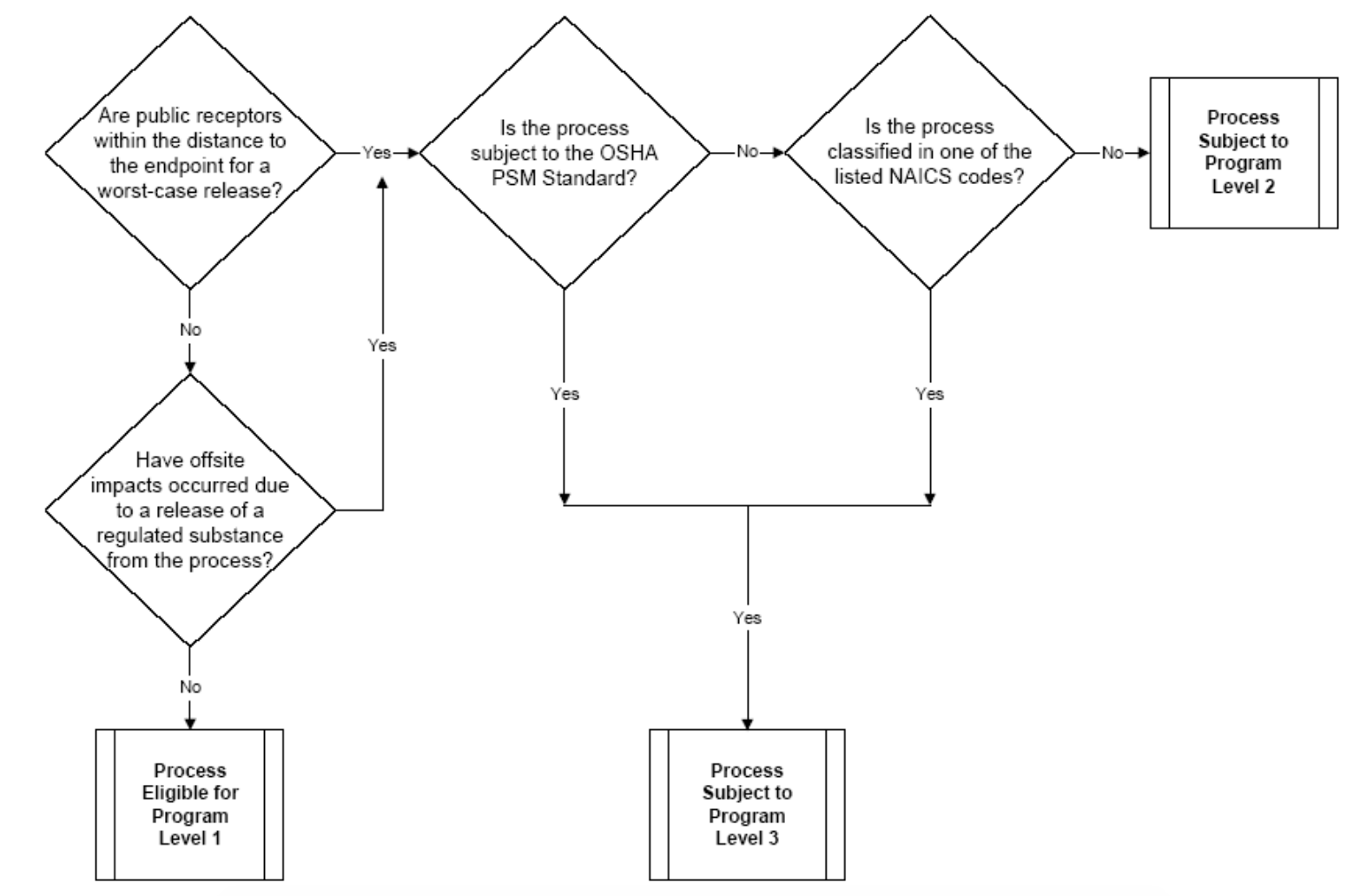
PLEASE NOTE: that just because your process falls under PSM, that does NOT automatically make your process a Program Level 3 process. It may actually be eligible for Program Level 1. However, if it does not qualify for a Program Level 1 AND its is a PSM covered process, it then AUTOMATICALLY goes to Program Level 3.
How did OSHA’s revision of a “retail establishment” impact my RMP Level 2 Program?
OSHA’s definition of a “retail establishment”, which was EXEMPTED from PSM requirements under the following:
1910.119(a)(2) This section does not apply to:
1910.119(a)(2)(i) Retail facilities;
When OSHA revised their definition, which used to be defined as selling 50% of the HHC directly to an end-user, to the new definition (7/2015) which defines “retail” by the NAICS codes, it means that a lot of businesses (especially ammonia fertilizer distributors) no longer met the NEW “retail” definition and thus were NO LONGER exempted under 1910.119(a)(2)(i). This meant that a process that qualified for Program Level 2 (merely because it was exempt from OSHA’s PSM standard because they were a “retail facility”) is NOW covered under PSM and NOW becomes a Program Level 3 because the process is now covered by OSHA’s PSM standard.
So what actually has to happen to go from a Program Level 2 to a Program Level 3?
Keeping in mind that this revised definition DOUBLED these businesses enforcement risks. Not only does the process go from a Program Level 2 to a 3, it also OPENS the door for OSHA PSM inspections as well. So with a few key strokes on a computer, your process went to bed Friday night not covered by PSM and being an RMP Program Level 2 and when you woke up Monday morning you were a PSM covered facility with an RMP Program Level 3 process.
Speaking specifically, moving from a Program Level 2 to a 3 will entail the following:
| A Program Level 2 prevention program includes the following requirements: | A Program Level 3 prevention program includes the following requirements: |
| §68.48 Safety information §68.50 Hazard review §68.52 Operating procedures §68.54 Training §68.56 Maintenance §68.58 Compliance audits §68.60 Incident investigation |
§68.65 Process safety information §68.67 Process hazard analysis §68.69 Operating procedures §68.71 Training §68.73 Mechanical integrity §68.75 Management of change §68.77 Pre-startup review §68.79 Compliance audits §68.81 Incident investigation §68.83 Employee participation §68.85 Hot work permit §68.87 Contractors |
The first thing one notices when comparing these lists is that Program Level 2 has seven (7) requirements and Program Level 3 has twelve (12) requirements. Some may even notice the subtle differences in the titles in the following three requirements…
§68.48 Safety information vs. §68.65 Process safety information
§68.50 Hazard review vs. §68.67 Process hazard analysis
§68.56 Maintenance vs. §68.73 Mechanical integrity
The difference in titles may be subtle, but these three (3) requirements are the RESOURCE HOGS of process safety when it comes to resources so we will be taking a much closer look at these differences later in this article. Trust me when I say the only thing subtle in these requirements is the difference in their titles!
But even for those titles that are identical, like “Operating Procedures” and “Training”, the specifics of these requirements add up to make an impact on our resources.
So let’s look at each of these differences.
§68.48 Safety information vs. §68.65 Process safety information
Program 2 §68.48 Safety information.
(a) The owner or operator shall compile and maintain the following up-to-date safety information related to the regulated substances, processes, and equipment:
(1) Material Safety Data Sheets that meet the requirements of 29 CFR 1910.1200(g);
(2) Maximum intended inventory of equipment in which the regulated substances are stored or processed;
(3) Safe upper and lower temperatures, pressures, flows, and compositions;
(4) Equipment specifications; and
(5) Codes and standards used to design, build, and operate the process.
(b) The owner or operator shall ensure that the process is designed in compliance with recognized and generally accepted good engineering practices. Compliance with Federal or state regulations that address industry-specific safe design or with industry-specific design codes and standards may be used to demonstrate compliance with this paragraph.
(c) The owner or operator shall update the safety information if a major change occurs that makes the information inaccurate.
Program 3 §68.65 Process safety information.
(a) In accordance with the schedule set forth in §68.67, the owner or operator shall complete a compilation of written process safety information before conducting any process hazard analysis required by the rule. The compilation of written process safety information is to enable the owner or operator and the employees involved in operating the process to identify and understand the hazards posed by those processes involving regulated substances. This process safety information shall include information pertaining to the hazards of the regulated substances used or produced by the process, information pertaining to the technology of the process, and information pertaining to the equipment in the process.
(b) Information pertaining to the hazards of the regulated substances in the process. This information shall consist of at least the following:
(1) Toxicity information;
(2) Permissible exposure limits;
(3) Physical data;
(4) Reactivity data:
(5) Corrosivity data;
(6) Thermal and chemical stability data; and
(7) Hazardous effects of inadvertent mixing of different materials that could foreseeably occur.
Note to paragraph (b): Material Safety Data Sheets meeting the requirements of 29 CFR 1910.1200(g) may be used to comply with this requirement to the extent they contain the information required by this subparagraph.
(c) Information pertaining to the technology of the process.
(1) Information concerning the technology of the process shall include at least the following:
(i) A block flow diagram or simplified process flow diagram;
(ii) Process chemistry;
(iii) Maximum intended inventory;
(iv) Safe upper and lower limits for such items as temperatures, pressures, flows or compositions; and,
(v) An evaluation of the consequences of deviations.
(2) Where the original technical information no longer exists, such information may be developed in conjunction with the process hazard analysis in sufficient detail to support the analysis.
(d) Information pertaining to the equipment in the process.
(1) Information pertaining to the equipment in the process shall include:
(i) Materials of construction;
(ii) Piping and instrument diagrams (P&ID’s);
(iii) Electrical classification;
(iv) Relief system design and design basis;
(v) Ventilation system design;
(vi) Design codes and standards employed;
(vii) Material and energy balances for processes built after June 21, 1999; and
(viii) Safety systems (e.g. interlocks, detection or suppression systems).
(2) The owner or operator shall document that equipment complies with recognized and generally accepted good engineering practices.
(3) For existing equipment designed and constructed in accordance with codes, standards, or practices that are no longer in general use, the owner or operator shall determine and document that the equipment is designed, maintained, inspected, tested, and operating in a safe manner.
What is the key difference with these process safety information requirements?
A Program Level 2 can merely use the SDS for their Extremely Hazardous Substance(s), but Program Level 3 allows the use of the SDS ONLY when it contains ALL the required information that is listed in §68.65(b). And as I have written about before, there are a lot of SDS that do NOT contain all of these requirements, specifically
(7) Hazardous effects of inadvertent mixing of different materials that could foreseeably occur
After all, how would the SDS developer know what other materials are present on a site where the material is present!?!?! So without a doubt, a PROGRAM 3 is going to require this assessment to establish the hazardous effects of inadvertent mixing of different materials that could foreseeably occur.
BOTH program levels require the employer to establish the Safe upper and lower limits for such items as temperatures, pressures, flows or compositions; however, a Program Level 3 has to conduct An evaluation of the consequences of deviations from these safe upper and lower limits, where as there is NO mention of this requirement in Program Level 2 PSI. PLEASE do not read anything into this, as I am merely pointing out the differences in the TEXT; as I am not sure how one could establish the Safe upper and lower limits for such items as temperatures, pressures, flows or compositions without doing some type of hazard evaluation in which the consequences are considered! But the text is what it is, it is specifically called out in a Program Level 3 PSI, but not in a Program Level 2.
You may have noticed that Program Level 2 uses the phrase “Equipment Specifications“, whereas a Program Level 3 uses the phrase “Information pertaining to the equipment in the process”. When we peel back the layers of these different phrases we see an entirely different workload as to what has to be in place! EPA states the following about “Equipment Specifications“…
You must document the specifications of any equipment you use to store, move, or react regulated substances in a covered process. Equipment specifications will usually include information on the materials of construction, actual design, and tolerances. The vendor should be able to provide this information; you may have the specifications in your files from the time of purchase. Many vessels and other pieces of equipment provide specification data on an attached nameplate. You are not expected to develop engineering drawings of your equipment to meet this requirement, but you must be able to document that your equipment is appropriate for the substances and activities for which it is used, and you must know what the limits of the equipment are. Specifications are particularly important if your vessels or pipes are not specifically designed for your type of operation. Substances may react with certain metals or corrode them if water is introduced. You should be sure that the vessels you purchase or lease are appropriate for your operations. Understanding equipment specifications will help you when you need to buy replacement parts. Any such parts must be appropriate for your existing equipment and your use of that equipment. It is not sufficient to replace parts with something that “fits” unless the new part meets the specifications; substitution of inappropriate parts may create serious hazards. SOURCE
Compare that language to what is stated in Program Level 3 PSI requirements and you will notice that a Program Level 3 process MUST have the following in place, that a Program Level 2 does not:
(ii) Piping and instrument diagrams (P&ID’s);
(iii) Electrical classification;
(iv) Relief system design and design basis;
(v) Ventilation system design;
…
(vii) Material and energy balances for processes built after June 21, 1999; and
(viii) Safety systems (e.g. interlocks, detection or suppression systems).
Anyone who has had to start from scratch to develop just these six (6) PSI requirements can tell you that it is these six (6) that make up the core of work in developing our PSI. So this should not be taken lightly and NOT delayed as we have ONLY six months to get this in place AND to complete our PHA (which I will discuss next).
NOTE: BOTH OSHA and EPA have established the 6-month window and actually OSHA took their timing directly from EPA…
§68.190 Updates.
(a) The owner or operator shall review and update the RMP as specified in paragraph (b) of this section and submit it to the method and format to the central point specified by EPA as of the date of submission.
(b) The owner or operator of a stationary source shall revise and update the RMP submitted under §68.150 as follows:
…
(7) Within six months of a change that alters the Program level that applied to any covered process.
You may have also noted that Program Level 2 language regarding “document that equipment complies with recognized and generally accepted good engineering practices” is different. Program Level 2 employers can use “Compliance with Federal or state regulations that address industry-specific safe design or with industry-specific design codes and standards to demonstrate compliance with this paragraph.” Program Level 3 employers should also use those federal and state compliance codes as a “BUILDING BLOCK”, but that is ALL they are… a nice building block from which we start our process safety efforts! Program Level 3 employers have to fully adopt a chosen RAGAGEP and comply with them ON TOP of establishing compliance with the state codes and baseline OSHA standards. For example, a program level 2 employer can show they have complied with their state fire/hazmat code and 1910.111 for their ammonia process and be compliant. A program level 3 employer would have to adopt the latest IIAR, ASHARE, ANSI/CGA standards SPECIFICALLY applicable to those parts of the process to fully comply. Note, there is a cost in just buying all these latest and greatest RAGAGEPs; it will not cause bankruptcy but these costs will not go without someone noticing!
§68.50 Hazard review vs. §68.67 Process hazard analysis
§68.50 Hazard review.
(a) The owner or operator shall conduct a review of the hazards associated with the regulated substances, process, and procedures. The review shall identify the following:
(1) The hazards associated with the process and regulated substances;
(2) Opportunities for equipment malfunctions or human errors that could cause an accidental release;
(3) The safeguards used or needed to control the hazards or prevent equipment malfunction or human error; and
(4) Any steps used or needed to detect or monitor releases.
(b) The owner or operator may use checklists developed by persons or organizations knowledgeable about the process and equipment as a guide to conducting the review. For processes designed to meet industry standards or Federal or state design rules, the hazard review shall, by inspecting all equipment, determine whether the process is designed, fabricated, and operated in accordance with the applicable standards or rules.
(c) The owner or operator shall document the results of the review and ensure that problems identified are resolved in a timely manner.
(d) The review shall be updated at least once every five years. The owner or operator shall also conduct reviews whenever a major change in the process occurs; all issues identified in the review shall be resolved before startup of the changed process.
§68.67 Process hazard analysis.
(a) The owner or operator shall perform an initial process hazard analysis (hazard evaluation) on processes covered by this part. The process hazard analysis shall be appropriate to the complexity of the process and shall identify, evaluate, and control the hazards involved in the process. The owner or operator shall determine and document the priority order for conducting process hazard analyses based on a rationale which includes such considerations as extent of the process hazards, number of potentially affected employees, age of the process, and operating history of the process. The process hazard analysis shall be conducted as soon as possible, but not later than June 21, 1999. Process hazards analyses completed to comply with 29 CFR 1910.119(e) are acceptable as initial process hazards analyses. These process hazard analyses shall be updated and revalidated, based on their completion date.
(b) The owner or operator shall use one or more of the following methodologies that are appropriate to determine and evaluate the hazards of the process being analyzed.
(1) What-If;
(2) Checklist;
(3) What-If/Checklist;
(4) Hazard and Operability Study (HAZOP);
(5) Failure Mode and Effects Analysis (FMEA);
(6) Fault Tree Analysis; or
(7) An appropriate equivalent methodology.
(c) The process hazard analysis shall address:
(1) The hazards of the process;
(2) The identification of any previous incident which had a likely potential for catastrophic consequences.
(3) Engineering and administrative controls applicable to the hazards and their interrelationships such as appropriate application of detection methodologies to provide early warning of releases. (Acceptable detection methods might include process monitoring and control instrumentation with alarms, and detection hardware such as hydrocarbon sensors.);
(4) Consequences of failure of engineering and administrative controls;
(5) Stationary source siting;
(6) Human factors; and
(7) A qualitative evaluation of a range of the possible safety and health effects of failure of controls.
(d) The process hazard analysis shall be performed by a team with expertise in engineering and process operations, and the team shall include at least one employee who has experience and knowledge specific to the process being evaluated. Also, one member of the team must be knowledgeable in the specific process hazard analysis methodology being used.
(e) The owner or operator shall establish a system to promptly address the team’s findings and recommendations; assure that the recommendations are resolved in a timely manner and that the resolution is documented; document what actions are to be taken; complete actions as soon as possible; develop a written schedule of when these actions are to be completed; communicate the actions to operating, maintenance and other employees whose work assignments are in the process and who may be affected by the recommendations or actions.
(f) At least every five (5) years after the completion of the initial process hazard analysis, the process hazard analysis shall be updated and revalidated by a team meeting the requirements in paragraph (d) of this section, to assure that the process hazard analysis is consistent with the current process. Updated and revalidated process hazard analyses completed to comply with 29 CFR 1910.119(e) are acceptable to meet the requirements of this paragraph.
(g) The owner or operator shall retain process hazards analyses and updates or revalidations for each process covered by this section, as well as the documented resolution of recommendations described in paragraph (e) of this section for the life of the process.
Just a quick glance and we can see that the Process Hazard Analysis (PHA) requirements in Program Level 3 is considerably more detailed than the “Hazard Review” for Program Level 2. For a Program 2 process,
… you must conduct a hazard review. EPA has streamlined the process hazard analysis (PHA) requirement of OSHA’s PSM standard to create a requirement that will detect process hazards at the simpler processes in Program 2. The hazard review will help you determine whether you are meeting applicable codes and standards; identify, evaluate and address the types of potential failures; and focus your emergency response planning efforts. Many Program 2 processes are covered by industry-specific risk management program guidance (appended to this guidance) that will help with this hazard review. The hazard review is key to understanding how to operate safely on a continuous basis. You must identify and review specific hazards and safeguards for your Program 2 processes. EPA lists the types of hazards and safeguards in the rule. Exhibit 6-5 below summarizes things you must do for a hazard review.
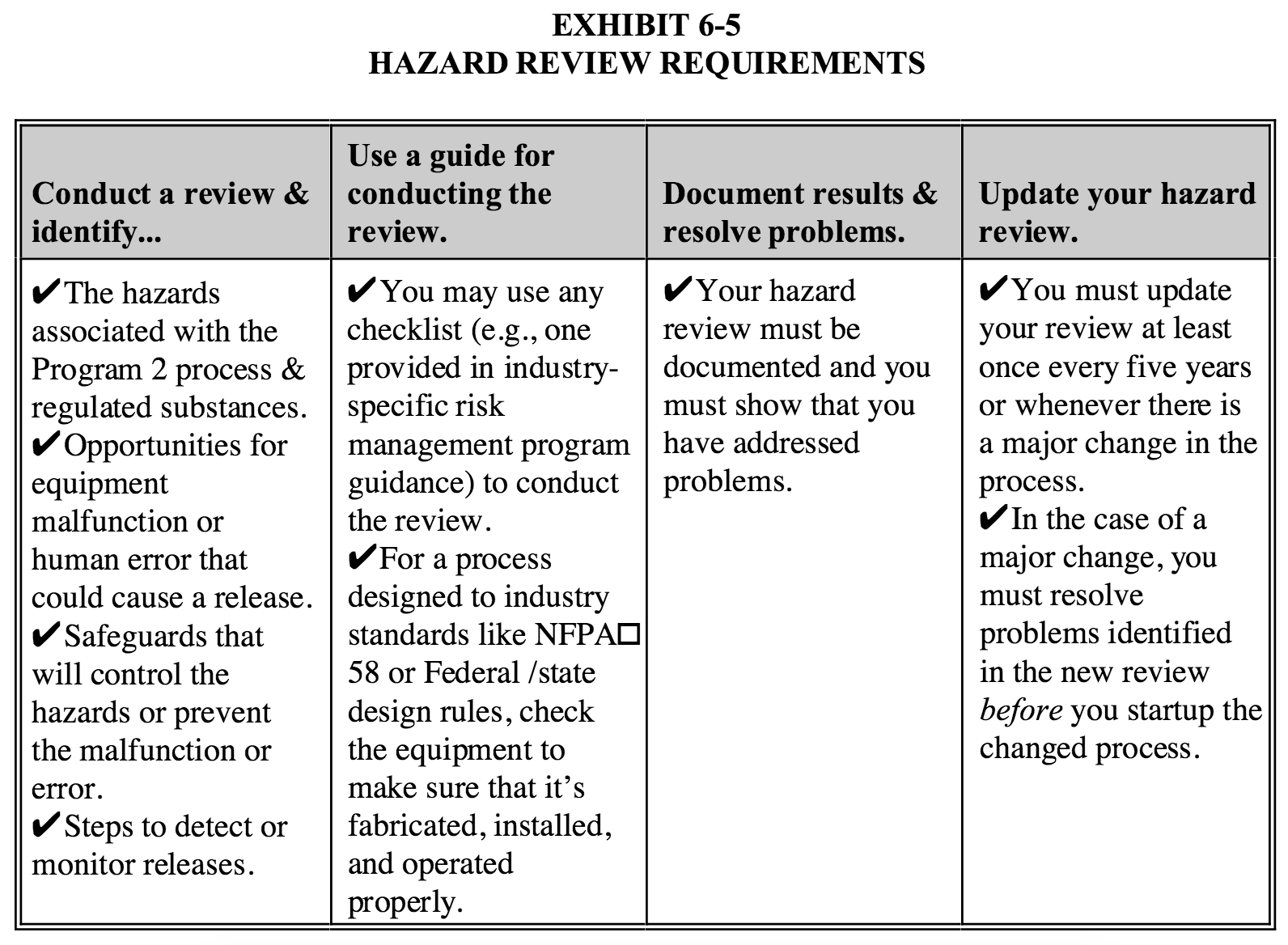
There are three possible approaches to conducting a “hazard review”; which you use depends on your particular situation:
- Processes designed to legal or industry-specific codes,
- Industry checklist/industry-specific risk management program,
- Develop your own checklist.
When we look at the PHA requirements we find a much more robust hazard analysis with some very specific exercises that must be done to comply with Program Level 3 PHA(s). Most notable is that the Program Level 2 Checklist method is NOT the same as (2) Checklist or (3) What-If/Checklist. The PHA checklist methodology in Program Level 3 is more rigouros than the “Industry checklist/industry-specific risk management program” checklist called out in Program Level 2.
The Program Level 2 Hazard Review is required to consider:
(1) The hazards associated with the process and regulated substances;
(2) Opportunities for equipment malfunctions or human errors that could cause an accidental release;
(3) The safeguards used or needed to control the hazards or prevent equipment malfunction or human error; and
(4) Any steps used or needed to detect or monitor releases.
And the Program Level 3 PHA is required to consider:
(1) The hazards of the process;
(2) The identification of any previous incident which had a likely potential for catastrophic consequences.
(3) Engineering and administrative controls applicable to the hazards and their interrelationships such as appropriate application of detection methodologies to provide early warning of releases. (Acceptable detection methods might include process monitoring and control instrumentation with alarms, and detection hardware such as hydrocarbon sensors.);
(4) Consequences of failure of engineering and administrative controls;
(5) Stationary source siting;
(6) Human factors; and
(7) A qualitative evaluation of a range of the possible safety and health effects of failure of controls.
Most notable here is what the PHA must include, which is NOT required in the Program Level 2 “Hazrad Review”:
- identification of any previous incidents
- engineering and administrative controls applicable to the hazards and their interrelationships
- consequences of failure of engineering and administrative controls
- stationary source siting
- human factors
- qualitative evaluation of a range of the possible safety and health effects of failure of controls
Bottom line is that a Program 2 Hazard Review is merely inspecting all equipment, determine whether the process is designed, fabricated, and operated in accordance with the applicable standards or rules. Where as a PHA done in Program Level 3 is an actual hazards analysis that is well beyond a determination that the process is designed, fabricated, and operated in accordance with the applicable standards or rules.
A program Level 3 PHA requires the employer to:
- establish a system to promptly address the team’s findings and recommendations;
- assure that the recommendations are resolved in a timely manner and
- that the resolution is documented;
- document what actions are to be taken; complete actions as soon as possible;
- develop a written schedule of when these actions are to be completed; and
- communicate the actions to operating, maintenance and other employees whose work assignments are in the process and who may be affected by the recommendations or actions.
A program Level 2 PHA only requires the employer to ensure that problems identified are resolved in a timely manner. No management system is required, no action plans with a written schedule to address the recommendations are required, and these plans do not have to be communicated to anyone outside the Hazard Review team.
Lastly, there is NO requirement that the Program Level 2 Hazard Review be retained for the life of the process, as is required for Program Level 3 PHA’s. In fact, there are no retention requirements at all for the Program Level 2 Hazard Review. Although BOTH the Hazard Review and PHA must be revalidated every five years.
§68.52 Operating procedures vs. §68.69 Operating procedures
Don’t be fooled into thinking that since the tiles are identical, that the Operating procedure requirements are identical. There is actually a lot different in these two requirements:
Program Level 2 §68.52 Operating procedures.
(a) The owner or operator shall prepare written operating procedures that provide clear instructions or steps for safely conducting activities associated with each covered process consistent with the safety information for that process. Operating procedures or instructions provided by equipment manufacturers or developed by persons or organizations knowledgeable about the process and equipment may be used as a basis for a stationary source’s operating procedures.
(b) The procedures shall address the following:
(1) Initial startup;
(2) Normal operations;
(3) Temporary operations;
(4) Emergency shutdown and operations;
(5) Normal shutdown;
(6) Startup following a normal or emergency shutdown or a major change that requires a hazard review;
(7) Consequences of deviations and steps required to correct or avoid deviations; and
(8) Equipment inspections.
(c) The owner or operator shall ensure that the operating procedures are updated, if necessary, whenever a major change occurs and prior to startup of the changed process.
Program Level 3 §68.69 Operating procedures.
(a) The owner or operator shall develop and implement written operating procedures that provide clear instructions for safely conducting activities involved in each covered process consistent with the process safety information and shall address at least the following elements.
(1) Steps for each operating phase:
(i) Initial startup;
(ii) Normal operations;
(iii) Temporary operations;
(iv) Emergency shutdown including the conditions under which emergency shutdown is required, and the assignment of shutdown responsibility to qualified operators to ensure that emergency shutdown is executed in a safe and timely manner.
(v) Emergency operations;
(vi) Normal shutdown; and,
(vii) Startup following a turnaround, or after an emergency shutdown.
(2) Operating limits:
(i) Consequences of deviation; and
(ii) Steps required to correct or avoid deviation.
(3) Safety and health considerations:
(i) Properties of, and hazards presented by, the chemicals used in the process;
(ii) Precautions necessary to prevent exposure, including engineering controls, administrative controls, and personal protective equipment;
(iii) Control measures to be taken if physical contact or airborne exposure occurs;
(iv) Quality control for raw materials and control of hazardous chemical inventory levels; and,
(v) Any special or unique hazards.
(4) Safety systems and their functions.
(b) Operating procedures shall be readily accessible to employees who work in or maintain a process.
(c) The operating procedures shall be reviewed as often as necessary to assure that they reflect current operating practice, including changes that result from changes in process chemicals, technology, and equipment, and changes to stationary sources. The owner or operator shall certify annually that these operating procedures are current and accurate.
(d) The owner or operator shall develop and implement safe work practices to provide for the control of hazards during operations such as lockout/tagout; confined space entry; opening process equipment or piping; and control over entrance into a stationary source by maintenance, contractor, laboratory, or other support personnel. These safe work practices shall apply to employees and contractor employees.
There’s not much difference in the “phases of operations” requirements between the two program levels, but do take notice that Equipment inspections are listed as a requirement for the Program Level 2 requirements and that is covered under the MI element for Program Level 3.
“Consequences of Deviation” and the “steps to correct or avoid deviation are the same.
Where we increase our content for Program Level 3 SOPs is:
(3) Safety and health considerations:
(i) Properties of, and hazards presented by, the chemicals used in the process;
(ii) Precautions necessary to prevent exposure, including engineering controls, administrative controls, and personal protective equipment;
(iii) Control measures to be taken if physical contact or airborne exposure occurs;
(iv) Quality control for raw materials and control of hazardous chemical inventory levels; and,
(v) Any special or unique hazards.
(4) Safety systems and their functions.
Program Level 2 SOPs are not required to contain this information. Now some may just blow this off as being insignificant, but including all of the Safety and health considerations and Safety systems and their functions in the SOPs adds a lot of content and then this content has to be verified and certified annually. Note that the Program Level 2 SOPs have NO annual review OR certification requirement; only that the operating procedures are updated, if necessary, whenever a major change occurs and prior to startup of the changed process. This is called out in the SOP requirements for Program Level 2 because Program Level 2 does NOT require Management of Change program. You will also notice that there is no mention of Safe Work Practices in the Program Level 2 requirements, where as a Program Level 3 must develop and implement safe work practices to provide for the control of hazards during operations such as:
- lockout/tagout
- confined space entry
- opening process equipment or piping; and
- control over entrance into a stationary source by maintenance, contractor, laboratory, or other support personnel.
These safe work practices shall apply to employees and contractor employees.
Now I can not imagine one of these Program Level 2 facilities NOT having a LOTO and PRCS program as these are already REQUIRED by OSHA even if your facility is not a PSM covered facility. But the “opening process equipment or piping” and “control over entrance into a stationary source by maintenance, contractor, laboratory, or other support personnel” programs/procedures can be very difficult to implement as they are often a drastic change from past practices (e.g coming and going in/out of process areas, opening process without additional layers of administrative controls and PPE, etc.).
§68.54 Training vs. §68.71 Training
Program Level 2 §68.54 Training.
(a) The owner or operator shall ensure that each employee presently operating a process, and each employee newly assigned to a covered process have been trained or tested competent in the operating procedures provided in §68.52 that pertain to their duties. For those employees already operating a process on June 21, 1999, the owner or operator may certify in writing that the employee has the required knowledge, skills, and abilities to safely carry out the duties and responsibilities as provided in the operating procedures.
(b) Refresher training. Refresher training shall be provided at least every three years, and more often if necessary, to each employee operating a process to ensure that the employee understands and adheres to the current operating procedures of the process. The owner or operator, in consultation with the employees operating the process, shall determine the appropriate frequency of refresher training.
(c) The owner or operator may use training conducted under Federal or state regulations or under industry-specific standards or codes or training conducted by covered process equipment vendors to demonstrate compliance with this section to the extent that the training meets the requirements of this section.
(d) The owner or operator shall ensure that operators are trained in any updated or new procedures prior to startup of a process after a major change.
Program Level 3 §68.71 Training.
(a) Initial training.
(1) Each employee presently involved in operating a process, and each employee before being involved in operating a newly assigned process, shall be trained in an overview of the process and in the operating procedures as specified in §68.69. The training shall include emphasis on the specific safety and health hazards, emergency operations including shutdown, and safe work practices applicable to the employee’s job tasks.
(2) In lieu of initial training for those employees already involved in operating a process on June 21, 1999 an owner or operator may certify in writing that the employee has the required knowledge, skills, and abilities to safely carry out the duties and responsibilities as specified in the operating procedures.
(b) Refresher training. Refresher training shall be provided at least every three years, and more often if necessary, to each employee involved in operating a process to assure that the employee understands and adheres to the current operating procedures of the process. The owner or operator, in consultation with the employees involved in operating the process, shall determine the appropriate frequency of refresher training.
(c) Training documentation. The owner or operator shall ascertain that each employee involved in operating a process has received and understood the training required by this paragraph. The owner or operator shall prepare a record which contains the identity of the employee, the date of training, and the means used to verify that the employee understood the training.
These two requirements are VERY similar, yet the one BIG difference is that a Program Level 2 training program need not have a “means to verify knowledge” of the training, nor are there any specific requirements to document the training, as found in Program Level 3 requirements…
ascertain that each employee involved in operating a process has received and understood the training required by this paragraph. The owner or operator shall prepare a record which contains the identity of the employee, the date of training, and the means used to verify that the employee understood the training.
§68.56 Maintenance vs. §68.73 Mechanical integrity
Program Level 2 §68.56 Maintenance.
(a) The owner or operator shall prepare and implement procedures to maintain the on-going mechanical integrity of the process equipment. The owner or operator may use procedures or instructions provided by covered process equipment vendors or procedures in Federal or state regulations or industry codes as the basis for stationary source maintenance procedures.
(b) The owner or operator shall train or cause to be trained each employee involved in maintaining the on-going mechanical integrity of the process. To ensure that the employee can perform the job tasks in a safe manner, each such employee shall be trained in the hazards of the process, in how to avoid or correct unsafe conditions, and in the procedures applicable to the employee’s job tasks.
(c) Any maintenance contractor shall ensure that each contract maintenance employee is trained to perform the maintenance procedures developed under paragraph (a) of this section.
(d) The owner or operator shall perform or cause to be performed inspections and tests on process equipment. Inspection and testing procedures shall follow recognized and generally accepted good engineering practices. The frequency of inspections and tests of process equipment shall be consistent with applicable manufacturers’ recommendations, industry standards or codes, good engineering practices, and prior operating experience.
Program Level 3 §68.73 Mechanical integrity.
(a) Application. Paragraphs (b) through (f) of this section apply to the following process equipment:
(1) Pressure vessels and storage tanks;
(2) Piping systems (including piping components such as valves);
(3) Relief and vent systems and devices;
(4) Emergency shutdown systems;
(5) Controls (including monitoring devices and sensors, alarms, and interlocks) and,
(6) Pumps.
(b) Written procedures. The owner or operator shall establish and implement written procedures to maintain the on-going integrity of process equipment.
(c) Training for process maintenance activities. The owner or operator shall train each employee involved in maintaining the on-going integrity of process equipment in an overview of that process and its hazards and in the procedures applicable to the employee’s job tasks to assure that the employee can perform the job tasks in a safe manner.
(d) Inspection and testing.
(1) Inspections and tests shall be performed on process equipment.
(2) Inspection and testing procedures shall follow recognized and generally accepted good engineering practices.
(3) The frequency of inspections and tests of process equipment shall be consistent with applicable manufacturers’ recommendations and good engineering practices, and more frequently if determined to be necessary by prior operating experience.
(4) The owner or operator shall document each inspection and test that has been performed on process equipment. The documentation shall identify the date of the inspection or test, the name of the person who performed the inspection or test, the serial number or other identifier of the equipment on which the inspection or test was performed, a description of the inspection or test performed, and the results of the inspection or test.
(e) Equipment deficiencies. The owner or operator shall correct deficiencies in equipment that are outside acceptable limits (defined by the process safety information in §68.65) before further use or in a safe and timely manner when necessary means are taken to assure safe operation.
(f) Quality assurance.
(1) In the construction of new plants and equipment, the owner or operator shall assure that equipment as it is fabricated is suitable for the process application for which they will be used.
(2) Appropriate checks and inspections shall be performed to assure that equipment is installed properly and consistent with design specifications and the manufacturer’s instructions.
(3) The owner or operator shall assure that maintenance materials, spare parts and equipment are suitable for the process application for which they will be used.
The first difference we notice is that Program Level 2 does not spell out the equipment that must be included, yet Program Level 2 does require the on-going mechanical integrity of the process equipment. Although permitted in Program Level 3 as well, Program Level 2 permits procedures or instructions provided by covered process equipment vendors or procedures in Federal or state regulations or industry codes as the basis for stationary source maintenance procedures. It is expected that Program Level 3 processes would have more detail for their maintenance procedures.
The MI training requirements are almost identical, although Program Level 2 uses a weird phrase “or cause to be trained “. I am sorry I am not a lawyer, but I do spend a lot of time sleeping in Holiday Inn Express’s and still I have NO IDEA what this means!
Testing methods and frequencies requirements are virtually the same.
Program Level 2 mentions maintenance contractor training since there is no requirement for Program Level 2 facility/process to have a Contractor Safety Program, but these requirements for contractor training are essentially the same.
Where we have a separation between Program 2 and 3 MI requirements comes when we talk about responding to inspections/testing and quality assurance programs. A Program Level 3 MI program is required to have a means to correct deficiencies in equipment that are outside acceptable limits (defined by the process safety information in §68.65) before further use or in a safe and timely manner when necessary means are taken to assure safe operation and there is NO mention of this in the Program Level 2 requirements. Although I would argue this does not have to be written to be cited! If a Program Level 2 process inspection found a deficiency and they did not take the necessary action to correct or make safe until it was fully corrected would be a no brainer citation for either OSHA or EPA – so be careful reading too much into mere comparisons of text!
Also, a Program Level 3 MI program is required to have a QA program that covers construction of new plants and equipment and that appropriate checks and inspections shall be performed to assure that equipment is installed properly and consistent with design specifications and the manufacturer’s instructions. This Program Level 3 QA program also covers maintenance materials, spare parts, and equipment where there is no mention of this in the Program Level 2 MI program.
§68.75 Management of change and §68.77 Pre-startup review
Program 3 §68.75 Management of change.
(a) The owner or operator shall establish and implement written procedures to manage changes (except for “replacements in kind”) to process chemicals, technology, equipment, and procedures; and, changes to stationary sources that affect a covered process.
(b) The procedures shall assure that the following considerations are addressed prior to any change:
(1) The technical basis for the proposed change;
(2) Impact of change on safety and health;
(3) Modifications to operating procedures;
(4) Necessary time period for the change; and,
(5) Authorization requirements for the proposed change.
(c) Employees involved in operating a process and maintenance and contract employees whose job tasks will be affected by a change in the process shall be informed of, and trained in, the change prior to start-up of the process or affected part of the process.
(d) If a change covered by this paragraph results in a change in the process safety information required by §68.65 of this part, such information shall be updated accordingly.
(e) If a change covered by this paragraph results in a change in the operating procedures or practices required by §68.69, such procedures or practices shall be updated accordingly.
Program 3 §68.77 Pre-startup review.
(a) The owner or operator shall perform a pre-startup safety review for new stationary sources and for modified stationary sources when the modification is significant enough to require a change in the process safety information.
(b) The pre-startup safety review shall confirm that prior to the introduction of regulated substances to a process:
(1) Construction and equipment are in accordance with design specifications;
(2) Safety, operating, maintenance and emergency procedures are in place and are adequate;
(3) For new stationary sources, a process hazard analysis has been performed and recommendations have been resolved or implemented before startup; and modified stationary sources meet the requirements contained in management of change, §68.75.
(4) Training of each employee involved in operating a process has been completed.
These two Program Level 3 requirements are NOT required for those that are Program Level 2 process(s). These two programs are a HUGE shift in “culture” at any facility, as still today, plants who have been doing PSM since 1992 still struggle with MOCs and PSSR’s. Writing these programs is EASY, as there are hundreds of examples that one can find on the internet. IMPLEMENTING these programs is very difficult, especially when senior management takes the view that process safety is a function of the “safety leader/department”. As I have said for years… MOC is a four letter word! Yes I know MOC has only three letters and it is not even a word, but I hope you can see the humor in me saying this what I mean by calling it a four letter word! Most facilities do not view an MOC as a tool to manage their changes, but instead as a piece of paper “I have to get signed so I can do my job”. So bottom line, it is not the written programs and training that make these two elements a difficult transition from Program Level 2 to Level 3 – it is the IMPLEMENTATION of actually making these programs FUNCTION within your process safety management system that is the real challenge.
§68.58 Compliance audits vs. §68.79 Compliance audits
Program Level 2 §68.58 Compliance audits.
(a) The owner or operator shall certify that they have evaluated compliance with the provisions of this subpart at least every three years to verify that the procedures and practices developed under the rule are adequate and are being followed.
(b) The compliance audit shall be conducted by at least one person knowledgeable in the process.
(c) The owner or operator shall develop a report of the audit findings.
(d) The owner or operator shall promptly determine and document an appropriate response to each of the findings of the compliance audit and document that deficiencies have been corrected.
(e) The owner or operator shall retain the two (2) most recent compliance audit reports. This requirement does not apply to any compliance audit report that is more than five years old.
Program Level 3 §68.79 Compliance audits.
(a) The owner or operator shall certify that they have evaluated compliance with the provisions of this subpart at least every three years to verify that procedures and practices developed under this subpart are adequate and are being followed.
(b) The compliance audit shall be conducted by at least one person knowledgeable in the process.
(c) A report of the findings of the audit shall be developed.
(d) The owner or operator shall promptly determine and document an appropriate response to each of the findings of the compliance audit, and document that deficiencies have been corrected.
(e) The owner or operator shall retain the two (2) most recent compliance audit reports.
There is only one difference between these requirements and it will NOT have an impact on us when going from a Program Level 2 or 3…
This requirement does not apply to any compliance audit report that is more than five years old.
§68.60 Incident investigation vs. §68.81 Incident investigation
Program Level 2 §68.60 Incident investigation.
(a) The owner or operator shall investigate each incident which resulted in, or could reasonably have resulted in a catastrophic release.
(b) An incident investigation shall be initiated as promptly as possible, but not later than 48 hours following the incident.
(c) A summary shall be prepared at the conclusion of the investigation which includes at a minimum:
(1) Date of incident;
(2) Date investigation began;
(3) A description of the incident;
(4) The factors that contributed to the incident; and,
(5) Any recommendations resulting from the investigation.
(d) The owner or operator shall promptly address and resolve the investigation findings and recommendations. Resolutions and corrective actions shall be documented.
(e) The findings shall be reviewed with all affected personnel whose job tasks are affected by the findings.
(f) Investigation summaries shall be retained for five years.
Program Level 3 §68.81 Incident investigation.
(a) The owner or operator shall investigate each incident which resulted in, or could reasonably have resulted in a catastrophic release of a regulated substance.
(b) An incident investigation shall be initiated as promptly as possible, but not later than 48 hours following the incident.
(c) An incident investigation team shall be established and consist of at least one person knowledgeable in the process involved, including a contract employee if the incident involved work of the contractor, and other persons with appropriate knowledge and experience to thoroughly investigate and analyze the incident.
(d) A report shall be prepared at the conclusion of the investigation which includes at a minimum:
(1) Date of incident;
(2) Date investigation began;
(3) A description of the incident;
(4) The factors that contributed to the incident; and,
(5) Any recommendations resulting from the investigation.
(e) The owner or operator shall establish a system to promptly address and resolve the incident report findings and recommendations. Resolutions and corrective actions shall be documented.
(f) The report shall be reviewed with all affected personnel whose job tasks are relevant to the incident findings including contract employees where applicable.
(g) Incident investigation reports shall be retained for five years.
The first difference that we see is that there is NO mention of the II’s being done by a “team” at those Program Level 2 process(s); Program Level 3 does require the II’s be done by an incident investigation team… and consist of at least one person knowledgeable in the process involved, including a contract employee if the incident involved work of the contractor, and other persons with appropriate knowledge and experience to thoroughly investigate and analyze the incident.
No differences in the report content.
Although not much difference, Program Level 3 II programs require owner or operator to establish a system to promptly address and resolve the incident report findings and recommendations. Program Level 2 II programs are NOT required to establish a system BUT they must promptly address and resolve the investigation findings and recommendations.
BOTH programs are required to:
- document the resolutions and corrective actions taken
- the report/findings are shared with all affected personnel whose job tasks are affected
- retain reports for five (5) years
§68.83 Employee participation
Program Level 3 §68.83 Employee participation.
(a) The owner or operator shall develop a written plan of action regarding the implementation of the employee participation required by this section.
(b) The owner or operator shall consult with employees and their representatives on the conduct and development of process hazards analyses and on the development of the other elements of process safety management in this rule.
(c) The owner or operator shall provide to employees and their representative’s access to process hazard analyses and to all other information required to be developed under this rule.
For the life of me, I can not understand why EPA chose to leave out the EP requirement for Program Level 2 processes. The EP component is KEY to successfully implementing a process safety management system. Without any specific requirement found in Subpart C—Program 2 Prevention Program we have to assume that an owner/operator could development the entire Program Level 2 Prevention Program and undertake virtually ALL of the assessments/exercises and never be required to involve the hourly/wage workforce. Does not make any sense to me, but I am guessing it could be done and most likely it has been done on some Program Level 2 processes.
§68.85 Hot work permit
Program 3 §68.85 Hot work permit.
(a) The owner or operator shall issue a hot work permit for hot work operations conducted on or near a covered process.
(b) The permit shall document that the fire prevention and protection requirements in 29 CFR 1910.252(a) have been implemented prior to beginning the hot work operations; it shall indicate the date(s) authorized for hot work; and identify the object on which hot work is to be performed. The permit shall be kept on file until completion of the hot work operations.
This is another EASY program and permit to find/write but it is also VERY DIFFICULT to implement at a facility that has never had a written HW permit. Keep in mind that 1910.252(a), the main driver of these requirements, does NOT require a written HW permit. It was not until 1992 when OSHA came out with the PSM standard in which they specifically required a WRITTEN PERMIT that documented FULL compliance with 1910.252(a). Many facilities have been using HW permits because their insurance carrier requires them and OFTEN times these insurance permits will NOT fully comply with 1910.252(a), so be VERY careful “checking the box” on this requirement and assuming your existing permit is adequate.
For those who will be going from nothing to having to issue a HW permit for all types of HW, this is a HUGE cultural shift and requires significant support from senior management. From getting the program and permit developed, then training a lager segment of the workforce (including those who will be acting as a fire watch), and then actually auditing the implementation to ensure the program/permit are being used properly – SENIOR MANAGEMENT MUST BE ENGAGED at every stage!
§68.87 Contractors
Program Level 3 §68.87 Contractors.
(a) Application. This section applies to contractors performing maintenance or repair, turnaround, major renovation, or specialty work on or adjacent to a covered process. It does not apply to contractors providing incidental services which do not influence process safety, such as janitorial work, food and drink services, laundry, delivery or other supply services.
(b) Owner or operator responsibilities.
(1) The owner or operator, when selecting a contractor, shall obtain and evaluate information regarding the contract owner or operator’s safety performance and programs.
(2) The owner or operator shall inform contract owner or operator of the known potential fire, explosion, or toxic release hazards related to the contractor’s work and the process.
(3) The owner or operator shall explain to the contract owner or operator the applicable provisions of subpart E of this part.
(4) The owner or operator shall develop and implement safe work practices consistent with §68.69(d), to control the entrance, presence, and exit of the contract owner or operator and contract employees in covered process areas.
(5) The owner or operator shall periodically evaluate the performance of the contract owner or operator in fulfilling their obligations as specified in paragraph (c) of this section.
(c) Contract owner or operator responsibilities.
(1) The contract owner or operator shall assure that each contract employee is trained in the work practices necessary to safely perform his/her job.
(2) The contract owner or operator shall assure that each contract employee is instructed in the known potential fire, explosion, or toxic release hazards related to his/her job and the process, and the applicable provisions of the emergency action plan.
(3) The contract owner or operator shall document that each contract employee has received and understood the training required by this section. The contract owner or operator shall prepare a record which contains the identity of the contract employee, the date of training, and the means used to verify that the employee understood the training.
(4) The contract owner or operator shall assure that each contract employee follows the safety rules of the stationary source including the safe work practices required by §68.69(d).
(5) The contract owner or operator shall advise the owner or operator of any unique hazards presented by the contract owner or operator’s work, or of any hazards found by the contract owner or operator’s work.
The contractor safety program is ANOTHER HUGE shift in safety management efforts. This single program can change the entire scope of a safety leaders time allotment, as usually this burden comes to rest squarely on the shoulders of the safety leader at the facility. Developing the program is once again the EASY part of implementing this program; getting EVERYONE on board is something else! First a facility has to “define” their contractors and based on which bucket the contractors end up in, the level of attention they receive will vary greatly. Do remember the discussion above in the SOP section where I mentioned “control over entrance into a stationary source by maintenance, contractor, laboratory, or other support personnel”? This is where the rubber meets the road! For a facility that has been operating for decades and has never had a “control” mechanism to control the entry and exit, as well as the work of contractors while in the covered process, the idea that this is now a requirement does not sit well with many. I am at a loss as to why EPA did not require a Contractor Program in the Program Level 2, especially after what we know about process safety and contractors. Instead EPA decided to sprinkle some contractor requirements in items like SOP, Maintenance, and Training elements for those that are Program Level 2. I can tell you already that the BIGGEST issue that many of these facilities taking the journey from Program Level 2 to 3 will be the “mom and pop” contractors who have been working at these plants for many years and have never been asked for their safety information or safety programs (which we will for sure find some contractors who do not have a single safety program!). When you make the change from Program Level 2 to 3 contractor safety is a SIGNIFICANT change in how the business hires contractors – NO LONGER do we hire the cheapest! A lot of facilities/businesses can say that the impact of contractor safety was a significant and measurable increase in costs for the business. Now I am not saying that contractor safety is not worth the $, but for a business that has always hired the absolute cheapest contractor who often times has no PPE, no safety programs, no training for their employees, etc. to now having to hire a contractor who has invested in safety, costs are going to increase. In fact, my experience has been that the host company will go to great measures to help their “nested contractors” get the necessary programs, training and PPE so that they can continue to do work at the facility and the contractor will merely invoice the host for these increased costs. EPA does not tell us which contractors we can and can not use, but whatever contractor is hired better have all the required items in place or EPA (and OSHA) will take issue with the host hiring that contractor.
So there you have what it means to go from a Program Level 2 to a Program Level 3. There are dozens of topics that I could have touched on and most likely will in a follow-up article but this should shed some little on what must be done to make this change. Keep in mind, that these changes MUST be addressed (i.e. in place) in six (6) months. And oh yeah, DON’T forget to log into your CDX account and UPDATE your RMP once you have all this completed.