
One part of managing flammable liquids is minimizing fuel load in the event there is a fire. Both state codes and OSHA utilize what is called “maximum allowable quantity per control area“. This practice is based on the “degree of hazard” or as OSHA calls them today “Hazard Category” of the flammable liquid or gas being stored/handled/processed. OSHA’s 1910.106 standard is badly outdated to provide us with decent guidance so I always suggest we use the International Fire Code (IFC) which is reviewed/revised every three years. But we need to establish the bare minimum first and this is what 1910.106 states when the flammable liquids are used/handled/stored in an “industrial plant”:
NOTE: the highlighted parts are how OSHA enforces their “maximum allowable quantity per control area“.
1910.106(e) “Industrial plants” –
1910.106(e)(1) “Scope” –
1910.106(e)(1)(i) “Application.” This paragraph shall apply to those industrial plants where:
1910.106(e)(1)(i)(a) The use of flammable liquids is incidental to the principal business, or
1910.106(e)(1)(i)(b) Where flammable liquids are handled or used only in unit physical operations such as mixing, drying, evaporating, filtering, distillation, and similar operations which do not involve chemical reaction. This paragraph shall not apply to chemical plants, refineries or distilleries.
1910.106(e)(1)(ii) “Exceptions.” Where portions of such plants involve chemical reactions such as oxidation, reduction, halogenation, hydrogenation, alkylation, polymerization, and other chemical processes, those portions of the plant shall be in accordance with paragraph (h) of this section.
1910.106(e)(2) “Incidental storage or use of flammable liquids” –
1910.106(e)(2)(i) “Application.” This subparagraph shall be applicable to those portions of an industrial plant where the use and handling of flammable liquids is only incidental to the principal business, such as automobile assembly, construction of electronic equipment, furniture manufacturing, or other similar activities.
1910.106(e)(2)(ii) “Containers.” flammable liquids shall be stored in tanks or closed containers.
1910.106(e)(2)(ii)(a) Except as provided in subdivisions (b) and (c) of this subdivision, all storage shall comply with paragraph (d) (3) or (4) of this section.
1910.106(e)(2)(ii)(b) The quantity of liquid that may be located outside of an inside storage room or storage cabinet in a building or in any one fire area of a building shall not exceed:
1910.106(e)(2)(ii)(b)(1) 25 gallons of Category 1 flammable liquids in containers
1910.106(e)(2)(ii)(b)(2) 120 gallons of Category 2, 3, or 4 flammable liquids in containers
1910.106(e)(2)(ii)(b)(3) 660 gallons of Category 2, 3, or 4 flammable liquids in a single portable tank.
1910.106(e)(2)(ii)(c) Where large quantities of flammable liquids are necessary, storage may be in tanks which shall comply with the applicable requirements of paragraph (b) of this section.
1910.106(e)(2)(iii) “Separation and protection.” Areas in which flammable liquids are transferred from one tank or container to another container shall be separated from other operations in the building by adequate distance or by construction having adequate fire resistance. Drainage or other means shall be provided to control spills. Adequate natural or mechanical ventilation shall be provided.
1910.106(e)(2)(iv) “Handling liquids at point of final use.”
1910.106(e)(2)(iv)(a) Category 1 or 2 flammable liquids, or Category 3 flammable liquids with a flashpoint below 100 °F (37.8 °C), shall be kept in covered containers when not actually in use.
1910.106(e)(2)(iv)(b) Where flammable liquids are used or handled, except in closed containers, means shall be provided to dispose promptly and safely of leakage or spills.
1910.106(e)(2)(iv)(c) Category 1 or 2 flammable liquids, or Category 3 flammable liquids with a flashpoint below 100 °F (37.8 °C), may be used only where there are no open flames or other sources of ignition within the possible path of vapor travel.
1910.106(e)(2)(iv)(d) flammable liquids shall be drawn from or transferred into vessels, containers, or portable tanks within a building only through a closed piping system, from safety cans, by means of a device drawing through the top, or from a container or portable tanks by gravity through an approved self-closing valve. Transferring by means of air pressure on the container or portable tanks shall be prohibited.
The IFC goes into more detail about this practice.
Control Areas: Spaces within a building which are enclosed and bounded by exterior walls, firewalls, fire separation assemblies, and roofs, or a combination thereof, where quantities of hazardous materials not exceeding the exempt amounts are stored, dispensed, used or handled
Fire barriers shall include walls and floors as necessary to provide separations from other portions of the building.
But the IFC, unlike OSHA, puts limitations on the “maximum allowable quantity per control area” based on the floor/level where the flammable liquids (or any HAZMAT) are present.
We turn to
| TABLE 5003.8.3.2 DESIGN AND NUMBER OF CONTROL AREAS | |||
|
Floor Level |
# of Control Areas Per Floor |
Percentage of the Maximum Allowable Quantity Per Control Area (%) |
Fire Resistance Rating for Fire Barriers (hours) |
|
9 and up |
1 |
5 |
2 |
|
8 |
2 |
5 |
2 |
|
7 |
2 |
5 |
2 |
|
6 |
2 |
12.5 |
2 |
|
5 |
2 |
12.5 |
2 |
|
4 |
2 |
12.5 |
2 |
|
3 |
2 |
50 |
1 |
|
2 |
3 |
75 |
1 |
|
1 |
4 |
100 |
1 |
|
Basement 1 |
3 |
75 |
1 |
|
Basement 2 |
2 |
50 |
1 |
|
NO STORAGE BELOW B-2 |
|||
|
a. Percentages shall be of the maximum allowable quantity per control area shown in Tables 5003.1.1(1) and 5003.1.1(2), with all increases allowed in the footnotes to those tables. b. Separation shall include fire barriers and horizontal assemblies as necessary to provide separation from other portions of the building. |
|||
Then to know how much we can actually store in each area we turn to TABLE 5003.1.1(1) MAXIMUM ALLOWABLE QUANTITY PER CONTROL AREA OF HAZARDOUS MATERIALS POSING A PHYSICAL HAZARDa, j, m, n, p
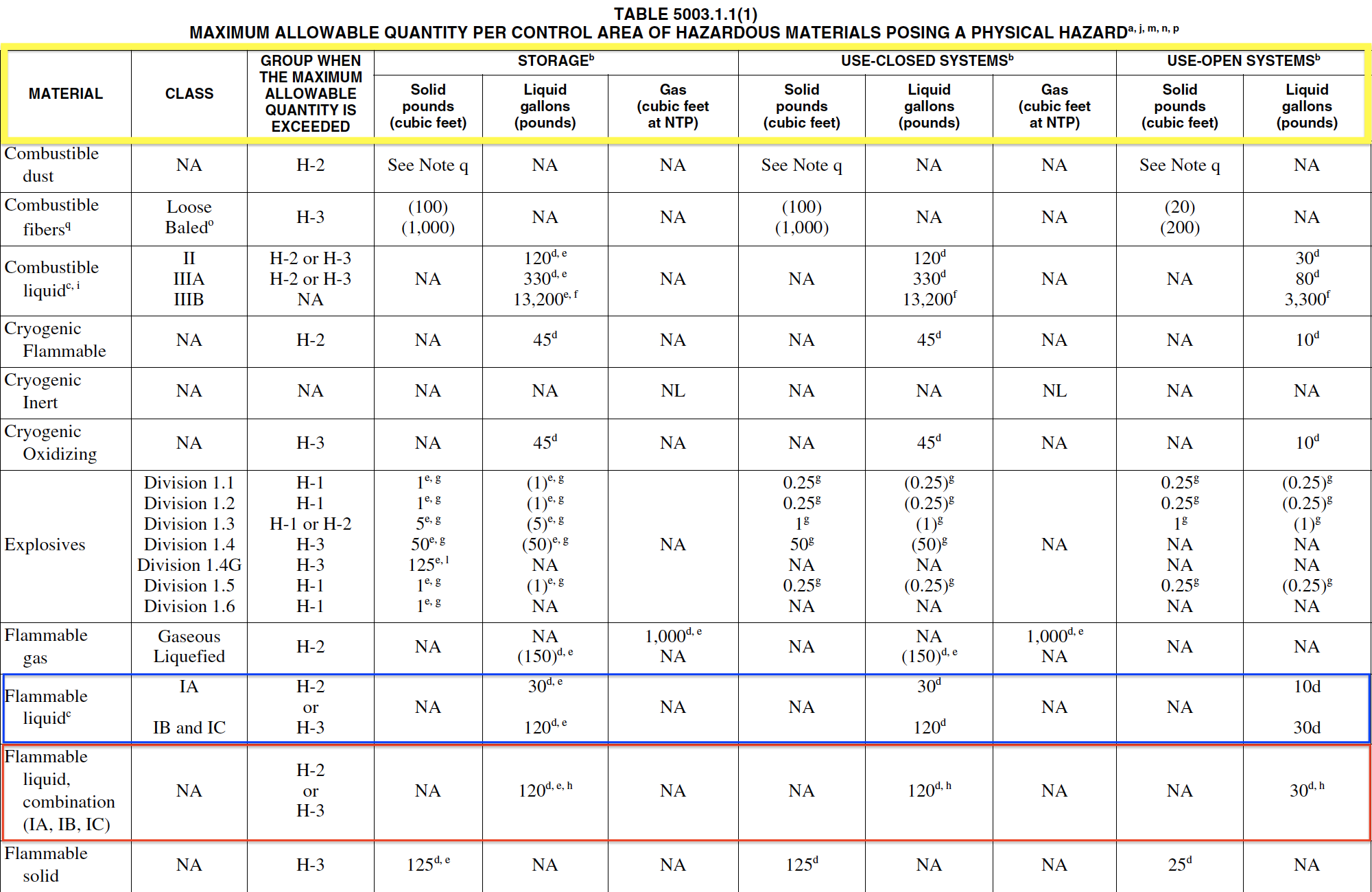
When we look at the BLUE box above we see that when the Flammable Liquid is a Class IA (Category 1) we are limited to 30 gallons per control area. The lesser Classes and Categories we see the amount goes to 120 gallons per control area. Remember OSHA does not define “control areas” or limit the number of control areas based on the floor where the flammables are outside of their designated/designed storage room/cabinet. The code does allow for an increase (up to a 200% increase) based on available safeguards, such as a properly designed and maintained sprinkler system…
d. Maximum allowable quantities shall be INCREASED 100 PERCENT in buildings equipped throughout with an approved automatic sprinkler system in accordance with Section 903.3.1.1.
Where Note e applies, the increase for both notes shall be applied ACCUMULATIVELY.
e. Maximum allowable quantities shall be INCREASED 100 PERCENT where stored in approved storage cabinets, day boxes, gas cabinets, gas rooms, exhausted enclosures or in listed safety cans in accordance with Section 5003.9.10.
Where Note d applies, the increase for both notes shall be applied ACCUMULATIVELY.
We can also see the IFC answers the question about a mixed quantity of flammables and it just sets the max to 120 gallons.
When we use these tables together, we see that handling a chemical like Xylene (Class IB/Category 2) we can have 120 gallons per control area and if we are on the 1st floor of the building we can have up to four (4) control areas. This means we can have no more than 480 gallons of xylene outside of our flammable storage room or cabinets at any one time on that floor/level.
As we go up to the 2nd floor we see that we can ONLY have three (3) control areas on that floor AND we are limited to 75% or 90 gallons in each of the three (3) control areas.
As we go up to the 3rd floor we see that we can ONLY have two (2) control areas on that floor AND we are limited to 50% or 60 gallons in each of the two (2) control areas.
Remember though, we can double these amounts when we have PROPER fire separation AND approved automatic sprinkler system, but you get the idea – as we go up in floors, we become more and more dependent on emergency egress and TIME to get out, comes into play. So as we go up (or down) from the ground level (e.g. 1st Floor) so get restricted on much fuel load we are permitted to have outside of a flammable storage room or cabinet.
Next article I will discuss the differences between a “CLOSED SYSTEM” vs. “OPEN SYSTEM” and why the “open system” limits the gallons.