
Canada has an interesting requirement for their NH3 refrigeration plants that operate within structures where the general public could be exposed to the NH3. Since the promulgation of OSHA’s PSM standards in 1992, OSHA has shied away from even mentioning “staffing” for a covered process. In the USA, we have plants that run 24/7/365 without trained refrigeration personnel on-site, and under the current PSM/RMP regulations, this is permitted [until something goes wrong]. OSHA/EPA can use PHA and SOP matters to enforce staffing, but it is a “round-about,” to say the least. Another interesting matter is that Canada does not base its risk analysis on pounds of NH3 in the process, but rather they use KW of energy used by the process.
PLEASE NOTE that these regulations qualify specific roles to be in charge of a “shift” but not the entire “plant” – a very logical and interesting idea.
Here is a look at how they manage their NH3 refrigeration plants in public occupancies:
Plant Supervision
Terminology and references provided in this presentation on plant supervision are applicable to refrigeration plants in public occupancies such as ice rinks and curling rinks.
For the purposes of plant supervision, a plant is deemed to be in operation if any part of the refrigeration system contains refrigerant (e.g. ammonia, Freon, etc.) at a pressure greater than 15 psig, unless:
– the refrigerant charge is pumped down and contained in a liquid receiver, or parts of a system designed for that purpose,
– provided with over-pressure protection, and
– isolated to prevent the circulation of refrigerant
The regulation sets out the requirements for the supervision of refrigeration plants:
- that exceed 50 kW total capacity (Group A3, B2, and B3 refrigerants) (NH3 is a B2 refrigerant based on CA regulations – ASHRAE now calls it a B2L)
- that exceed 200 kW total capacity (Group A1, A2, and B1 refrigerants)
Plants can be operated as
- CONTINUOUS SUPERVISION or
- RISK ASSESSED STATUS
The owner of a refrigeration plant must designate a person to be in charge of the plant that is responsible for the plant at all times that it is in operation. The owner must report incidents and hazards to Technical Safety BC.
The person in charge of a plant that is Continuous Supervision or Risk Assessed Status refrigeration plant is required to hold a:
- 4th Class Power Engineer (PE) (or higher), or
- Refrigeration Operator (RO) certificate
Note – a PE or RO are also qualified to be in charge of a SHIFT
Ice Facility Operator (IFO) can be the PERSON IN CHARGE OF A SHIFT in a Continuous Supervision or Risk Assessed Status refrigeration plant that does NOT exceed 1000 kW total capacity. Note – an IFO is NOT qualified to be the person in charge of a PLANT. The person in charge of a shift is not intended to be within the refrigeration machinery room at all times but must be on-site, within the plant premises
CONTINUOUS SUPERVISION status plants:
A plant that meets this requirement is required to be under continuous supervision at all times that the plant is in operation.
Supervision is not required when:
- the plant is not in operation
- the plant does not exceed 50 kW total capacity (Group A3, B2 (e.g. ammonia) and B3 refrigerants )
- the plant does not exceed 200 kW total capacity (Group A1, A2, and B1 refrigerants)
A person in charge of a shift in a Continuous Supervision Status plant is required to hold a:
- 4th Class Power Engineer (or higher),
- Refrigeration Operator, or
- Ice Facility Operator certificate
SUPERVISION for RISK ASSESSED plants
Section 56 of the regulation provides the requirements for a Risk Assessed Status Plant:
- Limited to refrigeration plants up to and including 1000 kW capacity
- The plant must meet additional technical specifications including REMOTE MONITORING AND ALARMS
- Provides for reduced supervision when the plant is in operation and the premises are NOT OCCUPIED [by the general public]
Supervision of a risk-assessed plant is required at all times when:
- The plant is in operation, AND
- The premises are occupied (by any person)
Supervision of a risk-assessed plant is not required when:
- The plant is not in operation, OR
- The plant is in operation and the premises are unoccupied
The person in charge of a shift for a minimum of 7 hours in a 24 hour period is required to hold a:
- 4th Class Power Engineering (or higher), or
- a Refrigeration Operator certificate
The person in charge of the remaining shifts in any 24 hour period is required to hold a:
- PE (4thclass or higher), RO, IFO, or
- a Refrigeration Safety Awareness certificate
NOTE: It is the responsibility of the owner of the plant to ensure that the Refrigeration Safety Awareness (RSA) certificate holder is trained in the safety procedures for that SPECIFIC PLANT prior to being assigned to the shift schedule. In other words, as I have been told numerous times by our friends up north, a plant can not hire someone who is qualified to be in charge of a PLANT on day 1 of their employment. Just because they were qualified to in charge of their previous plant under their previous employer, in NO WAY QUALIFIES them to come into a new plant with different practices/procedures and be qualified to be in charge of the plant.
MAINTENANCE GUIDELINES
Ammonia Refrigeration Incidents
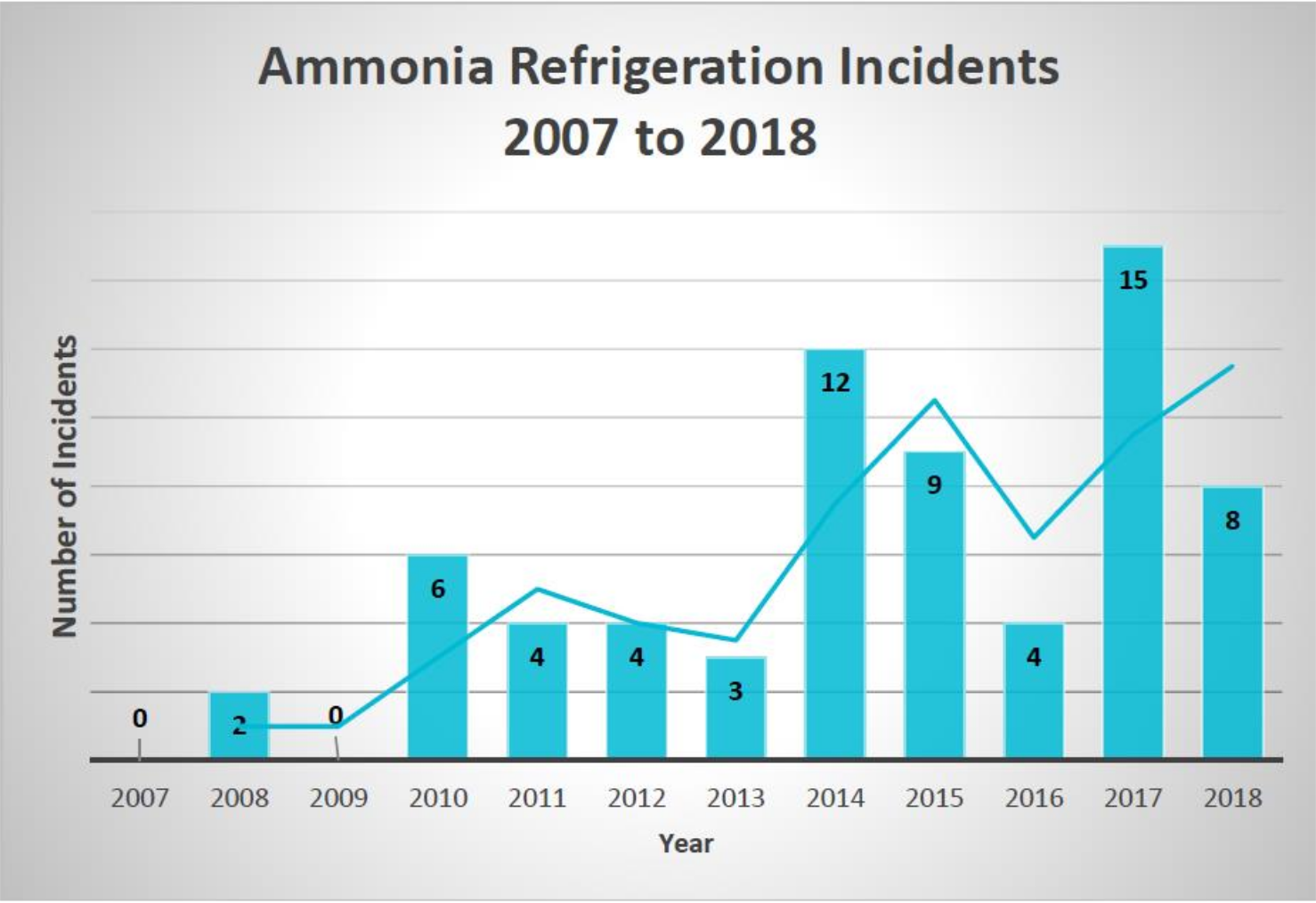
Upward incident trend
- 39 injuries
- 3 fatalities
- Two area evacuations
- One state of emergency
75% of incidents caused by:
- Equipment Failure
- Inadequate procedure
Maintenance Requirements:
- CSA B51 – in-service inspection must be performed to determine the condition and fitness to continue to operate safely of pressure vessels, piping, and fittings in a refrigeration system
- CSA B52 – the owner must maintain the refrigeration system to preserve the operating efficiencies, equipment integrity, personal protection and protection of the building and natural environments
- NBIC, Part 2
CLICK HERE to see the full Technical Safety BC presentation