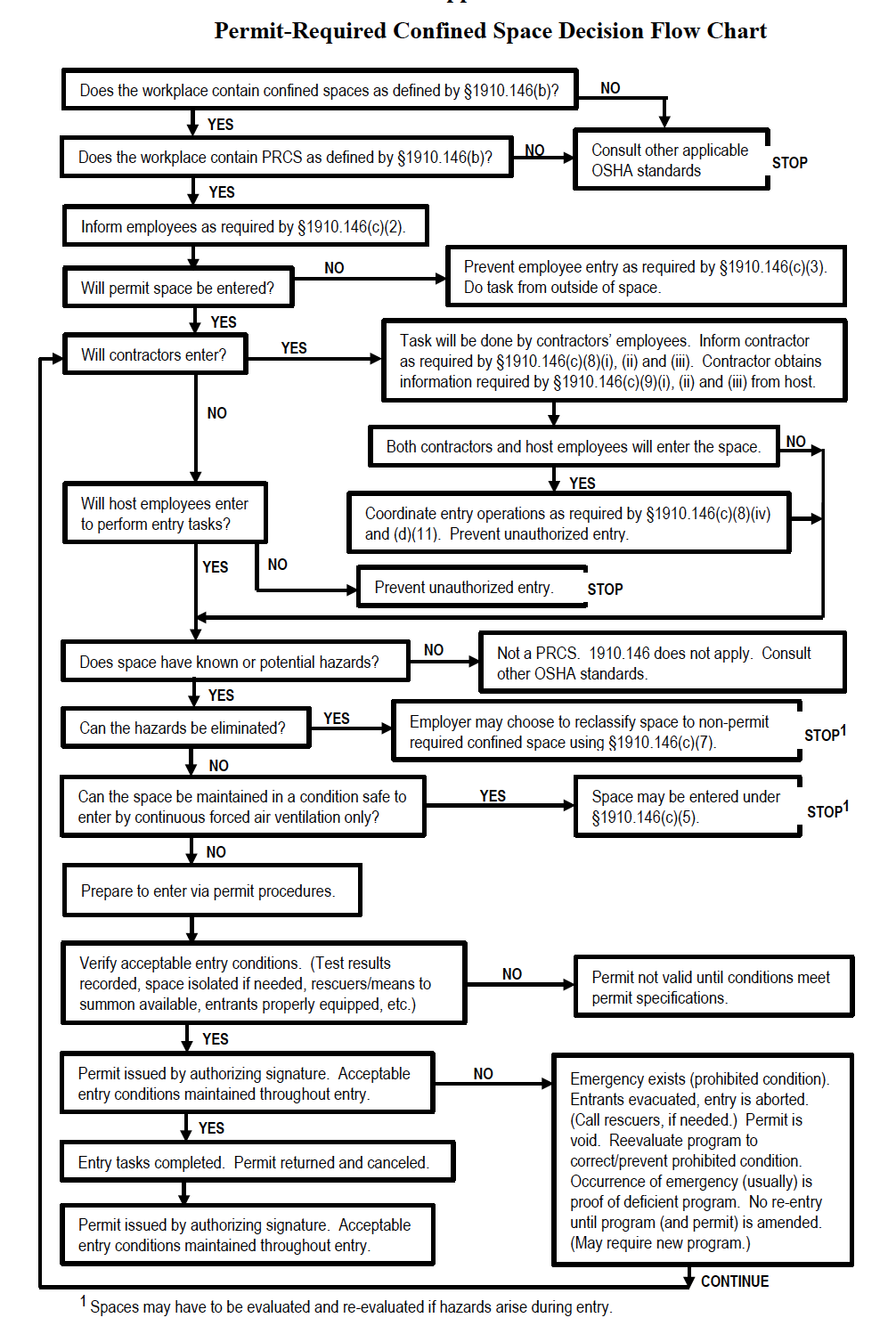
The only OSHA standards that make mention of the phrase “Double Block and Bleed” (DB&B) are its Permit-Required Confined Space (PRCS) standards. In both 1910.146(b) and 1926.1203, OSHA defines a DB&B as:
the closure of a line, duct, or pipe by closing and locking or tagging two in-line valves and by opening and locking or tagging a drain or vent valve in the line between the two closed valves.
PLEASE take notice that OSHA requires TWO (2) in-line valves are CLOSED and the drain/vent valve in between the CLOSED valves be locked or tagged OPEN. This is in stark contrast to how one American Petroleum Institute standard defines DB&B. API 6D Specification for Pipeline Valves defines a DB&B arrangement using a SINGLE valve as:
a single valve with two seating surfaces that, in the closed position, provides a seal against pressure from both ends of the valve with a means of venting/bleeding the cavity between the seating surfaces.
NOTE This valve does not provide positive double isolation when only one side is under pressure. See double-isolation-and-bleed valve.
Double-isolation-and-bleed valve (DIB) is:
a single valve with two seating surfaces, each of which, in the closed position, provides a seal against pressure from a single source, with a means of venting/bleeding the cavity between the seating surfaces
We should be able to discern the difference in the application of these standards as one is for entry into a PRCS and one is a specification for valves used in a pipeline, but I can’t count the number of times where a facility has laid claim to their SINGLE DB&B valve as acceptable isolation for a PRCS. Some facilities have spent a lot of money “upgrading” their piping with these SINGLE style DB&B valves as a way of reducing down-time when isolating for entry into a PRCS and they take considerable issues with me telling them it was a bad design/decision. Heck in almost all instances where I have run across this, the facility’s entry program still defines DB&B using the OSHA definition.
I will refer you to the best energy isolation guide I have ever come across:
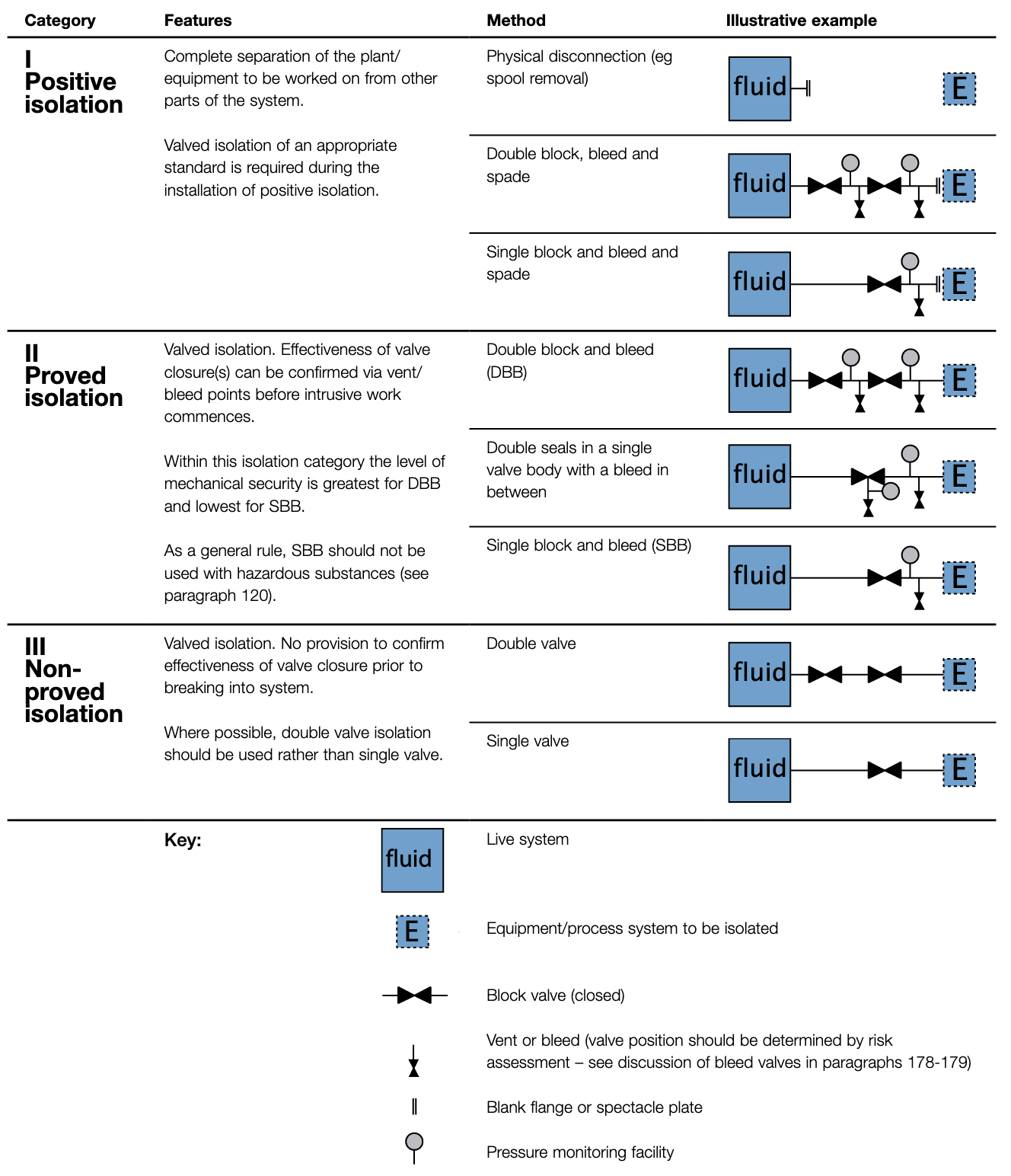
Did you notice the ADDITIONAL design requirements for the UK’s HSE DB&B arrangement? It is the EXTRA pressure gauge AND bleed valve as shown in the red box below:
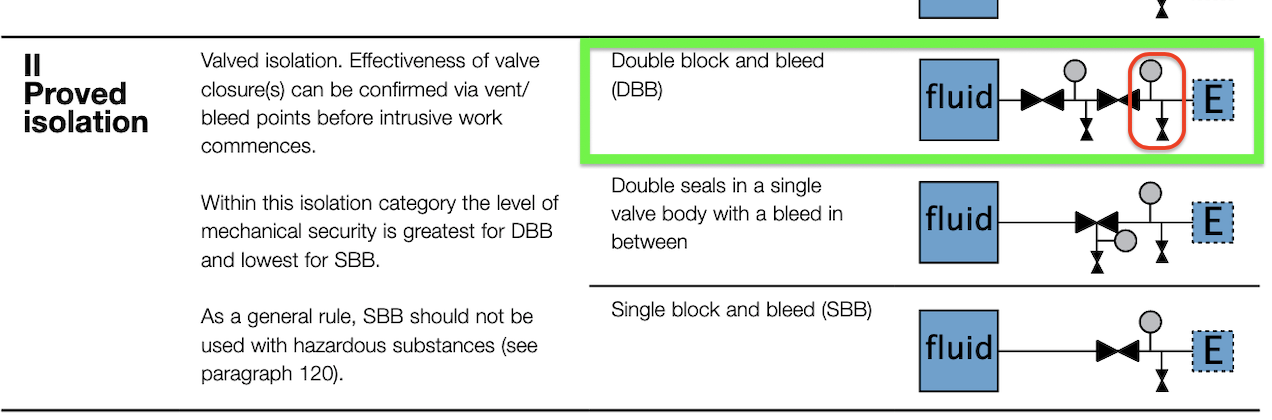
But even with this extra requirement, they do not consider DB&B to be a “Positive Isolation” means. Heck OSHA does not even require the pressure gauge between the two CLOSE isolation valves. A couple of my former plants and current clients require the pressure gauge between the isolation valves OR they manage the opening of the bleed/vent as a “process opening” and it is is a “permitted-task” just like any other opening. BOTH gauges in this arrangement are a means to verify ZES before opening the bleed/vent so that we do not have an LOPC event involving our highly hazardous chemicals/extremely hazardous substances. But it is rare to find this level of sophistication in the USA when it comes to our DB&B arrangements.
But let me be VERY CLEAR in closing… Double Block and Bleed arrangements used for isolating a PRCS MUST have two (2) in-line valves locked CLOSED and the bleed/vent between them locked OPEN.