
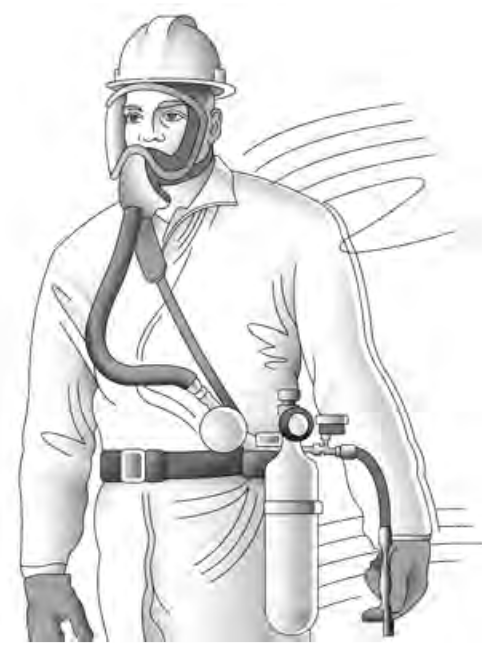
 So what is the Assigned-Protection Factor (APF) for an air-line respirator, commonly used inside PRCSs which has, or has the potential to have an IDLH atmosphere? Is it 1,000 or 10,000?
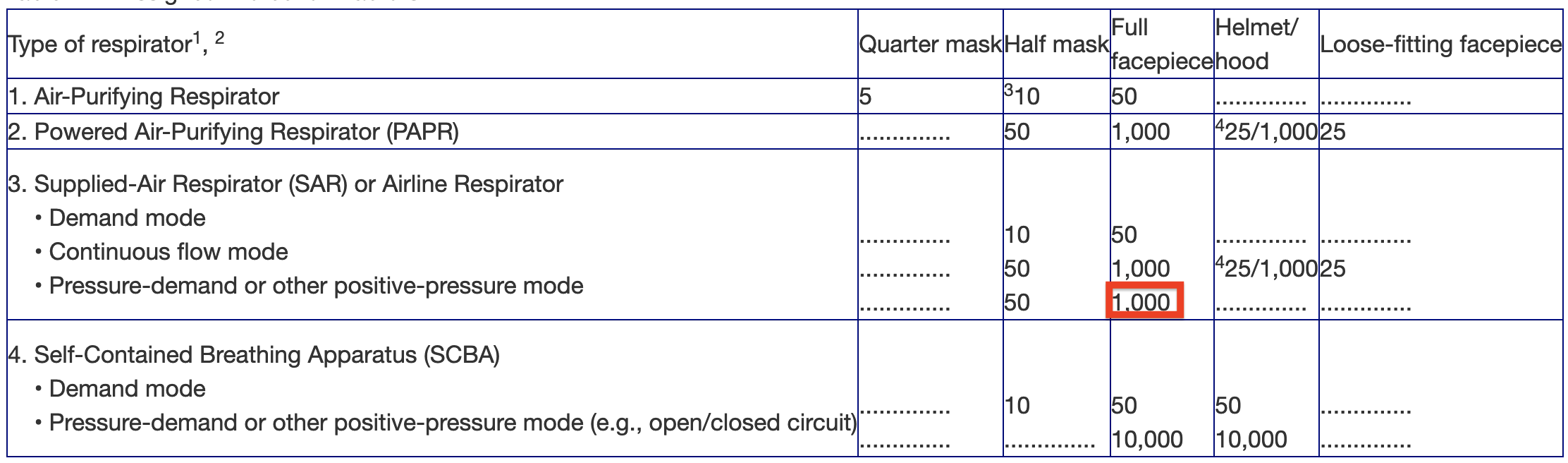
I have always been taught/trained that the simple air-line respirator (Pressure-demand/Positive pressure mode) WITHOUT the Auxilary/Back-up cylinder the APF is 1,000, but the addition of the Auxilary/Back-up cylinder then makes it “acceptable” for entry/work within an IDLH atmosphere with an APF of 10,000. But to show that we can always learn in this profession, I had to ask my FaceBook Group what a “combination respirator (e.g., airline respirators with an air-purifying filter)” is. Luckily one of the members just happens to be a CIH and he did some digging and came up with a “combination respirator (e.g., airline respirators with an air-purifying filter)” so now we at least know what it looks like and why it gets an assigned protection factor of 1,000 (as shown in the red box below). So what does OSHA mean when it says… (emphasis by me)
1910.134(d)(3)(i)(A) Assigned Protection Factors (APFs)
Employers must use the assigned protection factors listed in Table 1 to select a respirator that meets or exceeds the required level of employee protection. When using a combination respirator (e.g., airline respirators with an air-purifying filter), employers must ensure that the assigned protection factor is appropriate to the mode of operation in which the respirator is being used.
Here is an image of a combination respirator (e.g., airline respirators with an air-purifying filter)…
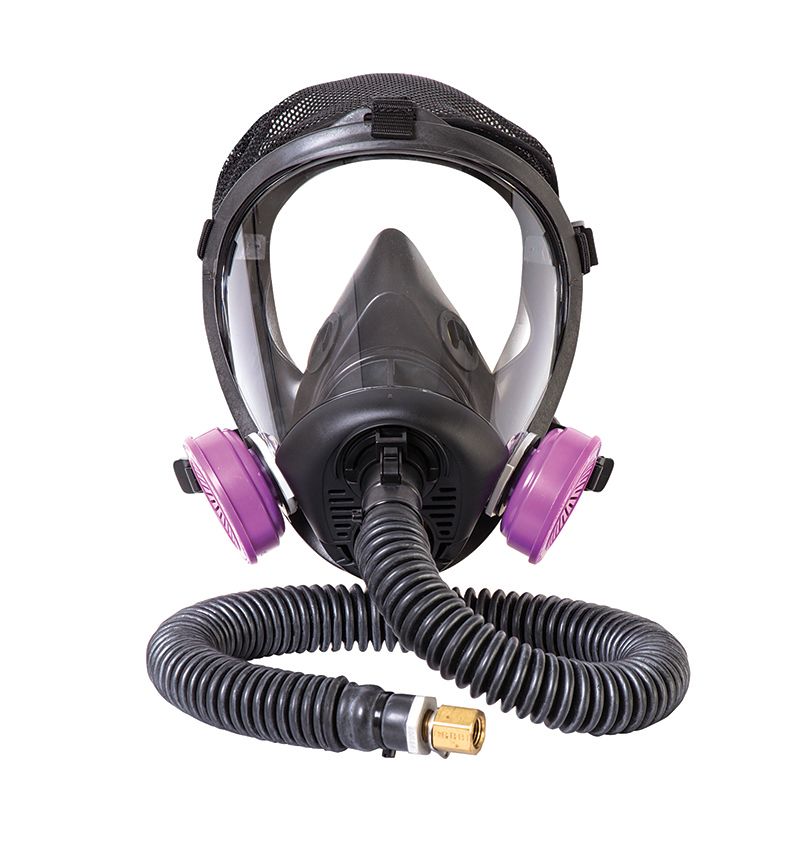
Source: Honeywell North CF4000 Series Front Mount CF-SAR
To date, MSHA/NIOSH has certified several types of air-purifying units in combination with the Type C supplied-air respirator. I found the following, in a 1984 archived NIOSH document, while trying to understand why on this earth would anyone want/need a combination respirator (e.g., airline respirators with an air-purifying filter).
|
Combination Supplied-Air/ Air-Purifying Respirator One type of combination respirator that MSHA/NIOSH has certified is the- Type C supplied-air and air-purifying respirator. These devices are certified under the class of the air-purifying element since it is the component in the combination which provides the least protection to the user. This type of respirator consists of
The air-purifying element may be a canister, chemical cartridge, or particulate filter. It is mounted either directly on the facepiece or on an adapter that is worn on the belt. An advantage of this type of respirator is that the wearer has respiratory protection while entering (in some cases) and leaving without being connected to an airline. The air-purifying element weighs less than a self-contained breathing apparatus cylinder. The disadvantage is that they have the limitations of the air-purifying element, and therefore, can be used only for specific conditions. Depending upon the specific respirator,
|
This combination supplied-air/air-purifying respirator gets an APF of 1,000 – NOT good enough for an IDLH atmosphere. OSHA is pretty clear that for an IDLH atmosphere we have ONLY two (2) choices:
1) A full facepiece pressure-demand SCBA certified by NIOSH for a minimum service life of thirty minutes (1910.134(d)(2)(i)(A)

2) A combination full facepiece pressure-demand supplied-air respirator (SAR) WITH AUXILIARY SELF-CONTAINED AIR SUPPLY (1910.134(d)(2)(i)(B)

So how can a respirator with an APF of only 1,000 be used in an IDLH atmosphere? OSHA explains, albeit poorly, in a 2013 LOI, where they state: (emphasis by me)
|
Background: Your letter describes the Federal Register, Volume 71, No. 164, dated August 24, 2006, as stating that the combination pressure-demand, full-facepiece SAR with auxiliary SCBA respirator is equivalent to an SCBA, and, therefore, the APF for an SCBA applies. However, you also mention that OSHA publication 3352-02 2009, Respiratory Protection: Assigned Protection Factors for the Revised Respiratory Protection Standard, contains a picture of a SAR with an egress SCBA ensemble that lists the APF as limited to 1,000, unless it is “used in escape mode.” If it is used in an escape mode, then according to OSHA publication 3352, it is assigned an APF of 10,000. Question: Why are pressure-demand, full-facepiece SARs used in non-escape mode listed with an APF of 1,000 in the Respiratory Protection Standard, 29 CFR 1910.134, Table 1? Response: The Federal Register, Volume 71, No. 164, dated August 24, 2006, and OSHA Publication 3352-2009 are both stating the correct protection factor in different ways. The Respiratory Protection Standard, 29 CFR 1910.134, and the Federal Register, Volume 71, No. 164, dated August 24, 2006, state: “When using a combination respirator (e.g., airline respirators with an air-purifying filter), employers must ensure that the assigned protection factor is appropriate to the mode of operation in which the respirator is being used.” [Emphasis added]. The combination pressure-demand, full-facepiece SAR with auxiliary self-contained breathing apparatus (SCBA) does not obtain supplied air from the compressor or stationary tank to the air hose at the same time as the auxiliary SCBA is supplying air from the bottle. When the respirator combination is being used in non-escape mode, the auxiliary bottle is not operating, and, in this mode, the APF is the same as a full-facepiece SAR (1,000). When the respirator combination is in escape mode, the air-line hose assembly has either failed or was disconnected so that the wearer may escape or change locations in an environment that is considered immediately dangerous to life or health (IDLH). Once the auxiliary escape bottle is being used solely without the air-line, the APF is converted to 10,000 for a full-facepiece SCBA. Therefore, the information provided in the Federal Register and the OSHA publications are both correct. |