
 Have you taken the 3 minutes to read OSHA’s expansive Compressed Gas Standard 1910.101? After all, the standard is three sections long and references Compressed Gas Association (CGA) pamphlets that are no longer in print. One of the most requested standards I get from SAFTENG members and clients is for CGA P-1 (1965): Safe Handling of Compressed Gases (which can now be downloaded for FREE since it has been out of print for 20 years!) This is NO FAULT of OSHA’s as they have repeatedly tried to update the standard with a reference to a newer revision. But with 1910.101 being so lame; being based off a 1965 standard that is not even in print anymore, what is a safety professional to do when it comes to the serious hazards posed by compressed gas cylinders? Now let me see if there was only some other standard that is recognized around the world that I could use? How about the International Fire Code, specifically Chapter 53, Compressed Gases (Free access link). I have been using the IFC since 1991 when I was in school at Murray State and working for the Physical Plant/EHS Group, especially Chapter 53 as the university used compressed gas cylinders in just about every building. So what does IFC, Chapter 53 require… (with my comments and emphasis added)
5303.4.2 Portable containers, cylinders, and tanks.
Portable compressed gas containers, cylinders, and tanks shall be marked in accordance with CGA C-7.
5303.4.3 Piping systems.
Piping systems shall be marked in accordance with ASME A13.1. Markings used for piping systems shall consist of the CONTENT’S NAME and INCLUDE A DIRECTION-OF-FLOW ARROW. Markings shall be provided at EACH VALVE; at WALL, floor or ceiling PENETRATIONS; at each CHANGE OF DIRECTION; and at NOT LESS THAN EVERY 20 FEET (6096 mm) or fraction thereof throughout the piping run.
Exceptions:
1. Piping that is designed or intended to carry more than one gas at various times shall have appropriate signs or markings posted AT THE MANIFOLD, ALONG THE PIPING and AT EACH POINT OF USE to provide clear identification and warning.
2. Piping within gas manufacturing plants, gas processing plants, refineries, and similar occupancies shall be marked in an APPROVED MANNER.
| ASME A13.1 is the baseline code that all other pipe labeling requirements are from. Section 4.3 above is so prescriptive that you would not need to buy a copy of ASME A13.1 to understand the piping/tubing labeling requirements. |
5303.5 Security.
Compressed gas containers, cylinders, tanks, and systems shall be secured against ACCIDENTAL DISLODGEMENT and against ACCESS BY UNAUTHORIZED PERSONNEL in accordance with Sections 5303.5.1 through 5303.5.3.
5303.5.1 Security of areas.
Areas used for the storage, use, and handling of compressed gas containers, cylinders, tanks, and systems shall be SECURED AGAINST UNAUTHORIZED ENTRY and safeguarded in an approved manner.
| This security requirement is one that is often overlooked. How a business defines who is “authorized” is wide open and this is usually easier than trying to define who is “unauthorized”. We always used HAZ COM training to define who was “authorized” to enter the storage area/room. When I was in semi-conductor we even had badge access to our storage room as some of our gases were “highly toxic” materials. The gain badge access there was a specific training program you had to complete. This included ALL contractors needing access. |
5303.5.2 Physical protection.
Compressed gas containers, cylinders, tanks and systems that could be exposed to physical damage shall be protected. Guard posts or other approved means shall be provided to protect compressed gas containers, cylinders, tanks and systems INDOORS AND OUTDOORS from VEHICULAR DAMAGE and shall comply with Section 312.
|
I have written dozens of posts about Section 312 (e.g. bollards), but for the sake of ease here are the Section 312 requirements for bollards… 312.2 Posts. Guard posts shall comply with all of the following requirements: |
5303.5.3 Securing compressed gas containers, cylinders, and tanks.
Compressed gas containers, cylinders, and tanks shall be secured to PREVENT FALLING caused by contact, vibration or seismic activity. SECURING of compressed gas containers, cylinders and tanks shall be by one of the following methods:
1. Securing containers, cylinders, and tanks to a fixed object with one or more restraints.
2. Securing containers, cylinders, and tanks on a cart or other mobile device DESIGNED for the movement of compressed gas containers, cylinders or tanks.
3. Nesting of compressed gas containers, cylinders, and tanks at container filling or servicing facilities or in sellers’ warehouses NOT open to the public. Nesting shall be allowed provided that the nested containers, cylinders or tanks if dislodged, DO NOT OBSTRUCT THE REQUIRED MEANS OF EGRESS.
4. Securing of compressed gas containers, cylinders, and tanks to or within a rack, framework, cabinet or similar assembly DESIGNED for such use.
Exception: Compressed gas containers, cylinders, and tanks in the process of examination, filling, transport or servicing.
| The #1 OSHA cited compressed gas safety requirement is the lack of securing cylinders. CGA P-1, 1965 has been clear for many years and yet there is probably not a workplace in the USA right now that does not have a cylinder free-standing somewhere. For most of us, we have three (3) options to secure our cylinders; as #3 above is going to be reserved ONLY for filling or servicing facilities and/or sellers’ warehouses. |
…
5303.7.3 Ledges, platforms and elevators.
Compressed gas containers, cylinders and tanks shall NOT be placed near ELEVATORS, UNPROTECTED PLATFORM LEDGES or OTHER AREAS WHERE FALLING would result in compressed gas containers, cylinders or tanks being ALLOWED TO DROP DISTANCES EXCEEDING ONE-HALF THE HEIGHT OF THE CONTAINER, CYLINDER OR TANK.
| I really like how the code quantifies the height limitations for how far the cylinder can fall. With most cylinders in industrial workplaces ranging in height from 48″ to 60″, we could be talking about a ledge just 2′ high. Of course, some cylinders are only 18″ tall so that would mean the fall potential can only be 9″. The elevator aspect comes from the concern of the cylinder falling down the elevator shaft. |
5303.7.4 Temperature extremes.
Compressed gas containers, cylinders, and tanks, whether full or partially full, shall not be exposed to artificially created high temperatures exceeding 125°F (52°C) or sub-ambient (low) temperatures unless designed for use under the exposed conditions.
| 125°F (52°C) is outside the ambient air temps even in a desert location, so the code makes specific reference to “artificially created” high temps such as by an industrial oven, boiler, heater, etc. Special NOTE: Type E cylinders (usually medical gases such as Oxygen) typically come with a max storage temp of 95°F. Notice that the code also includes low temps (i.e. sub-ambient). In my world, sub-ambient translates to colder than 0°F. Just like hot temps, metal failure can occur at lowe temps as well. But basically, the code restricts storage areas from being in areas such as freezers – this is because of the cylinder metal not because of fears of a gas leak into a freezer which is a serious hazard in its own right. |
5303.7.5 Falling objects.
Compressed gas containers, cylinders, tanks, and systems shall not be placed in areas where they are capable of being damaged by falling objects.
| Falling objects can range from tree limbs to icicles, as well as storage areas overhead. There is a bit of judgment as to what the fall objects is, as it would have to be substantial enough to cause damage. And remember, the cylinder must have its safety cap (if designed to accept one) while it is in storage. |
5303.7.6 Heating.
Compressed gas containers, cylinders, and tanks, whether full or partially full, shall not be heated by devices that could raise the surface temperature of the container,
cylinder or tank to above 125°F (52°C). Heating devices shall comply with the International Mechanical Code and NFPA 70. Approved heating methods involving temperatures
of less than 125°F (52°C) are allowed to be used by trained personnel. Devices designed to maintain individual compressed gas containers, cylinders or tanks at constant
temperature shall be approved and shall be designed to be fail-safe.
| More restrictions based on the metal temps of the cylinder. Most of us have seen some crazy things done to increase pressure in a cylinder or to raise the temp so as to ensure the cylinder is “gas-free”. Whatever the reason… NEVER apply a direct heat source to a cylinder!!! That includes space heaters placed in front of one, a salamander heater pointed at one, or even a heat blanket NOT designed for the specific purpose of heating a compressed gas cylinder with a LIMITED heat capacity below 125°F. |
5303.7.7 Sources of ignition.
Open flames and high-temperature devices shall not be used in a manner that creates a hazardous condition.
5303.7.8 Exposure to chemicals.
Compressed gas containers, cylinders, tanks, and systems shall not be exposed to corrosive chemicals or fumes that could damage containers, cylinders, tanks, valves or valve-protective caps.
| I should point out that this requirement applies to corrosive chemicals in the area and NOT inside the cylinder(s). This does not require cylinders of corrosive gases to be segregated from other cylinders’ storage. It is ALWAYS a good idea to segregate storage areas based on compatibility, but this requirement is NOT part of this practice. This requirement is intended to prevent storage in Chlorine Rooms, Acid Rooms, etc. |
Exhausted Enclosures left out of this discussion
Tube Trailers requirements left out of this discussion
5303.8 Wiring and equipment.
Electrical wiring and equipment shall comply with NFPA 70. Compressed gas containers, cylinders, tanks, and systems SHALL NOT BE LOCATED WHERE THEY COULD BECOME PART OF AN ELECTRICAL CIRCUIT. Compressed gas containers, cylinders, tanks, and systems shall not be used for electrical grounding.
| Nothing special here… we just can have electrical running near our cylinder storage area (even the electrical for the lighting needs) where a cylinder can become part of an electrical circuit. I even go as far as preventing extension cords from being used around my storage areas, but that is my practice and not necessarily code required. And I hope one day we can write a code/standard and not have to say the OBVIOUS, but society is not there yet, so the code PROHIBITS a compressed gas cylinder being used as an electrical ground (including temporary bonding/grounding associated with the transfer of flammable liquids). |
5303.9 Service and repair.
Service, repair, modification or removal of valves, pressure-relief devices or other compressed gas containers, cylinder, or tank appurtenances shall be performed by trained personnel.
| NEVER EVER EVER EVER should anyone other than a trained technician attempt to service, repair, modify or remove valves and/or pressure-relief devices! |
5303.10 Unauthorized use.
Compressed gas containers, cylinders, tanks, and systems SHALL NOT BE USED FOR ANY PURPOSE OTHER THAN TO SERVE AS A VESSEL FOR CONTAINING THE PRODUCT that it is designed to contain.
5303.11 Exposure to fire.
Compressed gas containers, cylinders, and tanks that HAVE BEEN EXPOSED TO FIRE SHALL BE REMOVED FROM SERVICE. Containers, cylinders, and tanks so removed shall be handled by approved, qualified persons.
| The concern here is again, metal temperatures exceeding the MAWT of 125°F. When the cylinder is exposed to fire and this does NOT have to be a direct flame impingement on the cylinder. A fire in the “area” of the cylinder(s) can certainly expose the cylinder(s) to temperatures exceeding 125°F. When this happens we have two (2) concerns: 1) metal fatigue and 2) the pressure in the cylinder greatly increases and may even lift the relief device and release its contents. |
5303.12 Leaks, damage or corrosion.
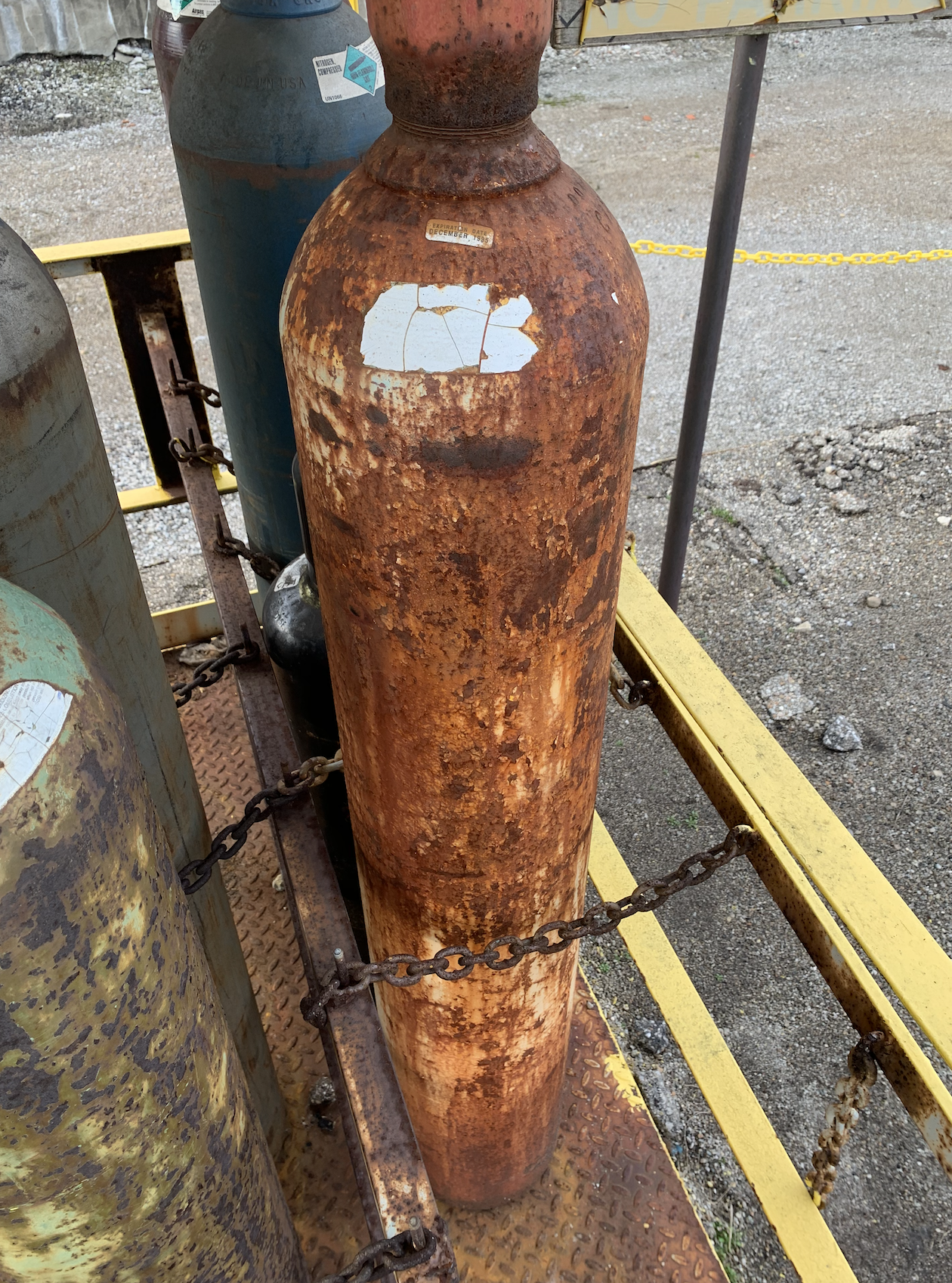
Leaking, damaged or corroded compressed gas containers, cylinders, and tanks shall be removed from service. Leaking, damaged or corroded compressed gas systems shall be replaced or repaired in accordance with the following:
1. Compressed gas containers, cylinders, and tanks that have been removed from service shall be handled in an approved manner.
2. Compressed gas systems that are determined to be leaking, damaged or corroded shall be repaired to a serviceable condition or removed from service.
5303.13 Surface of unprotected storage or use areas.
Unless otherwise specified in Section 5303.14, compressed gas containers, cylinders, and tanks are allowed to be stored or used without being placed under overhead cover. To prevent bottom corrosion, containers, cylinders, and tanks shall be protected from direct contact with soil or unimproved surfaces. The surface of the area on which the containers are placed shall be graded to prevent the accumulation of water.
| Years ago when I designed an outside storage area, I always included a weather cover over the storage area and I was under the impression it was required, but as we can see here it is NOT a requirement. But we are REQUIRED to have a suitable floor/surface to sit the cylinder(s) on in order to prevent direct contact with soil or unimproved surfaces, which can include concrete not designed to drain/run-off! The requirement is to prevent external corrosion on the bottom of the cylinder(s). So anytime we come across a cylinder sitting in water, even a small shallow puddle, this is PROHIBITED. |
5303.14 Overhead cover.
Compressed gas containers, cylinders, and tanks are allowed to be stored or used in the sun except in locations where extreme temperatures prevail.
| IBC Section 414.6 prescribes construction requirements applicable to weather protection for hazardous materials. But what are “extreme temperatures” where an overhead cover would be required/necessary? As we have said, 125°F is the maximum temp for the shell and I am not sure we have any business located in the continental USA that can see ambient temps that high |
5303.15 Lighting.
Approved lighting by natural or artificial means shall be provided.
| The storage area MUST have artificial lighting, natural light is NOT enough except on bright sunny days. If your workplace works during dark hours and personnel are having to interact with the cylinders PROVIDE ARTIFICIAL LIGHTING! The American National Standard (ANS) A11.1-1965, R1970, Practices of Industrial Lighting, is a nationally-recognized consensus standard cited by reference under paragraph 1910.261 of Part 1910-Safety and Health Regulations For General Industry and under paragraph 1926.56 of Part 1926-Safety and Health Regulations For Construction. This ANS standard was developed with the active collaboration of the Illuminating Engineering Society (IES), now identified as the Illuminating Engineering Society of North America (IESNA). OSHA recommends that employers use this standard as guidelines to determine sufficient lighting required to provide for the safety and health of employees in workplaces. |
Storage Vaults left out
SECTION 5304 – STORAGE OF COMPRESSED GASES
5304.1 Upright storage.
Compressed gas containers, cylinders, and tanks, except those designed for use in a horizontal position, and all compressed gas containers, cylinders, and tanks containing non-liquefied gases, SHALL BE STORED IN AN UPRIGHT POSITION WITH THE VALVE END UP. An upright position shall include conditions where the container, cylinder or tank axis is inclined as much as 45 degrees (0.80 rad) from the vertical.
Exceptions:
1. Compressed gas containers with a water volume less than 1.3 gallons (5 L) are allowed to be stored in a horizontal position.
2. Cylinders, containers, and tanks containing non-flammable gases, or cylinders, containers and tanks containing non-liquefied flammable gases that have been secured to a pallet for transportation purposes.
5304.2 Material-specific regulations.
In addition to the requirements of this section, indoor and outdoor storage of compressed gases shall comply with the material-specific provisions of:
CHAPTER 54 CORROSIVE MATERIALS
CHAPTER 58 FLAMMABLE GASES AND FLAMMABLE CRYOGENIC FLUIDS
CHAPTER 60 HIGHLY TOXIC AND TOXIC MATERIALS
CHAPTER 61 LIQUEFIED PETROLEUM GASES
CHAPTER 62 ORGANIC PEROXIDES
CHAPTER 63 OXIDIZERS, OXIDIZING GASES AND OXIDIZING CRYOGENIC FLUIDS
CHAPTER 64 PYROPHORIC MATERIALS
CHAPTER 65 PYROXYLIN (CELLULOSE NITRATE) PLASTICS
CHAPTER 66 UNSTABLE (REACTIVE) MATERIALS
CHAPTER 67 WATER-REACTIVE SOLIDS AND LIQUIDS
You did not hear this from me, but you can get a FREE copy (pdf) of the 2018 IFC @ https://www.ci.independence.mo.us/userdocs/ComDev/2018%20INTL%20FIRE%20CODE.pdf
I want to encourage you to buy a copy and support the code development process, but some employers are cheap and won’t spend the $ so this is an alternative.