
Earlier this week I explained the OSHA requirements for storing Flammable Liquids “outside”, using Ethanol as my example since so many businesses have been converted over to making hand sanitizers, many of which have never managed such a large inventory of flammable liquids. Part 2 is to cover those businesses who wish to store their Ethanol Inventory inside a building, but NOT inside a room built to the “Inside Flammable Storage Room” design requirements. I will continue to use Ethanol in my example, but this will apply to any flammable liquid stored inside.
We start with 1910.105(d)(5) Storage inside building…
|
1910.106(d)(5)(i) “Egress.” Flammable liquids, including stock for sale, shall not be stored so as to limit use of exits, stairways, or areas normally used for the safe egress of people. 1910.106(d)(5)(ii) “Containers.” The storage of flammable liquids in containers or portable tanks shall comply with subdivisions (iii) through (v) of this subparagraph. 1910.106(d)(5)(iii) “Office occupancies.” Storage shall be prohibited except that which is required for maintenance and operation of building and operation of equipment. Such storage shall be kept in closed metal containers stored in a storage cabinet or in safety cans or in an inside storage room not having a door that opens into that portion of the building used by the public. 1910.106(d)(5)(iv) “Mercantile occupancies and other retail stores.” 1910.106(d)(5)(iv)(a)-(d) [Reserved] 1910.106(d)(5)(v) “General purpose public warehouses.” Storage shall be in accordance with Table H-14 or H-15 and in buildings or in portions of such buildings cut off by standard firewalls. Material creating no fire exposure hazard to the flammable liquids may be stored in the same area. |
So what does it mean when OSHA says “Flammable liquids, including stock for sale, shall not be stored so as to limit use of exits, stairways, or areas normally used for the safe egress of people.”? This is one of those requirements that if you asked 100 fire safety engineers, you would probably get 100 different answers. So in these circumstances, I look for guidance from other codes and my favorite of the International Fire Code and it too has similar language with some official commentary…
5704.3.3.3 Clear means of egress. Storage of any liquids, including stock for sale, shall not be stored near or be allowed to obstruct physically the route of egress.
The means of egress must be usable to be effective. The placement of flammable or combustible liquids near or in the route used to exit the room or building produces a risk that is not acceptable.
But the best response is found in the NOTES of 1910.106 Table H-14 Indoor Container Storage (emphasis by me)
NOTE 2: Aisles shall be provided so that NO CONTAINER IS MORE THAN 12 FT. FROM AN AISLE. Main aisles shall be at least 3 ft. wide and side aisles at least 4 ft. wide.
So now we have a measurable specification that our “indoor container storage” must be 12′ away from our aisles, INCLUDING our egress paths! And I need to add that this requirement applies to ALL flammable containers, other than safety cans or containers in flammable cabinets.
I will skip the “Office Occupancies” and the “Mercantile Occupancies” as most of you do not work in those types of businesses and let’s discuss the General purpose public warehouses requirements.
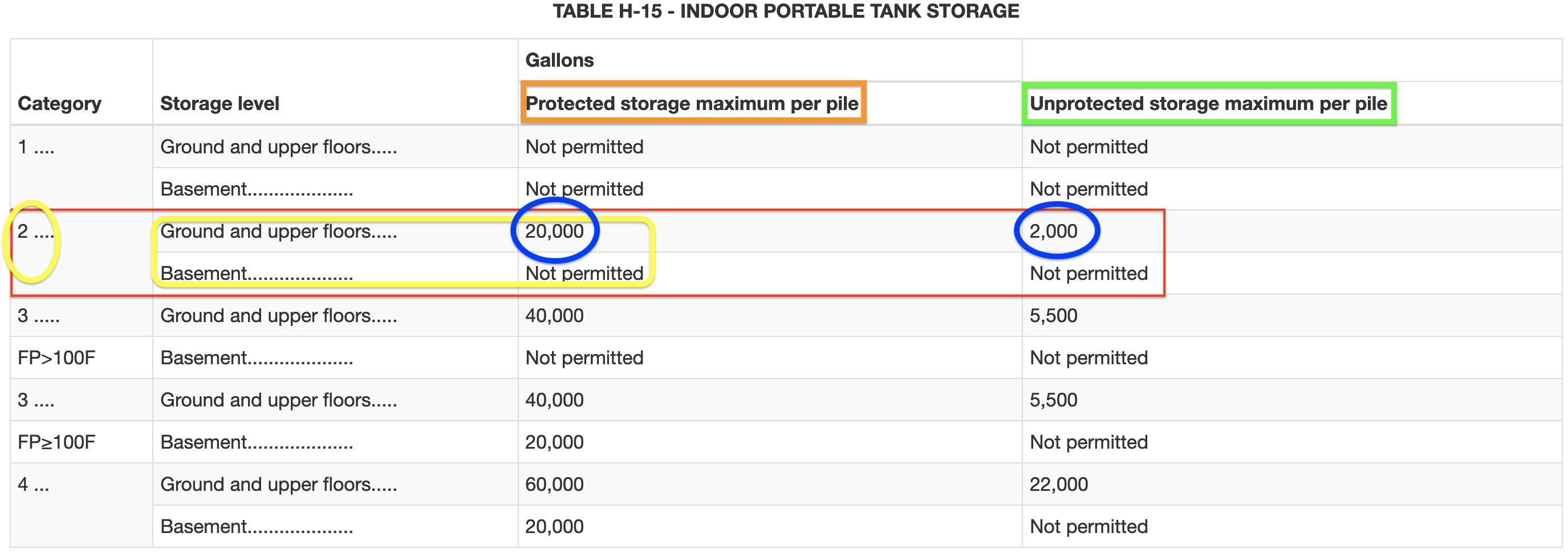
Simply put, we have to follow TABLE H-15 – INDOOR PORTABLE TANK STORAGE (Note: Table 14 is for indoor container storage). Just to be sure we are all on the same page, OSHA defines a “Portable Tank” as
a closed container having a liquid capacity OVER 60 U.S. gallons and not intended for fixed installation.
So by default, a 55-gallon drum is a “container” and anything larger, such as a “tote” would be managed as a “portable tank”, thus we will use TABLE H-15 – INDOOR PORTABLE TANK STORAGE table for our discussion. The table below has quite a few reference colors so let me explain how this all works…
RED BOX – this is for Category 2 flammable liquids (e.g. Ethanol)
YELLOW BOX – limitations for GROUND FLOORS and PROHIBITIONS for Basements
BLUE Circles – the quantities of CAT 2 Flammable Liquids permitted
ORANGE BOX – this column represents how many GALLONS is permitted in each pile since the area is SPRINKLED
GREEN BOX – this column represents how many GALLONS is permitted in each pile when the area is NOT sprinkled
NOTE 1: When 1 or more categories of materials are stored in a single pile, the maximum gallonage permitted in that pile shall be the smallest of the 2 or more separate maximum gallonages.
NOTE 2: Aisles shall be provided so that no portable tank is more than 12 ft. from an aisle. Main aisles shall be at least 8 ft. wide and side aisles at least 4 ft. wide.
NOTE 3: Each pile shall be separated from each other by at least 4 ft.
NOTE 4: FP means Flashpoint.
So we can see that on floors 1and above we can have 20,000 gallons of a CAT 2 Flammable Liquid (e.g. Ethanol) when the storage area is FULLY SPRINKLED and only 2,000 gallons when the area is NOT sprinkled. We are also PROHIBITED from storing ANY amount of a CAT 2 Flammable Liquid below grade (e.g. basement). A special NOTE for those who think 20,000 gallons is a lot, this would be 72 totes when we use the 275-gallon totes as we did in Part 1. We have to go back to (d)(5)(v) and pay close attention to how it is worded (emphasis by me)
1910.106(d)(5)(v) “General purpose public warehouses.” Storage shall be in accordance with Table H-14 or H-15 and in buildings or in portions of such buildings cut off by standard firewalls. Material creating no fire exposure hazard to the flammable liquids may be stored in the same area.
So EACH PILE that has the 72 totes (i.e. the pile) would have to be a single building or floor with one pile or if we wanted multiple piles we would need firewall separation! The last requirement that “material creating no fire exposure hazard to the flammable liquids may be stored in the same area” means (to me at least) that the storage is of NON-COMBUSTIBLE items. This means the “extra pallets” and “extra cardboard boxes” can NOT be stored in the same area.
NOTE: OSHA would classify warehouses as general-purpose public warehouses when your warehouses are not accessible to customers or the public, nor is it shared with other companies (See the 1976 LOI).