The humanity and compassion that many ordinary businesses are showing during this pandemic are heartwarming and patriotic. But it is also very concerning and quite frankly dangerous to see some of the images from their public announcements of their efforts. As a profession, we need to step up and help these businesses manage their hazardous materials properly so that they can aid in this fight and not become a significant problem for the community and it’s emergency responders. One such business, obtained 8,000 gallons (52,720 pounds) of Ethanol, a Category 2 (Class IB) Flammable Liquid. I will not get into the PSM aspect of having this much ethanol, I want to focus on safely storing this much ethanol outside.
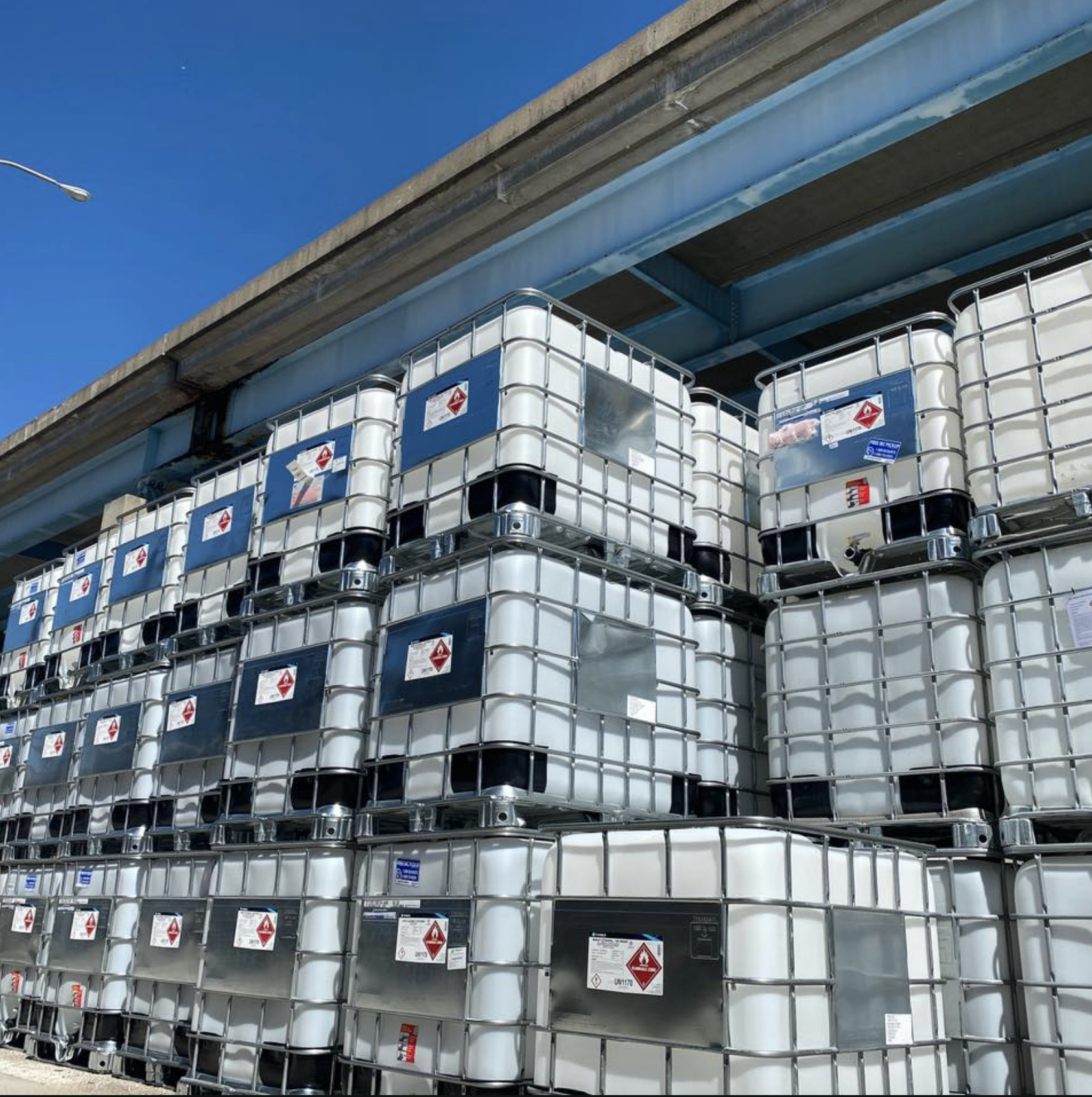
It is impossible to see some all the factors from this photo, but what we can see we need to discuss.
Let’s use the most basic of flammable liquids standards in our discussion – 1910.106, specifically 1910.106(d)(6) “Storage outside buildings”.
The Intermediate Bulk Containers (IBC) we see in the photo are 275-gallon containers, which means the business has acquired 191 of these containers with ethanol in them. We can also see that all of the containers visible in the picture are blow-molded plastic containers in a metal cage. Although commonly used for alcohol, this type of “tote” is the most dangerous type for a flammable liquid. From NFPA’s IBC Flammable Liquids Fact Sheet:
When composite IBCs containing combustible or flammable liquids are stored together in warehouses or other facilities, they can cause dangerous pool fires. These fire hazards have two components:
1. Release of combustible and flammable liquids. When IBCs containing flammable or combustible liquids fail, they can release a large pool of these liquids. If ignited, the extreme heat release rates can overtax most fire sprinkler systems. This hazard exists regardless of how the IBC is constructed.
2. Composite IBCs can be easily breached and then the IBC itself contributes to the fire hazard. Composite IBCs can be easily breached by exposure to even a small fire. Additionally, once the unit is emptied, the composite may ignite and contribute to the liquid pool. Pool fires caused by composite IBCs can be catastrophic events and are capable of destroying the building where the event occurs. A spreading pool fire can also threaten adjacent buildings.
But how are we to store this large inventory of a Category 2 (Class IB) flammable liquid outdoors? Here are the OSHA minimums…
| 1910.106(d)(6)(i) “General.” Storage outside buildings shall be in accordance with Table H-16 or H-17, and subdivisions (ii) and (iv) of this subparagraph.
TABLE H-16 – OUTDOOR CONTAINER STORAGE
TABLE H-17 – OUTDOOR PORTABLE TANK STORAGE
|
||||||||||||||||||||||||||||||||||||||||||||||||||||||||||||||||||||||
Using Table H-16 we look at CAT 2 flammable liquids in CONTAINERS (e.g. SMALLER than 60-gallons, such as a 55-gallon drum) and we see that the Maximum per pile is 2,200 gallons (yellow circle below). When our drums are 55-gallon containers with four (4) drums per pallet (e.g. , this translates to no more than ten (10) pallets per “pile”.
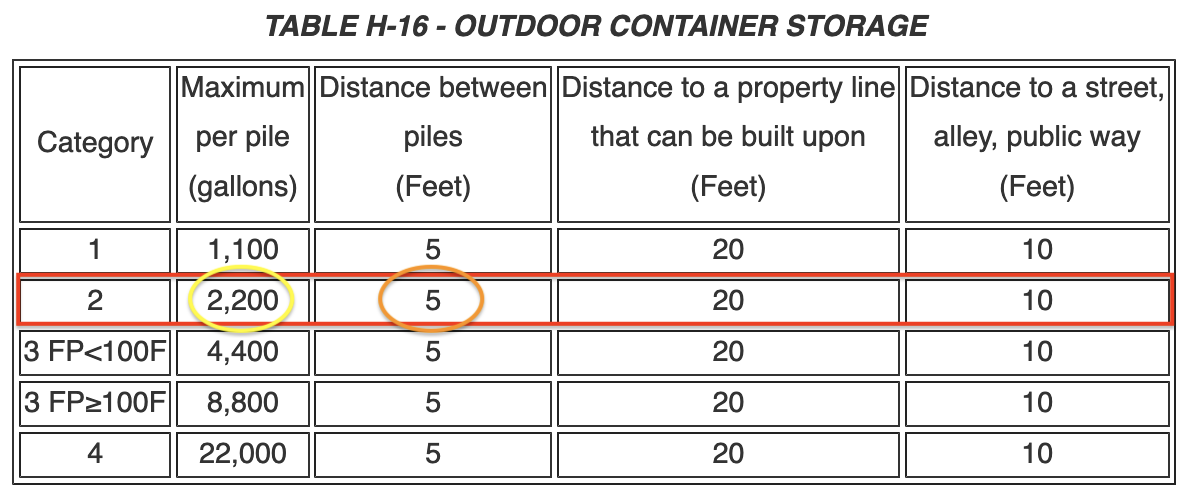
And between each “pile” we have to have a separation of 5′ all around EACH “pile” (orange circle above).
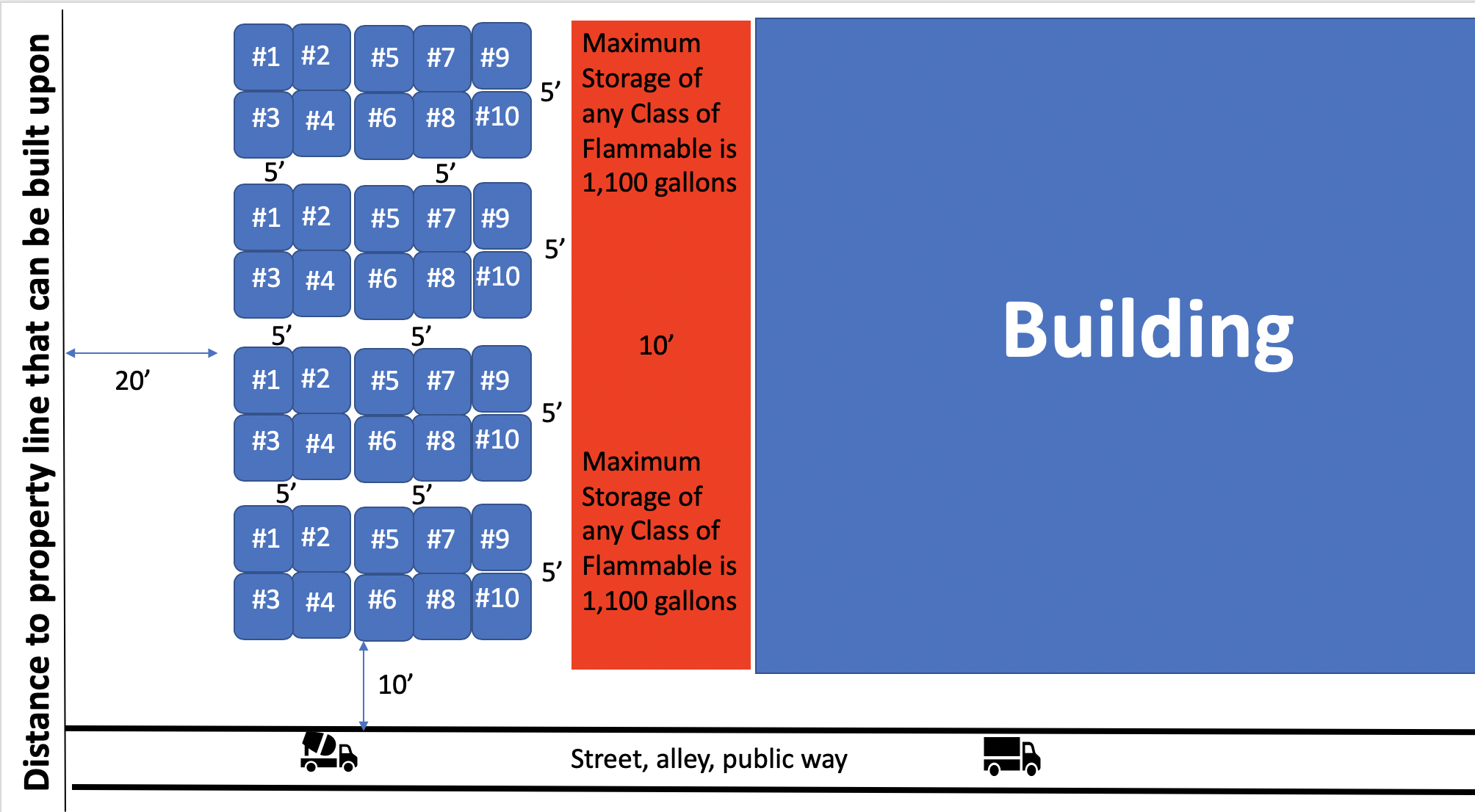
Here is an image I created showing these container piles and their spacing requirements.
We then get to another requirement… (emphasis by me)
|
1910.106(d)(6)(ii) “Maximum storage.”
A MAXIMUM OF 1,100 GALLONS of flammable liquids may be located adjacent to buildings located on the same premises and under the same management provided the provisions of subdivisions (a) and (b) of this subdivision are complied with.
1910.106(d)(6)(ii)(a) [Reserved]
1910.106(d)(6)(ii)(b) Where quantity stored exceeds 1,100 gallons, or provisions of subdivision (a) of this subdivision cannot be met, a MINIMUM DISTANCE of 10 feet between buildings and nearest container of flammable liquid shall be maintained.
|
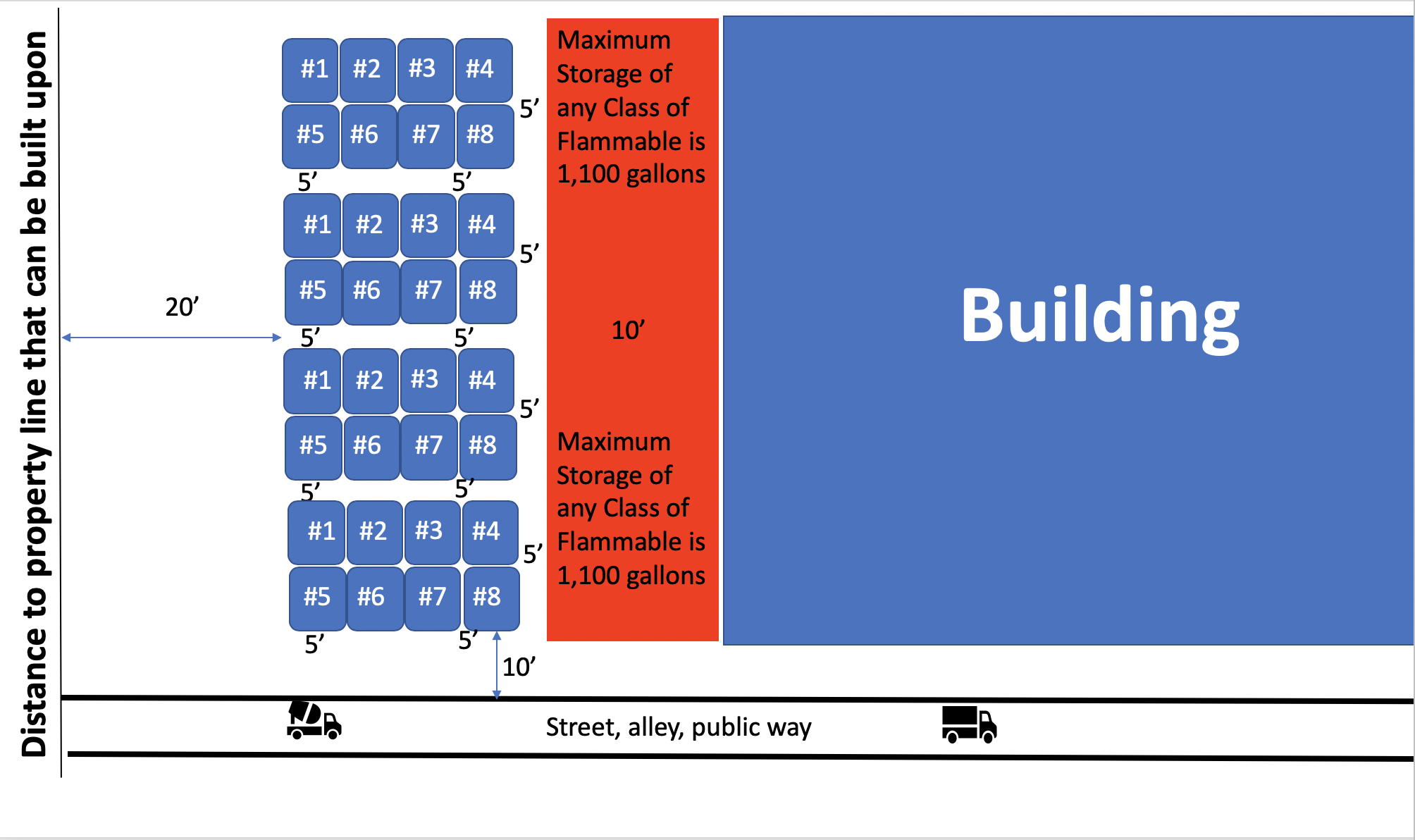
So this maximum storage is for those businesses where they are limited in their outdoor storage area. The idea is that the storage limits in Table H-16 are AWAY from buildings, but when there is limited outside space, OSHA limits the amount of flammable liquids, ALL Categories, that can be stored within 10′ of the building. So we can view this 10′ area next to the building(s) as a “LIMITED STORAGE AREA” with what I always called a “staging area” for totes that were waiting to be used inside the building, but this area can have NO MORE than four (4) of these 275-gallon totes.
Next we get into our secondary containment needs. This is a critical layer of protection for flammable liquids, as the surface area of a spill makes a HUGE difference. OSHA requires…
| 1910.106(d)(6)(iii) “Spill containment.” The storage area shall be graded in a manner to divert possible spills away from buildings or other exposures or shall be surrounded by a curb at least 6 inches high. When curbs are used, provisions shall be made for draining of accumulations of ground or rain water or spills of flammable liquids. Drains shall terminate at a safe location and shall be accessible to operation under fire conditions. |
We can not see from the picture if the area is diked/bermed/curbed or the direction of slope, if the area is even sloped at all.
| 1910.106(d)(6)(iv) “Security.” The storage area shall be protected against tampering or trespassers where necessary and shall be kept free of weeds, debris and other combustible material not necessary to the storage. |
We can not see if the storage area is protected against tampering or trespassers. The area we can see does appear to be free of weeds, debris and other combustible material.
Lastly, I am not sure about the structure over the storage area. I cant see if it is sprinkled or not. But with structures like this, my biggest concern is the posts that support the cover. These are oftentimes anchored inside the diked/bermed/curbed area and this poses a serious risk of collapse in a pool fire scenario. They can be located in the diked/bermed/curbed area but should be elevated by a concrete base and/or fire-proofed to protect it during the fire. A collapse of the roof onto these totes would/could cause much more flammable liquid to feed the pool fire AND it would block all fire fighting water/foam from reaching the seat of the fire. And if the area is sprinkled, the collapse would render the sprinkler useless.
Here is my graphic showing how Table H-16 for Category 2 Flammable Liquids would look like. We can DOUBLE STACK our drums as long as they are designed to be stacked! But we can have ten (10) pallets with four (4) drums on each pallet with a 5′ separation between each pile. I did not show any pallets in the RED section below but remember, we can have only twenty (20) drums (or 5 pallets with 4 drums) in the RED section at any given time. I also want to point out that the building wall is a “blank wall” with NO openings.
If we have “totes” of CAT 2 Flammable Liquids then we would use TABLE H-17 – OUTDOOR PORTABLE TANK STORAGE. Here is the highlighted table:
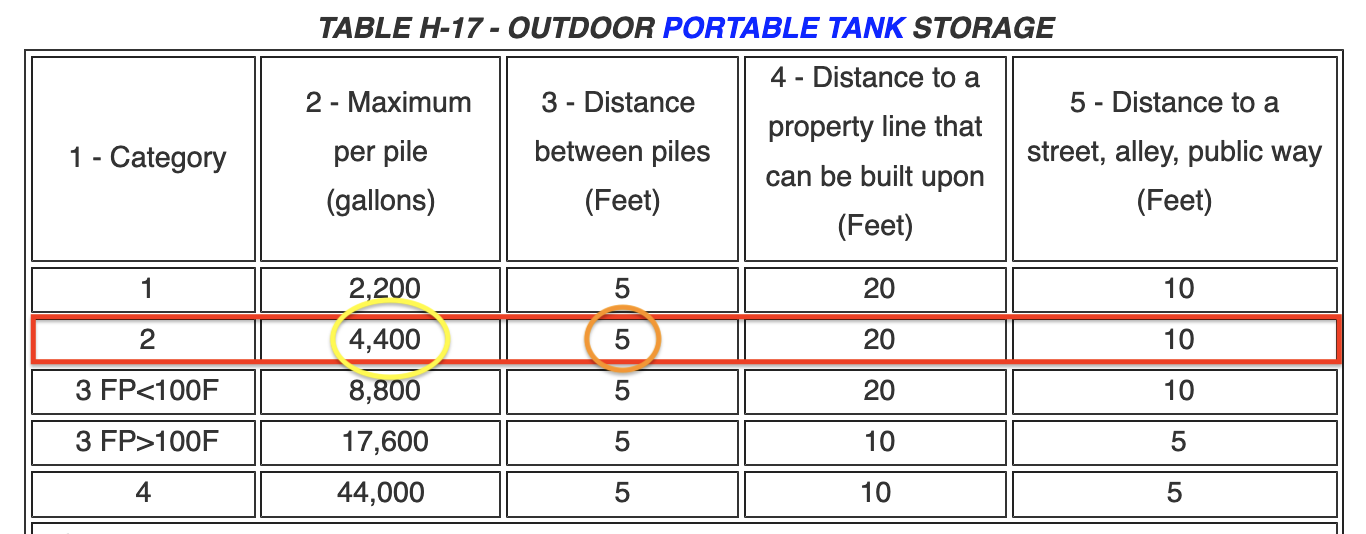
Here is my graphic showing how Table H-17 for Category 2 Flammable Liquids would look like. We can have 4,400 gallons of CAT 2 Flammable Liquid per “pile”. We can DOUBLE STACK our totes (as depicted below) as long as they are designed to be stacked!
But we can have sixteen (16) 275-gallon totes in a pile with a 5′ separation between each pile. I did not show any totes in the RED section below but remember, we can have only four (4) 275-gallon totes in the RED section at any given time. I also want to point out that the building wall is a “blank wall” with NO openings.