
This is a tale of Valve Handle Positions and the assumption the valve was CLOSED based on the position the handle was found in. No Lockout/Tagout and NO VERIFICATION of a Zero Energy State (ZES) before the NG pipe was disassembled. I am not sure why the NTSB makes no mention of “Energy Control” (e.g. Lockout/Tagout) in this accident report, but it was clear a needed administrative control for the scope of work. OSHA did cite the contractor for lack of LOTO and training issues, but no mention in the NTSB report.
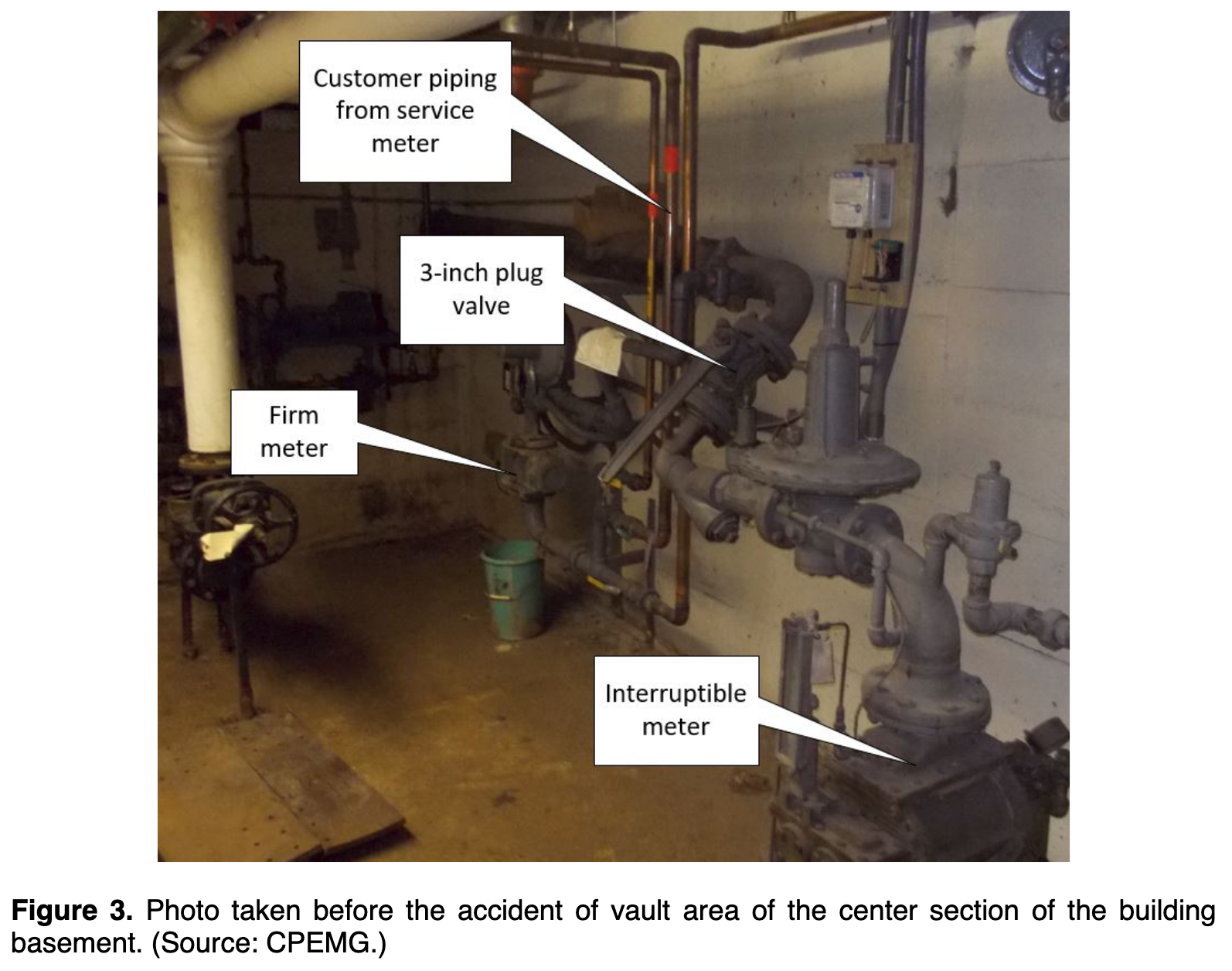
Natural gas service to the school could be shut off using the manually operated customer service valve (also known as a curb valve or fire valve), which was located in an underground valve box (also known as a curb box). Beyond the curb valve, the natural gas supply line penetrated the utility bunker wall and branched to supply gas to the firm and interruptible meters. The branch to the interruptible meter passed through a manually operated plug valve (involved in the accident). The end of the plug is square, for attachment of a handle having a compatibly sized opening to accommodate the square stub on the plug. The handle can be attached in any of four (4) different orientations. The square hole of the handle was also equipped with a setscrew to lock the handle in place. The plug in the valve turns 90 degrees; in one orientation, a passage through the plug aligns with the attached piping and gas can flow; when turned 90 degrees, to achieve the CLOSED position, the passage is perpendicular to the attached piping and gas cannot flow.
On August 2, 2017, at 10:22 a.m., local time, a building on the north campus of a private school in Minneapolis, Minnesota, was destroyed by a natural gas explosion. Figure 1 shows an aerial view of the north campus prior to the accident, with a yellow arrow pointing toward the explosion site. Figure 2 is a photograph of the accident site taken after the building explosion, with emergency responders and gas company personnel on scene. At the time of the explosion, two workers were installing piping to support the relocation of gas meters from the basement of the building to the outside. Two new meters mounted on an exterior wall were ready for the piping to be connected. WHILE WORKERS WERE REMOVING THE EXISTING PIPING, A FULL-FLOW NATURAL GAS LINE AT PRESSURE WAS OPENED. The workers were unable to control the release of the gas; thus, they evacuated the building and warned others to evacuate. The explosion occurred during their evacuation. Two individuals were killed, and nine others were injured.
The National Transportation Safety Board determines that the probable cause of the natural gas explosion was the DISASSEMBLING OF PIPING UPSTREAM OF A GAS SERVICE METER IN THE BUILDING BY A PIPEFITTING CREW, RESULTING IN THE RELEASE OF NATURAL GAS, WHICH SUBSEQUENTLY IGNITED. Contributing to the accident was the lack of detailed documentation that clearly established the scope of work to be performed.
On the day of the accident, the field foreman and construction helper were at the job site to perform the piping relocation work. CenterPoint Energy Minnesota Gas (CPEMG) did not have any employees at the job site at the time of the explosion; the closest CPEMG employee was a block away in a company vehicle awaiting the arrival of a construction vehicle that was en route to the job site.
NTSB interview statements by the two MMI employees indicated that, prior to the explosion, they had encountered a plug valve that was connected to and located immediately prior to the interruptible meter in which the wrench was “stuck” in the CLOSED position (that is, the wrench could not be turned). The construction helper stated that he knew the valve was closed because the wrench was positioned perpendicular to the valve piping (the inlet/outlet connection ports of the valve). The field foreman also stated that he had determined that the plug valve was CLOSED and that it was safe for the construction helper to begin dissembling piping downstream of the valve. Based on NTSB interviews, upon instruction from the field foreman, the construction helper, working alone in the utility bunker, was then assigned to disconnect the piping from the interruptible gas service meter.
A school maintenance worker located on a floor above the basement heard a “horrendous flow of air,” and he immediately went to investigate the strong odor of natural gas and the loud noise coming from the basement. As he exited the basement, he made an announcement over his handheld radio that there was gas in the building and to evacuate immediately. As he made his radio announcement, he ran up the stairs and searched for occupants. Less than 1 minute later, the building exploded.
The on-scene examination by the NTSB of the plug valve, which the two on-site contractor employees had identified as having been “stuck” in the closed position, showed that the valve wrench was positioned perpendicular to the piping. Disassembly of the valve components showed that the internal “flow control” component of the valve (the valve plug) was in the OPEN position. The investigators were unable to determine how the valve wrench became positioned in that perpendicular orientation because of pre-accident photographs, provided by CPEMG and taken about 1.5 years prior to the accident, showed the WRENCH POSITIONED PARALLEL TO THE PIPING, thus indicating the valve was OPEN. It is customary to align the handle so that it is parallel with the piping when the valve is open and positioning the handle perpendicular to the piping when the valve is closed. However, CONFIRMATION OF THIS IS THE RESPONSIBILITY OF THE CREW WORKING ON THE PIPING. This confirmation would entail removal of the handle and noting the position of plug assembly and viewing the indicator or witness mark on the body of the valve.
Briefly summarized, the NTSB Materials Laboratory report indicated:
(1) the valve wrench was found oriented perpendicular to the valve body,
(2) the valve plug was oriented in the open position,
(3) “witness marks” were found on two surfaces of the valve stem that were consistent with contact by a valve wrench set screw,
(4) the valve stem collar had embossed arrows indicating the state of the valve (open or closed), in which the arrows were oriented parallel to the direction of flow, which was consistent with the valve being OPEN, and
(5) measurements of 344 and then 152 foot-pounds of torque were required to rotate the valve wrench (handle) of an exemplar plug valve, which compared to a measurement of 721 foot-pounds of torque that was applied to the wrench (handle) of the accident plug valve that had been exposed to the fire and had a 4-foot extension attached to the wrench (for additional leverage), in which no rotation was achieved.
CLICK HERE for the full NTSB report.