
These two terms are often discussed on OSHA outreach training courses, but I hardly ever mention them as they are more “legal” terms than safety terms. But this month, MI-OSHA issued guidance to their CSHO’s which I thought did a really nice job explaining what these terms mean and how they are used in issuing citations.
Vertical Standards – Standards that apply to a particular industry or to particular operations, practices, conditions, processes, means, methods, equipment or installations.
Horizontal Standards – Other (more general) standards applicable to multiple industries.
Identification of a Standard as Vertical
The safety officer/industrial hygienist (SO/IH) or consultant shall first determine whether the standard being considered for citing is a vertical standard. Below are examples of types of vertical standards.
A. Examples of industry-based vertical standards include:
1.General Industry Safety Standard Part 50, Telecommunications
2.General Industry Safety and Health Standard, Part 94, Textiles
3. Construction Safety Standards
a) Masonry Wall Bracing
b) Steel Erection
B. Examples of operation-based vertical standards include:
1. General Industry Safety Standard Part 71, Laundry and Dry-Cleaning Machinery and Operations
2. Occupational Health Standards
a) Coke Oven Emissions
b) Agricultural Operations
c) Diving Operations
d) Dipping and Coating Operations
3. Construction Safety Standards
a) Excavation, Trenching and Shoring
b) Concrete Construction
C. Examples of condition-based vertical standards include:
1.Occupational Health Standards for General Industry
a) Lead in General Industry
b) Chromium (VI) in General Industry
c) Bloodborne Infectious Diseases
2. Occupational Health Standards for Construction
a) Asbestos for Construction
b) Lead Exposure in Construction
D. Examples of equipment-based vertical standards include:
1. General Industry Safety Standards
a) Overhead and Gantry Cranes
b) Tractors
c) Metalworking Machinery
d) Woodworking Machinery
e) Helicopters
2. Construction Safety Standards
a) Crane and Derricks
b) Scaffolds and Scaffold Platforms
c) Tar Kettles
E. Examples of installation-based vertical standards include:
1. General Industry Safety Standards
a) Fixed Ladders
b) Design Safety Standards for Electrical Systems
2. Construction Safety Standard, Electrical Installation
The priority of Standards
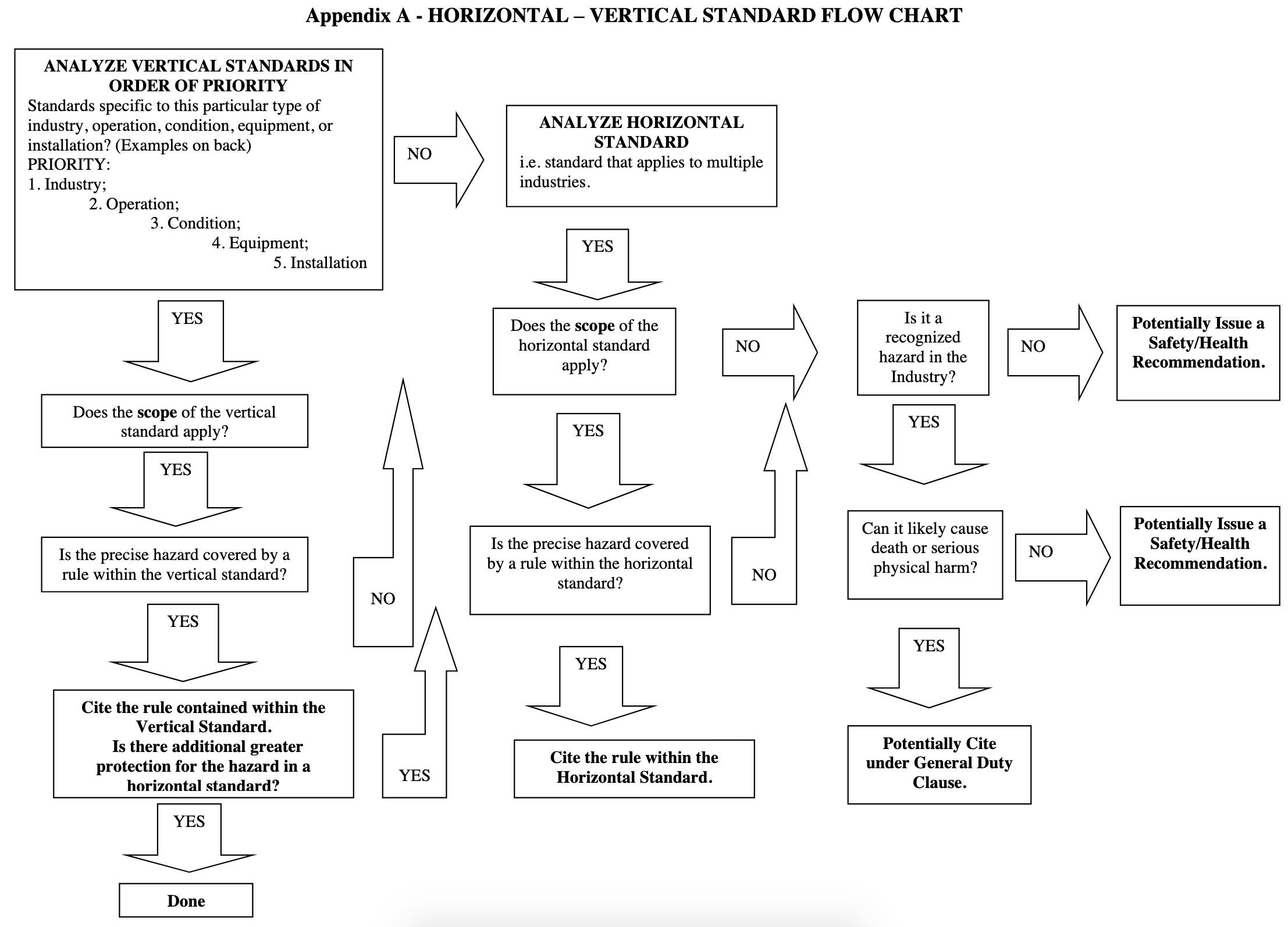
The following general guidelines apply and in addition refer to the Horizontal-Vertical Standard Flow Chart contained in Appendix A. For quick reference in the field, refer to Appendix B, Definitions and Guidelines. The supervisor may also be consulted.
A. Vertical Standard takes Precedence
When a hazard is covered by both a vertical and a horizontal standard, the vertical standard shall take precedence even if the horizontal standard is more stringent.
B.When Horizontal Standard is More Specific than Vertical
When a hazard is covered by both a horizontal (general) and vertical (specific) standard where the horizontal standard appears to offer greater protection, the horizontal (general) standard may be cited only if its requirements are not inconsistent or in conflict with the requirements of the vertical (specific) standard. To determine whether there is a conflict or inconsistency between the standards, an analysis of the intent of the two standards must be performed. For the horizontal standards to apply, the analysis must show either:
1. That the vertical standard does not address the precise hazard involved, even though it may address related or similar hazards;
OR
2. That the horizontal standard provides additional protection or correction for the hazard that is not required in the vertical standard but is still necessary to fully protect employees from the hazard.
C. Two Applicable Vertical Standards
Industry vertical standards take precedence over equipment standards. For example, if a swing saw is being used in a sawmill, the more specific vertical standard for sawmills (Part 52) takes precedence rather than the vertical standard for woodworking machinery (Part 27).
D. Nature of Activity vs. Nature of General Business
When determining whether a vertical or horizontal standard is applicable to a work situation, the SO/IH or consultant shall focus attention on the activity in which the employer is engaged at the establishment or worksite being inspected rather than the nature of the employer’s general business.
E.Requirements to Comply with Another Rule/Standard
When a rule in a vertical standard requires compliance with a rule contained in another horizontal or vertical standard, the citation shall be of the vertical standard with a reference to the external rule deficiencies.
Example: Rule 7436 of GI Part 74, Fire Fighting, requires an employer to have a written respiratory protection program that complies with OH Part 451, Respiratory Protection. If the inspection of a fire station reflects deficiencies with the written respiratory protection program, a violation of Part 74 should be cited with reference to the requirements specified in OH Part 451.
Appendix B–DEFINITIONS AND GUIDELINES
Definition of Vertical and Horizontal Standards.
A. Vertical standards are those standards which apply to a particular industry or to particular operations, practices, conditions, processes, means, methods, equipment or installations. There are two types of vertical standards:
1.Standards that apply to particular industries or sub-industries (Laundries, sawmills, pulp & paper), and
2. Standards that state more detailed requirements for certain types of operations, equipment, equipment usage, conditions, or installations, than are stated in another more general standard; e.g., woodworking machinery.
Some key examples of the two different vertical standards include:
1. Industry – A specific branch of manufacturing or trade; e.g., the textile industry. Examples: GI Parts 50, R 3403, R 3406 and CS Part 2, 262.
2. Operation – A process or series of acts involved in a particular form of work; e.g., automotive service operations. Examples: GI Parts 71, 314, 501, 504, 526 and CS Parts 9, 253.
3. Condition – A particular mode of being of a person or thing; existing state; the situation with respect to circumstances; e.g. bloodborne infectious diseases. Examples: GI Parts 310, 315, and CS Parts 602, 6034.
4. Equipment–Anything kept, furnished, or provided for a specific purpose; e.g., lifting and digging. Examples: GI Parts 18, 22, 26, 27, 59 and CS Parts 12, 245.
5. Installation–Something installed, as machinery or apparatus placed in position or connected for use; e.g., fixed ladders. Examples: GI Parts 39 and CS Part 17
B. Horizontal standards are other (more general) standards applicable to multiple industries; e.g., general provisions. Examples: GI Parts 1, 2 and CS Parts 1 and 21.
Deciding Which Standard to Cite.
If an SO/IH or consultant is uncertain whether to cite under a horizontal or a vertical standard when both apply, the Horizontal/Vertical Standard flow chart and/or the Supervisor should be consulted. The following general guidelines apply:
A. Vertical Standard Takes Precedence.
When a hazard is covered by both a vertical and a horizontal standard, the vertical standard shall take precedence even if the horizontal standard is more stringent.
B. When Horizontal Standard is More Specific Than Vertical.
In situations covered by both a horizontal (general) and vertical (specific) standard where the horizontal standard appears to offer greater protection, the horizontal (general) standard may be cited only if its requirements are not inconsistent or in conflict with the requirements of the vertical (specific) standard. To determine whether there is a conflict or inconsistency between the standards, an analysis of the intent of the two standards must be performed. For the horizontal standards to apply, the analysis must show that the vertical standard does not address the precise hazard involved, even though it may address related or similar hazards.
C.Two Applicable Vertical Standards.
Industry vertical standards take precedence over equipment standards. Thus if a swing saw is being used in a sawmill, the more specific vertical standard for sawmills (Part 52) takes precedence rather than the vertical standard for woodworking machinery (Part 27).
D.Nature of Activity vs. Nature of General Business.
When determining whether a vertical or horizontal standard is applicable to a work situation, the SO/IH shall focus attention on the activity in which the employer is engaged at the establishment or worksite being inspected rather than the nature of the employer’s general business.
CLICK HERE for the MI OSHA Guidance Document