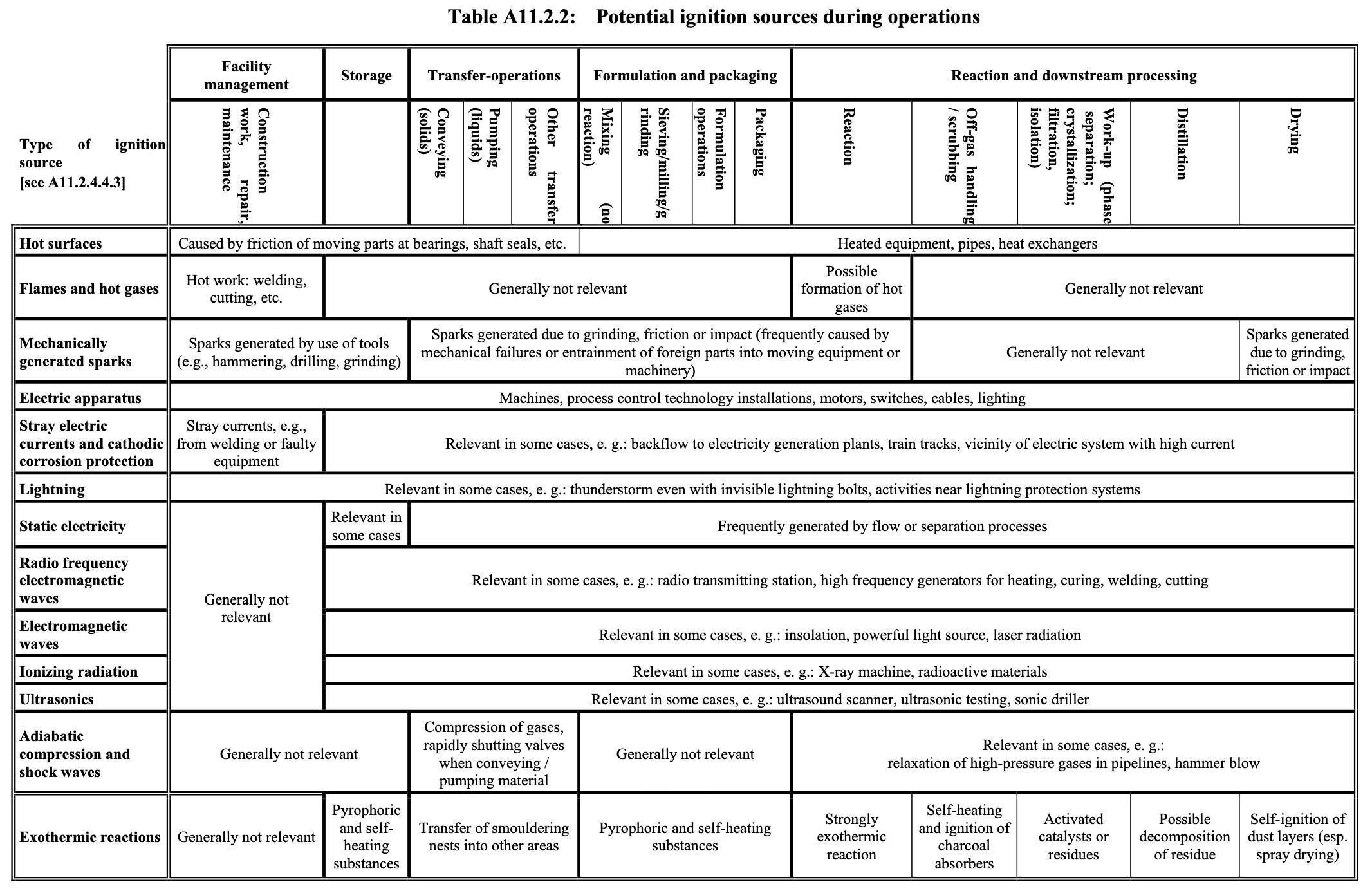
In the most recent revision of the Globally Harmonized System of Classification and Labelling of Chemicals (GHS), they list some very interesting potential ignition sources for dust explosions; several I have never ever even considered being an ignition source. Check these out…
A11.2.4.4.3 Potential sources of ignition include:
(a) Hot surfaces;
(b) Flames and hot gases;
(c) Mechanically generated sparks;
(d) Electric apparatus;
(e) Stray electric currents and cathodic corrosion protection;
(f) Lightning;
(g) Static electricity;
(h) Radiofrequency electromagnetic waves (104 Hz – 3×10¹² Hz) ;
(i) Electromagnetic waves (3×10¹¹ Hz – 3×10¹⁵ Hz);
(j) Ionizing radiation;
(k) Ultrasonics;
(l) Adiabatic compression and shock waves;
(m) Exothermic reactions, including self-ignition of dust, smoldering/glowing particles or dust, and thermite reactions (e.g., between aluminum and rusty steel).
Source: https://www.unece.org/fileadmin/DAM/trans/danger/publi/ghs/ghs_rev08/ST-SG-AC10-30-Rev8e.pdf
The assessment of ignition sources is a two-step procedure:
First, possible ignition sources are identified.
In the second step, each possible ignition source is assessed with respect to its ability to ignite the explosive atmosphere.
The ignition sources identified as effective in this procedure then require appropriate preventive measures within the explosion protection concept (see A11.2.6.1).