
 PSM/RMP covered processes that operate above 15 psi will have relief valves to protect pressure containing components such as vessels, piping, pumps, compressors, etc. It is standard practice that these relief valves get changed out at least every five (5) years or so; please follow your RAGAGEP and/or the RV manufacturer instructions for specific change/test schedules. But whenever we change these valves, we are in fact “opening the process” which means we have broken the pressure containment. When the new valves go on, it is necessary to pressure test the pressure containment once again. Of course, we MUST follow our RAGAGEP and/or the RV manufacturer instructions for installation of their RVs, but we also need to pressure test/leak test the installation of the new valves and this pressure test/leak test MUST be done properly. Here is what can happen when this is not done by the book. Please note that R-134a is a very low hazard refrigerant, but what if this incident occurred with a HHC/EHS?
On April 30, 2019, the service providers replaced two safety valves on a chiller as part of the plant’s preventative maintenance program.
On May 9, 2019, the service provider returned to this site to perform an unrelated servicing and noticed that the chiller refrigerant circuit had low operating pressure.
A leak detection test was initialed and the leak was traced to the safety valves that were previously replaced. These two safety valves were replaced and the system recharged with 35 pounds of R134a refrigerant to restore the system charge to a total charge of 120 pounds.
Investigation Conclusions
Site, system, and components
This machine room consists of a skid mounted double direct system supplying chilled water to the building cooling system.
The refrigerant used in this chiller unit does not leave the refrigeration machinery room. The chilled water is produced by expanding liquid refrigerant R-134a into a plate heat exchanger called an evaporator, the refrigerant absorbs heat from the chilled water side of the plate heat exchanger which is cooled to approximately 5º C. Water is pumped into the building chilled water piping system. The chilled water circulates between the building cooling radiators, picks up the heat by cooling the occupied space ai then the warmer water flows back to the chiller unit where this cycle is repeated.
Failure scenario(s)
During a preventative maintenance cycle for this chiller unit, the refrigerant side safety valves were replaced by the service providers on April 30th, 2019.
The service providers returned to this site on May 9th for unrelated service activities and noticed that one of the two refrigeration circuits was low in refrigeration gas pressure. The technician did a leak check and found both of the newly replaced safety valves were leaking.
Facts and evidence
- April 30, 2019, the service providers replaced two safety valves on this chiller as part of the plant’s preventative maintenance program.
- On May 9th, 2019 the service provider returned to this site to perform an unrelated repair and noticed that the chiller refrigerant circuit #2 had low gas operating pressure.
- Gas loss was traced to leaking safety valves recently replaced during a scheduled maintenance cycle.
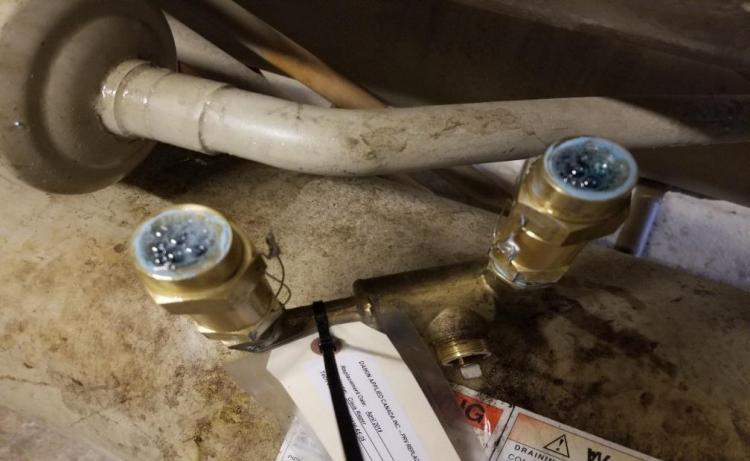
- The newly installed safety valves were found leaking, and as they were the only pressure-side that was touched these are the most likely point of leakage. This was proven by the technician doing a bubble test of the two valves (see photo)
- The leaking valves were removed from service and the chiller left shut-down and out of service, waiting for approval of the new valves.
- The service provider removed these valves and shipped them back to the chiller manufacturer, this was done without the Owners approval, nor was the local BSO given the opportunity to visually inspect these valves, their condition is left to the services providers recollection.
- Report from original value manufacture inclusive in findings
- Testing form submitted by service contractor documents leak test performed at 100 PSI
Causes and contributing factors
It is likely that when the safety valves were replaced during the routine maintenance by the service provider if a leak test was performed at 250 PSI this could have eliminated the loss of refrigerant in the machine room.
Only tested to 100 PSI the set pressure is 350 PSI