
Anyone who follows my ramblings knows that I am a big fan of bollards. I have written about them and shared dozens of incidents where a properly designed and installed bollard saves the day and more often than not I am sharing incidents with “fake” bollards where something was destroyed because the bollard was IMPROPERLY designed and installed. Last Friday we had another bollard failure incident and this time it was a doosey! A semi-truck at a gas station turned too sharply and wiped out a fueling island and started a “little fire” (sarcasm). The problem with the island’s vehicle protection device was that is was TOO SHORT and this allowed the trailer to pass over it and take out the island fuel pumps causing a fuel spill and fire. But the type of bollard involved in this incident has become more and more common over the years and for the life of me I am not sure why code officials accept them; as they are NOT an equivalent alternative to the bollard design. Here is me near my home showing how these railings are NOT filled with concrete either…
I won’t bore you with the bollard design again, anyone can find the dozens of posts I have put up regarding their design and location requirements; but these little posts are just a sad attempt at trying to meet the fire code. So just what does the code require for vehicle protection at the fueling island?
2306.7.3 Mounting of dispensers.
Dispensing devices, except those installed on top of a protected above-ground tank that qualifies as vehicle-impact resistant, shall be protected against physical damage by mounting on a concrete island 6 inches (152 mm) or more in height, or shall be protected in accordance with Section 312. Dispensing devices shall be installed and securely fastened to their mounting surface in accordance with the dispenser manufacturer’s instructions. Dispensing devices installed indoors shall be located in an approved position where they cannot be struck by an out-of-control vehicle descending a ramp or other slope.
2306.7.3.1 Additional impact protection.
The fire code official is authorized to require additional impact protection in accordance with Section 312 where dispensing devices are located in areas near parking areas, multiple dispensing devices, highway on- and off-ramps, and other areas where there is a higher potential for vehicle impacts.
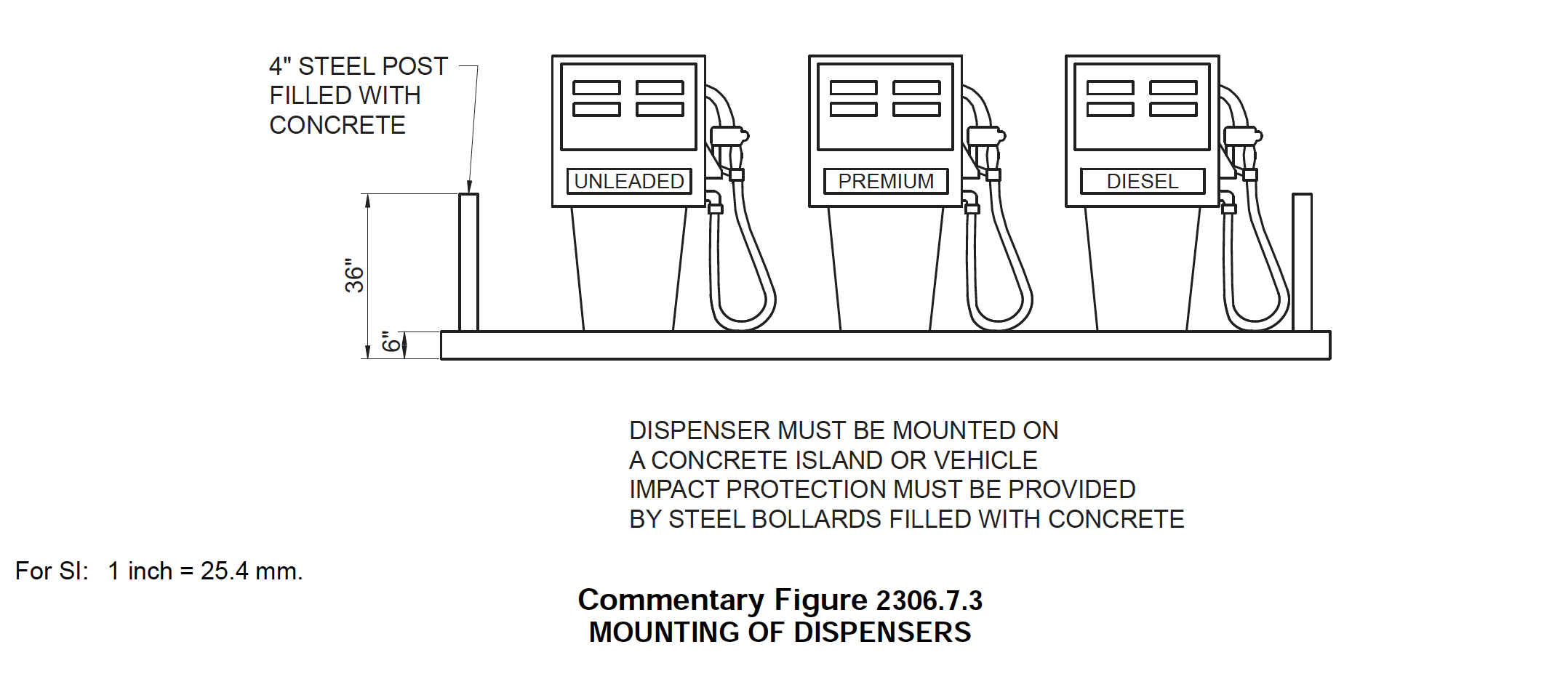
So as we can see, the primary means of protection of the pumps is by putting them on a 6″ raised surface. But this protection means provides protection for a parallel
vehicle impact and pushes the tire away prior to impact. It does not protect against a perpendicular or angled vehicle impact to the island-type dispenser. For this, we need the bollards at the end of the islands to prevent drivers from backing into the pumps or a driver misjudging as the position their vehicle. And from Friday’s incident, from a driver cutting their turn too sharp and taking out the fuel dispensers.

Source: Kyle Hansen and KCCI