As promised, this is my follow-up to my previous posts regarding Ammonia Refrigeration Evaporative Condensers and the fact that they are Permit-Required Confined Spaces (PRCS). In this article, I will explain the options we have to enter these spaces and what all goes into each entry option.
Before we get into each entry option, it would be helpful to explain that two (2) of the options, .1910.146 (c)(5) and (c)(7), have grown in popularity in recent years – primarily from OSHA issuing large citations to employers for failure to manage the rescue requirements for their permit-entries. These two (2) entry options, when applied PROPERLY and EXECUTED FLAWLESSLY, eliminate the requirement for any type of rescue needs (both non-entry and entry-style rescue), and if there is one major failure across the board, it is the rescue requirements found in 1910.146(k). We will discuss these rescue requirements in our final article, but in my 30 years, I can count the number of facilities fully meeting the rescue requirements on my two hands! So let’s discuss the three (3) options:
For some reason, a lot of safety personnel believe that (c)(5) and (c)(7) are “shortcuts” and do not allow them in their programs. Yet, the program and practices at the facility failed to meet the rescue requirements for their entries when trying to meet OSHA minimums for permitted entries. I have become a proponent of (c)(7) over the years because so many facilities fail miserably with their attempts to comply with 1910.146(k) Rescue and emergency services. So the idea with the (c)(7) entry method is that we take the time up-front to ELIMINATE the hazards, which makes the Confined Space a Permit-Required Confined Space (PRCS). And by ELIMINATING those hazards, we can “reclassify” our PRCS to a non-Permit-Required Confined Space while those means used to ELIMINATE the hazards are in place. By doing this reclassification, OSHA allows us to lower our protections, and thus paragraphs (d) through (f) and (h) through (k) of the standard no longer are required for entry into this reclassified space. By the way, paragraph (g) is the training requirements and it still applies!
So let’s discuss our three (3) entry options:
Option #1 – 1910.146(c)(5) Alternative Entry Method
1910.146(c)(5) An employer may use the alternate procedures specified in paragraph (c)(5)(ii) of this section for entering a permit space under the conditions set forth in paragraph (c)(5)(i) of this section.
1910.146(c)(5)(i) An employer whose employees enter a permit space need not comply with paragraphs (d) through (f) and (h) through (k) of this section, provided that:
1910.146(c)(5)(i)(A) The employer can demonstrate that the only hazard posed by the permit space is an actual or potential hazardous atmosphere;
1910.146(c)(5)(i)(B) The employer can demonstrate that continuous forced air ventilation alone is sufficient to maintain that permit space safe for entry;
1910.146(c)(5)(i)(C) The employer develops monitoring and inspection data that supports the demonstrations required by paragraphs (c)(5)(i)(A) and (c)(5)(i)(B) of this section;
1910.146(c)(5)(i)(D) If an initial entry of the permit space is necessary to obtain the data required by paragraph (c)(5)(i)(C) of this section, the entry is performed in compliance with paragraphs (d) through (k) of this section;
1910.146(c)(5)(i)(E) The determinations and supporting data required by paragraphs (c)(5)(i)(A), (c)(5)(i)(B), and (c)(5)(i)(C) of this section are documented by the employer and are made available to each employee who enters the permit space under the terms of paragraph (c)(5) of this section or to that employee's authorized representative; and
1910.146(c)(5)(i)(F) Entry into the permit space under the terms of paragraph (c)(5)(i) of this section is performed in accordance with the requirements of paragraph (c)(5)(ii) of this section.
NOTE: See paragraph (c)(7) of this section for reclassification of a permit space after all hazards within the space have been eliminated.
This option has some serious limitations and will rarely be available for most PRCSs in an industrial facility. This entry option is a carry-over from the Telecommunications 1910.268, specifically 1910.268(o)(2), and in my professional opinion, it has no place in 1910.146; but since it was already an accepted practice for entering “manholes and unvented vaults” in the telecommunications industry, it was included as an entry option for 1910.146. I’ve spent my career trying to convince anyone who would listen that this option is NOT an actual option for an industrial facility. And OSHA has made this fairly clear in its letters and directives over the years. This option is ONLY applicable to spaces where a hazardous atmosphere is the ONLY hazard that makes the space a PRCS, which, by the way, are the leading cause of deaths inside PRCSs. This means there is NOTHING that needs to be isolated and locked out to enter the space safely. In other words, no piping/hoses/ductwork is attached to the space; the space is just like an underground phone vault. So the first test for applicability is to establish that the ONLY hazard associated with the PRCS is a known or potentially hazardous atmosphere. If this is the case, then we must establish and document that the hazardous atmosphere can be CONTROLLED using forced-air ventilation.
NOTE: It is critical that we understand the difference between “CONTROLLING,” a hazard, and “ELIMINATING,” a hazard. (c)(5) is all about “CONTROLLING,” the ONLY hazard the space presents, a hazardous atmosphere.
If we use this option, we have several critical needs:
First, the personnel who are setting up the ventilation MUST FULLY UNDERSTAND the needs and limitations of the ventilation method. For example, the person setting up the ventilation would need to know the size of the space (in cubic feet) and understand the forced-air blower capacity to ensure the blower can achieve at least four (4) air exchanges each hour.
Second, the blower MUST then be set up correctly to ensure the air it is blowing into the space is from a CLEAN source and that the ventilation is NOT being short-circuited with the hazardous atmosphere exiting the space. We even need to understand where we blow the fresh air into the space and where the hazardous air is exiting the space, based on the physical properties of the gas/vapor.
In other words, the ventilation of a PRCS is about an additional 3-4 hour training class for well-trained entry supervisors. As an example of how this ventilation requirement is so misunderstood, how many have ever used this tool – or even included this tool in their written program and training?
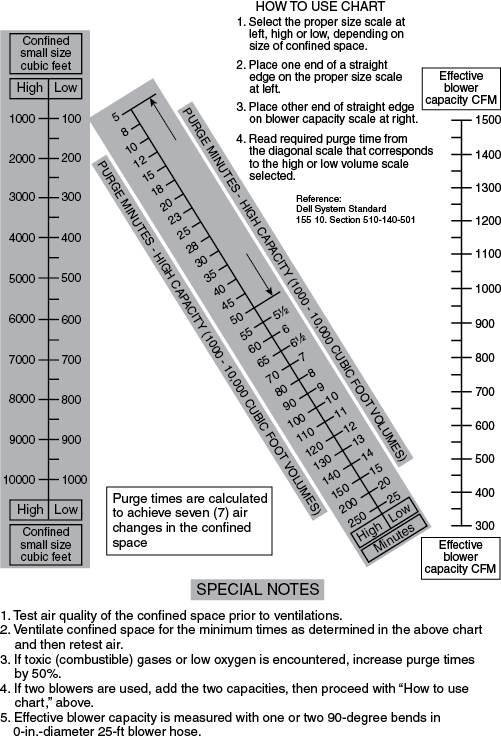
Source: NFPA 350
The last requirement when using (c)(5) is that we must DOCUMENT that our ventilation system is capable of CONTROLLING the hazardous atmosphere. Using the NFPA 350 tool above with a technical specification drawing of the space documenting the size of the space and the capacity of the blower being used is required. We must either do this each time we are in the space or, as OSHA intended, we keep this documentation on file. Remember, this PRCS is a space with NO other hazards and ONLY needs to be ventilated to CONTROL the hazardous atmosphere. Once we have completed our ventilation assessment, it should not change; the work inside the space will not impact our ventilation assessment.
PLEASE think twice before using (c)(5) as your entry method! Remember, the #1 killer inside PRCS is a hazardous atmosphere, and (c)(5) is totally dependent on merely CONTROLLING the hazardous atmosphere using forced-air ventilation.
Option #2 – 1910.146(c)(7) Reclassification to Non-Permit Required status
This option has gained immense popularity over the years and is still hotly debated within the safety profession. When APPLIED PROPERLY AND EXECUTED FLAWLESSLY, this should be our #1 choice for entry into a PRCS, as it ELIMINATES ALL THE HAZARDS that made the space a PRCS. But this entry option comes with some serious limitations as well… it cannot be used if there is a hazardous atmosphere or even the POTENTIAL for a hazardous atmosphere during the entry.
1910.146(c)(7) A space classified by the employer as a permit-required confined space may be reclassified as a non-permit confined space under the following procedures:
1910.146(c)(7)(i) If the permit space poses no actual or potential atmospheric hazards and if all hazards within the space are eliminated without entry into the space, the permit space may be reclassified as a non-permit confined space for as long as the non-atmospheric hazards remain eliminated.
One of the biggest mistakes we see with this entry option is that facilities do NOT adequately control the work taking place within the space, which generates a hazardous atmosphere (or has the potential to create a hazardous atmosphere).
Option #2 (reclassification) was intended to take a PRCS that was classified as such because it has either an engulfment hazard, configuration hazard, or a physical hazard(s) such as auger, agitators, chemical contact, etc.
This option takes more preparation time because the space has to be FULLY ISOLATED from these “eliminated” hazards. OSHA recognizes three (3) isolation methods for these hazards:
- Disconnect and misalignment
- Blinding/Blanking
- Double Block and Bleed
So how would all this work? We have a process vessel that we have classified as a PRCS, and we need to enter the space. This space does not have a known hazardous atmosphere, and the work that will take place within the space will NOT generate (or even have the potential to generate) a hazardous atmosphere. The space does have mixing blades and is ordinarily full of engulfment hazards and chemical hazards. So for us to enter this space, we have two options:
1) Reclassify the space to a non-permit status using (c)(7),
or
2) Issue a permit and meet (d)-(k) requirements
For us to use (c)(7), we must first empty the contents from the space. We may then need to flush and/or purge the space. Then, using any one of the three (3) recognized isolation methods, we will isolate every pipe, hose, and ductwork that is attached to the space to ensure that no hazard can be introduced into the space via these connections. To ensure we don’t make any mistakes, we always require EVERY SINGLE connection to be isolated; however, we did allow for some exceptions with written approval from the safety team. For example, we have a 50,000-gallon space with a ¼” potable water line attached to the bottom. We may allow this line to be isolated using single-valve isolation because if the water began to enter the space, it would not be an immediate hazard to the entrants, based on the fact that it would take 13-hours to fill the space and create an engulfment hazard and there is NO contact hazard from potable water at 60°F. Some facilities may not even isolate this water line, as they do not recognize it as a hazard; however, to meet the OSHA minimums, it does introduce an engulfment hazard, so in my professional opinion, it has to be recognized and isolated, maybe just not to the extent of using a DB&B arrangement, blinding/blanking, or disconnect & misalignment.
As you can imagine, isolating every pipe, hose, and ductwork that is attached to the space using one of the three (3) isolation methods may take some time. In fact, some spaces may take an entire day to properly isolate; keeping in mind that many of these pipes, hoses, and ductwork convey hazardous materials and thus, each one may need a “Line Break” permit to carry out the isolation means safely. This means that each one of these hazardous material pipes, hoses, and ductwork would have to have its own energy isolation plan and be locked out to get the line break permit so that the flange could be separated and the blind/blank inserted, or the hose disconnected, or the spool piece be disconnected and rolled out of alignment. PLEASE recognize that the energy isolation plan for the line breaks is TOTALLY different than what the energy isolation worksheet would say for the actual reclassification documentation. I suggest we leave the Line-Break isolation(s) in place during the entry, as we know that once the entry is done, the blinds will have to be pulled, which is another line break, and we will need that isolation to be in place.
Once we have this space fully isolated, it is then incumbent on the person performing the “reclassification” to walk down the energy isolation documentation to verify every pipe, hose, and ductwork conveying a hazard to the space has been isolated using one (1) of the approved isolation methods. Realize that physical hazards within the space, such as augers, agitators, ribbons, etc., require “simple lockout” but must be documented on our energy isolation worksheet. The person “reclassifying” this space will verify the space is at a Zero-Energy State (ZES), clean of any contact hazards, and in my world of safety, he/she will ALWAYS sample the atmosphere. Yes, you are correct in your assumption that for us to be using (c)(7), the space can not have a hazardous atmosphere or even have the potential for one; but I always try and exceed OSHA minimums, so we always check our atmosphere. With a clean atmosphere and a clean space that has been properly isolated, we now have a Non-Permit Required Confined Space.
“Non-permit confined space” means a confined space that does not contain or, with respect to atmospheric hazards, have the potential to contain any hazard capable of causing death or serious physical harm.
Because we have ELIMINATED the hazards which made this confined space a Permit-Required Confined Space, we document how we did this reclassification and post this documentation at the entry portal and explain to the entrants what we did to “reclassify the space.” This communication is CRITICAL, especially when contractors are the entrants, as many have never heard of this entry method, and they expect all the safety measures that come with a “permit-entry” to be in place. When you explain to them what was done to make the PRCS safe for entry, they will cry foul and accuse you of short-circuiting safety, when in fact, you actually made the space SAFER than if you followed the permit-entry requirements of (d)-(k).
The space will remain a Non-Permit Required Confined Space for as long as all the isolations remain in place. This means entrants can enter and exit the space as needed without an attendant in place, no atmospheric monitoring, and no rescue plan. But as soon as we remove one of the isolations or introduce a hazard into the space, the reclassification is VOIDED, and the space goes back to being a PRCS, and any entry into the space requires us to use a PRCS entry option.
For example, inside a Non-Permit Required Confined Space we can NOT do work that has the potential to create a hazardous atmosphere. Doing things such as taking a “cutting torch” into the space is STRICTLY PROHIBITED in a Non-Permit Required Confined Space as the hoses and valves can leak and create a flammable or oxygen-enriched atmosphere inside the space. We have to be very careful allowing flammable liquids to be taken into the space; as a general rule of thumb, we prohibit any flammable/combustible liquids from being used inside a Non-Permit Required Confined Space with a few exceptions. I have allowed a welding inspector to take in a “dixie cup” of acetone into a 1,000,000 gallon storage tank we had reclassified so he could clean a weld with cotton swabs. This was allowed as the quantities he was using did not have the potential to achieve a 10% LEL of acetone in such a large space. But these exceptions MUST be carefully evaluated by a competent professional and well documented on the reclassification form.
Using my 30 years of dealing with PRCS, I can say with a high degree of certainty that most of the PRCS accidents I have been involved with were due to work taking place inside them, generating a hazardous atmosphere after the permit was issued or the reclassification was complete. We MUST fully understand the scope of work to be done and the tools/supplies that will be used within the space before we can use (c)(7) reclassification as our entry method.
Option #3 – 1910.146(d) – (k) Full Permit Entry
This option is the most popular because of fear and ignorance. Many believe this is the only option for entry into their PRCSs, and those who know about (c)(5) and (c)(7) options either are afraid of them or misunderstand their application and use. But sadly, many do not understand that OSHA made this option for entry into PRCS(s) that have actually hazardous atmospheres that cannot be CONTROLLED or ELIMINATED. Some professionals outside the chemical industry may find this hard to believe, but we actually send workers into hazardous atmospheres because there is no other way to do the work, or in some cases, an oxygen-deficient atmosphere is more easily managed than an explosive atmosphere. And yes, we know that the #1 killer inside PRCSs is an Oxygen-Deficient atmosphere.
But when we have a space that does not qualify for entry options 1 or 2, we have this last option, and in reality, it should be our last option – not our first and only option. As I said earlier, the last article in this series will be all about the rescue requirements found in paragraph (k) and how difficult it is to manage, and how badly most facilities are ignorant of their efforts.
When we use the “permit entry” method, this is the “all hands on deck” option as it will entail many different people with special skill sets and training at the highest level. Entry supervisors will be just a step or two down from what a safety professional will know and understand about PRCS hazards (most notably atmospheric hazards) and energy isolation methods. The rescue team will be staffed, equipped, and trained for the style and methods of rescue necessary for the facility’s spaces.
For example:
Can the entry supervisors explain the “correction factor” for your brand(s) of the atmospheric monitor(s) they use?
Are your direct-reading instruments being calibrated per the manufacturer’s requirements?
Are your direct-reading instruments being bump-tested daily or per the manufacturer’s requirements?
Who manages your bump test and calibration gases? Using the wrong gas, or worse, a canister past its expiration date, can mislead us badly!
Can the entry supervisors explain what vapor density is and how this characteristic will cause the gas/vapor to behave?
There is just so much that can go wrong with a permitted entry that there must be many checks and balances in place to ensure a single person does not make a single mistake, as that mistake can be disastrous.
As for those who choose the use the “permit-entry” option as they feel it is the simplest and easy method, wait until the last article, where we discuss the rescue requirements. I think many will have a different perspective on issuing entry permits and a newfound love for reclassifying PRCSs to Non-Permit Required Confined Spaces.
Lastly, I would like to touch on the phrase “potential atmospheric hazards” and anhydrous ammonia in condenser coils. To be clear, the question that so many have is…
Can we reclassify a condenser to a Non-PRCS with anhydrous ammonia in the condenser coils?
We look up the definition of the word “potential,” and we see it says…
having or showing the capacity to become or develop into something in the future.
I see the ammonia in the coils (both liquid and gas) as a “potential” to create a hazardous atmosphere within the space. To ELIMINATE this “potential atmospheric hazard,” we need to REMOVE the ammonia from the coils and then isolate the coils using one of the three OSHA-recognized isolation methods.
But in contrast to my position, some argue that the coils are welded connections designed to hold the liquid/gas ammonia safely. Hence, there is no potential for a hazardous atmosphere. I could not agree any less with this risk management view, especially when dealing with an Extremely Hazardous Substance (EHS) such as Ammonia.
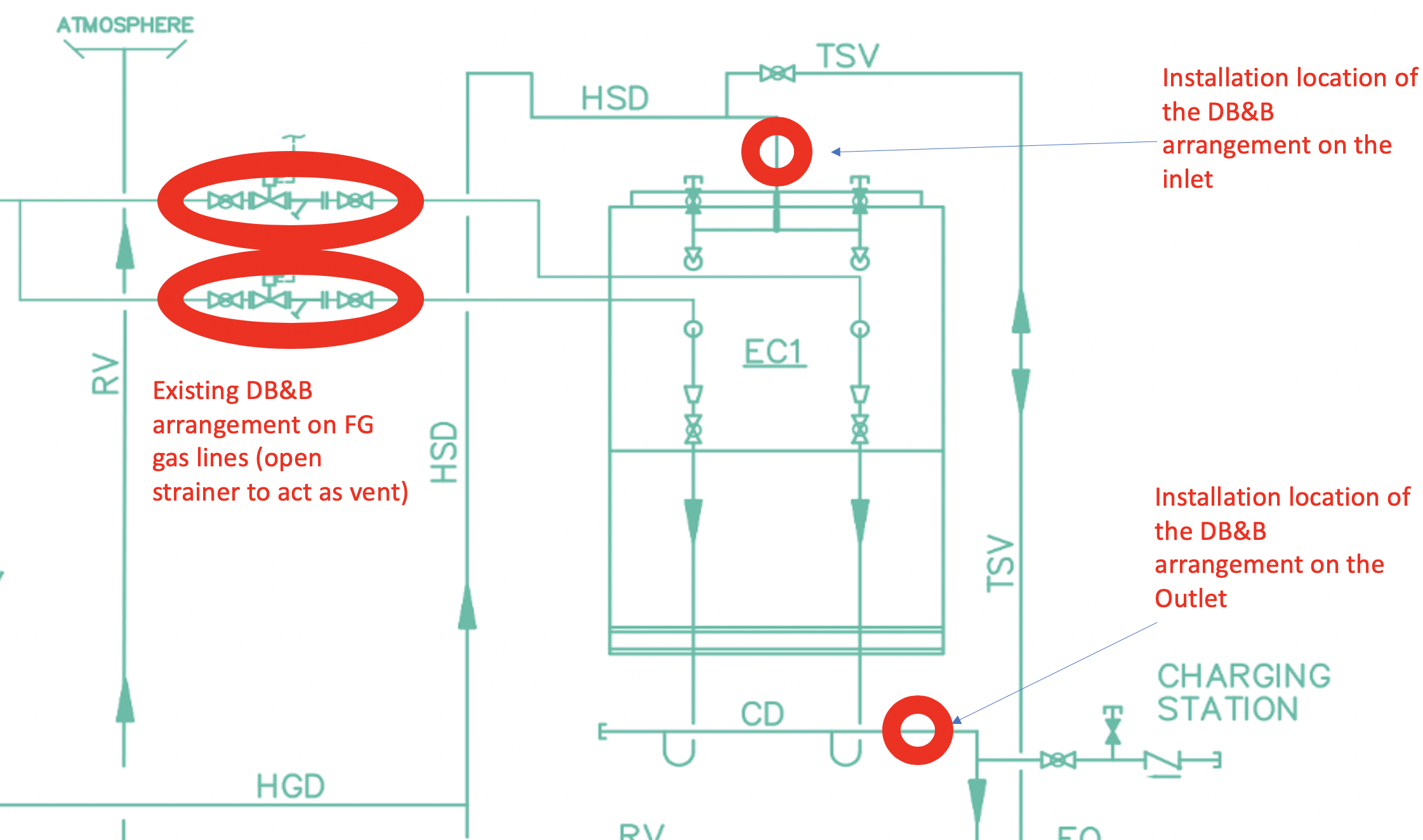
But my position does cause a dilemma for those who want to use (c)(7) as their entry method. In the industry I called home for 15 years, we learned in the 1990s that any piece of equipment that would be a PRCS would need to be installed with a means to isolate every pipe/hose/ductwork conveying a hazard to the space. It just made the prep time more efficient and actually safer if we designed the piping/hoses/ductwork so that they could be isolated using one of the three recognized isolation methods. However, ammonia refrigeration has not yet adopted these design practices for PRCSs within the refrigeration process, so removing the ammonia from the coil(s) of a condenser and then isolating the coils per OSHA-approved methods is easier said than done. Most condenser piping is welded to the coils making double block and bleed the only isolation method for this arrangement and how many condensers are installed with a DB&B set up on the inlet and outlet of the coils?
In my experience in the chemical industry, our refrigeration plants, specifically the evaporative condensers, were modified in 1990/2000s to ensure this type of arrangement was available so that we could reclassify these spaces. We had this type of set-up, and we used the “bleeds” that were in place for the DB&B arrangements as our ammonia evacuation tie-ins and the first valve in the DB&B arrangement to isolate the condenser from the process during the evacuation (e.g., pump down). We would evacuate 100% of the ammonia (well 99.99%), disconnect the hose(s) from the bleeds, and close the 2nd isolation valve in the DB&B set up, and thus we now have an empty coil that is isolated from the process using a DB&B. I have no idea on how much this would increase the cost of a condenser installation, but this would make reclassification easier and safer.
Here is a rudimentary depiction, using a portion of the IIAR 7 cover page showing how a condenser’s piping could be modified with the installation of a DB&B arrangement so that it could be isolated from the process and reclassified. If I can find a working example of a P&ID from a client that shows this more clearly I will update this post.