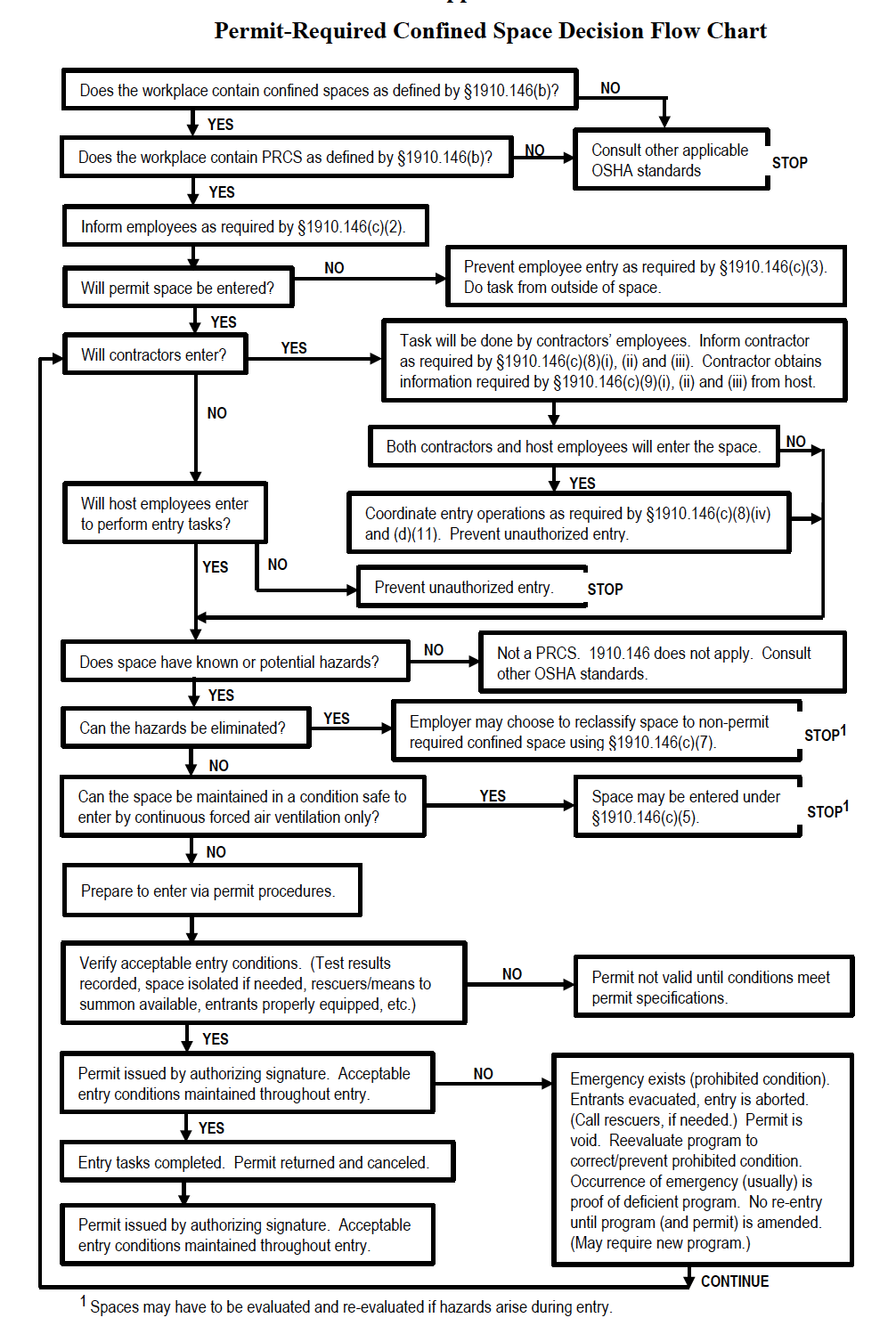
I spent several years working at semi-conductor facilities (the Cincinnati SUMCO plant was one of the finest!) and it was world’s apart from a chemical facility. When I worked in chemical plants we always used to say… “this ain’t no chocolate factory”. But when I arrived at SUMCO I swear it was cleaner than any food plant I had ever been in; yet this facility handled some of the most hazardous chemicals in my 27-year career in safety. And I am proud to say, they did it very well and taught me a lot of my “best practices” when it comes to these “highly toxic” materials. One of the debates we never settled before I left was the “under-floor” area(s) and their classification as a CS/PRCS. Here is a stock photo from Wikipedia showing what these areas look like…
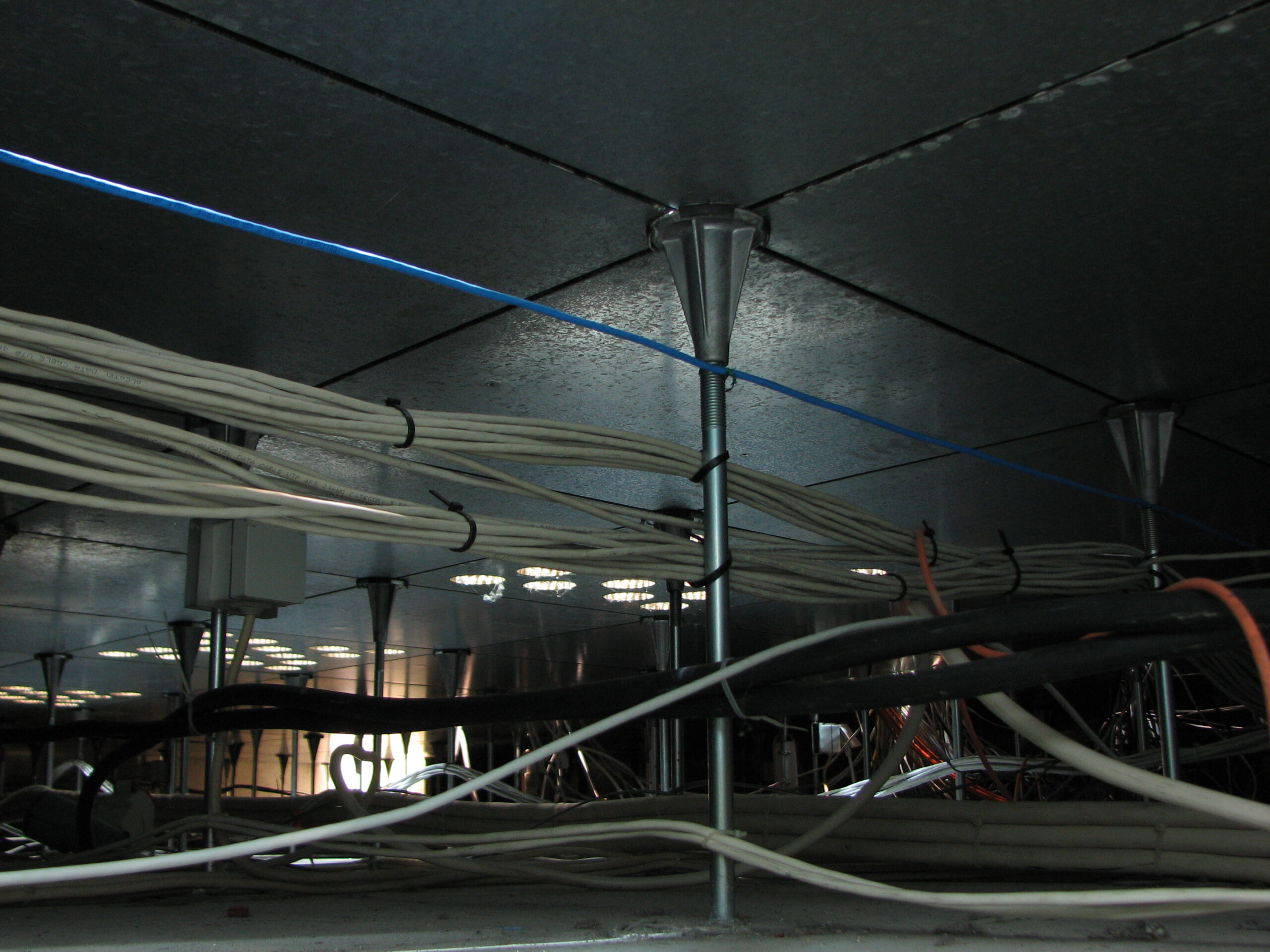
By Adamantios – Own work, CC BY-SA 3.0, https://commons.wikimedia.org/w/index.php?curid=5301314
Some of these spaces are taller than others, but for the sake of our discussion lets say the space is only 5′ high/tall. There is usually a full size, actually a very tall door, that opens to allow access below the floor and above the floor at the same time. Anyone taller than say 5′ would have to crouch down to fit under the floor and as you can see the floor supports and electrical and other pipes/tubes/hoses/ductwork make entry and exit sort of like a maze. And these areas can be very large in terms of square footage, thus you or I could be a long way from the single entry/exit portal. I have seen a few of these areas that were well light; however, the vast majority of these spaces are not provided with fixed lighting. These areas are well ventilated, due to the potential for a leak of these highly toxic materials, but this is industrial ventilation – NOT comfort ventilation (e.g. these spaces are not typically heated or cooled). So is a space like this a Confined Space? Does it rise to the level of being a Permit-Required Confined Space? My analysis…
Not to make you read all the rest – my short answer is… YES, in my professional opinion these spaces, that have low overhead as shown in the pic, are indeed a Confined Space and because of what is often found in the sub-floor areas, they are also Permit-Required Confined Spaces.
First, these types of spaces in most semiconductor facilities are designed for “maintenance access”, but they do meet all three (3) of the CS criteria. They:
- are large enough and so configured that an employee can bodily enter and perform assigned work; and
- have limited or restricted means for entry or exit; and
- are not designed for continuous employee occupancy
It is the debate as to whether they are designed for “continuous employee occupancy” is where I depart from many of my colleagues. If we truly intended for the space to be continuously occupied I think we would have made the headspace a little bit taller. Anyone who spends more than a couple hours in this space will either have very sore knees or a crick in their neck upon exiting the space! I also point out that this space is not well light, as is the space above the floor which is design for “continuous employee occupancy”.
As for the entry and egress capabilities, I also found these spaces difficult to navigate due to the layout of the electrical, piping/tubing, ductwork, etc. So I declare the egress from this space as “limited” as one would have to crawl or stoop due to the low overhead and the floor supports and equipment make simply walking about impossible.
But the space is clearly large enough for workers to enter and do their assigned task.
So in my professional opinion, this area is a Confined Space. Now let’s ask… is there a hazard within this CS that would make the space a PRCS?
In short, YES; at least all the ones I have crawled into as a safety engineer and consultant. This area is used as a pipe/tube/hose/duct runs for the highly toxic materials so the “potential for a hazardous atmosphere” is always there during normal production times. We would evacuate all the pipe/tube/hose/duct runs and then purge with to ensure these containment systems were FREE of any liquids or gases and then we would RECLASSIFY these spaces to a NON-PRCS. But under normal operations, these spaces are, in my opinion, PRCS due to this potential HAZ ATM. Here is an injury case from the OSHA Database supporting my position:
On April 15, 2014, Employee #1, a maintenance technician employed by Solarworld Industries America Inc., and Coworker #1, a tool operator in the plant’s fabrication area, were working at the employer’s solar cell manufacturing facility. Coworker #1 had submitted a work order to repair a leak of liquid hydrofluoric acid (HF). HF is used in the manufacture of solar cells in a process similar to that for making semiconductor wafers. The acid runs through double-contained plastic pipes that travel through a maintenance tunnel under the production floor, referred to as the Sub-Fab. There are low point drain boxes (liquid traps) at various points in the system to enclose valves. These drain boxes have sensors connected to alarms. A leak sensor on one of the low point drain boxes (#3CVB-310-2-6) in the Sub-Fab alerted Coworker #1 to a leak in the HF piping system. Coworker #1 tracked the leak and submitted a work order for the needed repair. Employee #1 arrived to perform the repair. Coworker #1 led Employee #1 to the leaking drain box and then moved out of the way. Employee #1 attempted to tighten the fittings on the valves within the drain box. He determined that the threads were stripped on one of the fittings. As Employee #1 tightened the fitting, acid sprayed out, some spraying onto his face shield and one of his gloves. Employee #1 was not wearing a respirator, and he stated that he could taste the acid, which would suggest that some of the acid sprayed under his face shield. Coworker #1 was standing far enough away that he avoided contact with the spray. Employee #1 exited the area and removed his gloves. He had no noticeable skin burns on his hands or face and no other symptoms. However, several hours later, delayed symptoms commenced. Employee #1 began vomiting and experiencing respiratory irritation and distress. Emergency services were called, and Employee #1 was transported to the hospital, where he was admitted and treated for systemic chemical poisoning. He remained hospitalized for several days.
Now some of you may remember an earlier article I posted about the hazardous atmospheres having to be an ACUTE hazard and if the hazard is not an ACUTE hazard which would cause impairment that would prevent the entrant(s) from self-rescue then this type of hazard is not applicable to 1910.146. See below:
| (4) Atmospheric concentration of any substance for which a dose or a permissible exposure limit is published in Subpart G, Occupational Health and Environmental Control, or in Subpart Z, Toxic and Hazardous Substances, of this Part and which could result in employee exposure in excess of its dose or permissible exposure limit;
NOTE: An atmospheric concentration of any substance that is not capable of causing death, incapacitation, impairment of ability to self-rescue, injury, or acute illness due to its health effects is not covered by this provision. |
But HF is one of those chemicals that can have a delayed impact and although the HF did not impair his ability to get out of the space after his exposure, I will ALWAYS treat HF as an IDLH risks. The OSHA write-up does not tell us what the concentration of the HF acid was that involved, but trust me, anything above 50% concentration can be lethal. I am not saying HF requires “lethal construction” I am just saying we manage HF in terms of PRCS entry as a lethal material.
These spaces will also have inert gases, such as Argon and Nitrogen, piped through them and this would pose a potential Oxygen deficiency hazard, again making the space a PRCS.
So the debate lives on, as the safety pro I am working with this week, is 100% convinced that her subfloors as I have described them above, are outside the scope of 1910.146. The question, from strictly a compliance position, if an employee was overcome from one of these chemical exposures and had to be professionally rescued and OSHA came knocking, what would your argument that 1910.146 does not apply these sub-floors?