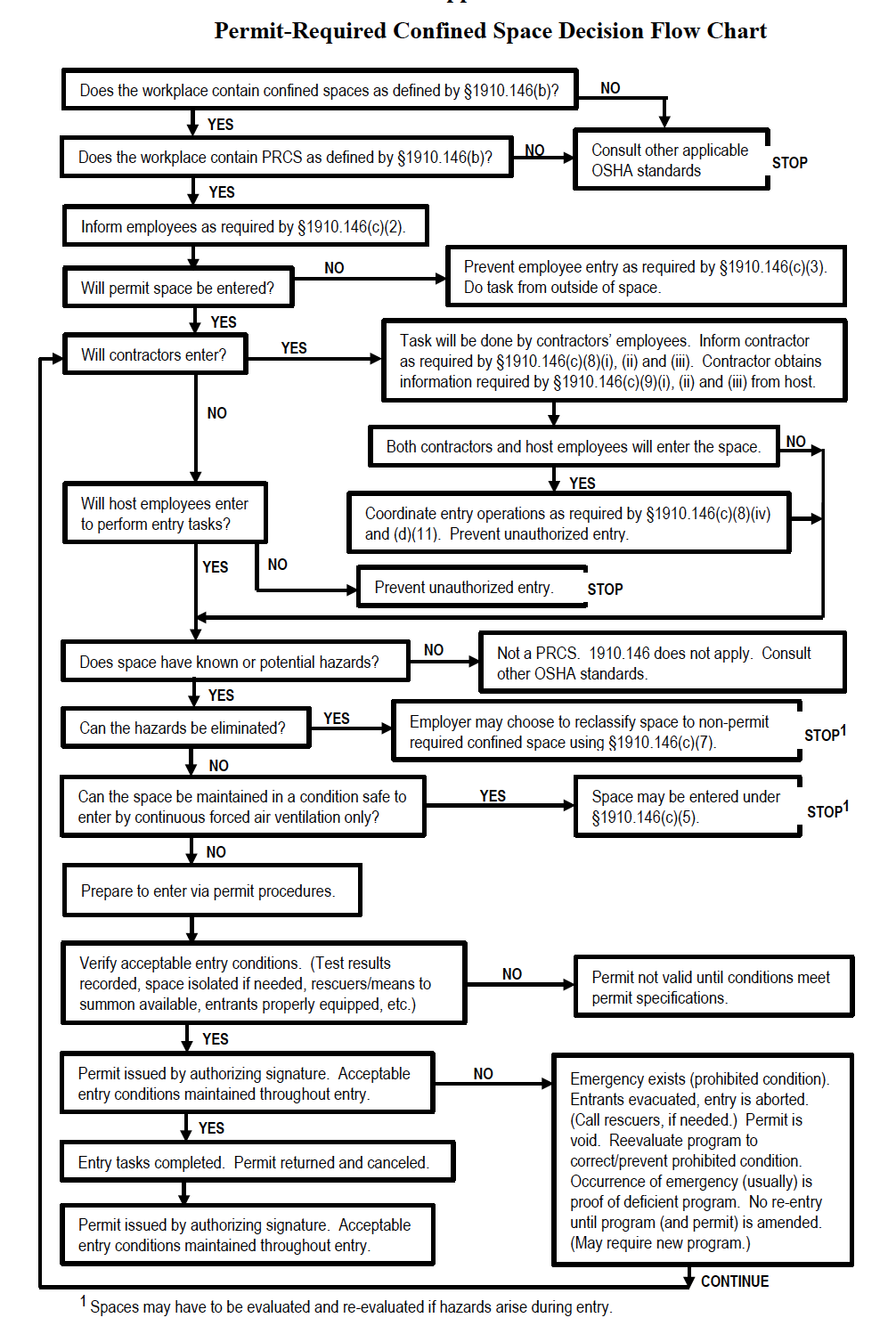
This a followup to my earlier posting about OSHA LOI and using both Reclassifications and Alternate procedures on the same space at the same time. I received a lot of questions from that post so I thought I would share the info I shared with those who contacted me. This information is also directly from OSHA materials…
(emphasis by me)
Unlike a space that contains ONLY physical hazards, a space containing an atmospheric hazard can NOT be reclassified as a non-permit space. However, if the atmospheric hazard in a permit space can be CONTROLLED by forced air ventilation, the employer may use less stringent procedures instead of full permit space procedures when workers enter the space.
The alternate procedures may be used IF THE EMPLOYER CAN SHOW that:
- ALL physical hazards are eliminated or isolated;
- The ONLY hazard is an actual or potential hazardous atmosphere that can be and is made safe for entry using CONTINUOUS FORCED AIR VENTILATION; and
- In the event the ventilation system stops working, entrants can exit the space safely.
An employer who uses the alternate procedures MUST DOCUMENT the reasons, and the supporting data, for concluding that these criteria are met. The documentation must be made available to each worker who enters the space or to that worker’s authorized representative.
The alternate procedures are as follows:
- Entry and Exit
- Any conditions making it unsafe to remove an entrance cover must be ELIMINATED BEFORE the cover is removed.
- When entrance covers are removed, the opening MUST BE IMMEDIATELY GUARDED by a railing, temporary cover, or other temporary barrier that will prevent an accidental fall through the opening and that will protect each employee working in the space from foreign objects entering the space.
- BEFORE a worker enters the space, the internal atmosphere must be tested, with calibrated direct-reading instruments, for oxygen content, for flammable gases and vapors, and for potential toxic air contaminants, IN THAT ORDER.
- The testing must demonstrate that the atmosphere in the space is not hazardous. Any worker who enters the space, or that worker’s authorized representative, must be provided an opportunity to observe the pre-entry testing.
- The employer must verify that the space is safe for entry and that the pre-entry measures discussed above have been taken, through a written certification that contains the date, the location of the space, and the signature of the person providing the certification. The certification must be made before entry and must be made available to each worker entering the space or to that worker’s authorized representative.
- The employer must provide workers with a safe method of entering and exiting the space. Any hoisting system that is used must either:
- be designed and manufactured for personnel hoisting; or
- be approved for personnel hoisting by a registered professional engineer prior to use.
- Ventilation Requirements
- CONTINUOUS FORCED AIR VENTILATION MUST BE USED. (Exhaust ventilation is NOT an acceptable substitute for forced air ventilation.)
- If the forced air VENTILATION STOPS for any reason, the ENTRANT(S) MUST IMMEDIATELY LEAVE THE SPACE.
- The forced air ventilation MUST BE DIRECTED TO VENTILATE THE IMMEDIATE AREAS where each entrant is or will be located within the space and must continue until all employees have left the space.
- The air supply for the forced air ventilation MUST BE FROM A CLEAN SOURCE and must not increase the hazards in the space.
- During Entry
- The ATMOSPHERE WITHIN THE SPACE MUST BE MONITORED to ensure that the forced air ventilation is preventing the accumulation of a hazardous atmosphere. Monitoring must be conducted CONTINUOUSLY unless the entry employer can demonstrate that equipment for continuous monitoring is not commercially available or that periodic monitoring is sufficient to ensure that the atmosphere remains non-hazardous. Employers must provide any worker who enters the space, or that worker’s authorized representative, with an OPPORTUNITY TO OBSERVE THE TESTING required by this paragraph.
- If a hazard is detected during entry:
- Employers must make sure each worker leaves the space immediately;
- The space must be evaluated to determine how the hazard developed; and
- The employer must implement measures to protect workers from the hazard before any subsequent entry takes place.
The following table compares the requirements for spaces where permits are required and for spaces where alternate procedures are permitted.
| Comparison of Requirements for Permit-Required Spaces and Alternate Procedure Spaces | ||
| Precautions Required |
Permit-Required Space |
Alternate Procedures Space |
|
Written Permit Space Program Meeting Requirements of Sections 1926.1204-1206 |
Yes | No |
| Worker Training Meeting Section 1926.1207 | Yes | Yes |
|
Duties of Authorized Attendants (Section 1926.1208), Attendants (Section 1926.1209), and Entry Supervisors (Section 1926.1210 |
Yes | No |
| Rescue and Emergency Services (Section 1926.1211) | Yes | No |
|
Information exchange between controlling contractor and entry employer(s) (Section 1926.1203(h)) |
Yes | Yes |
|
Permit Space Warning Signs and Entry Restrictions (Sections 1926.1203(b) and (c)) |
Yes | Yes |