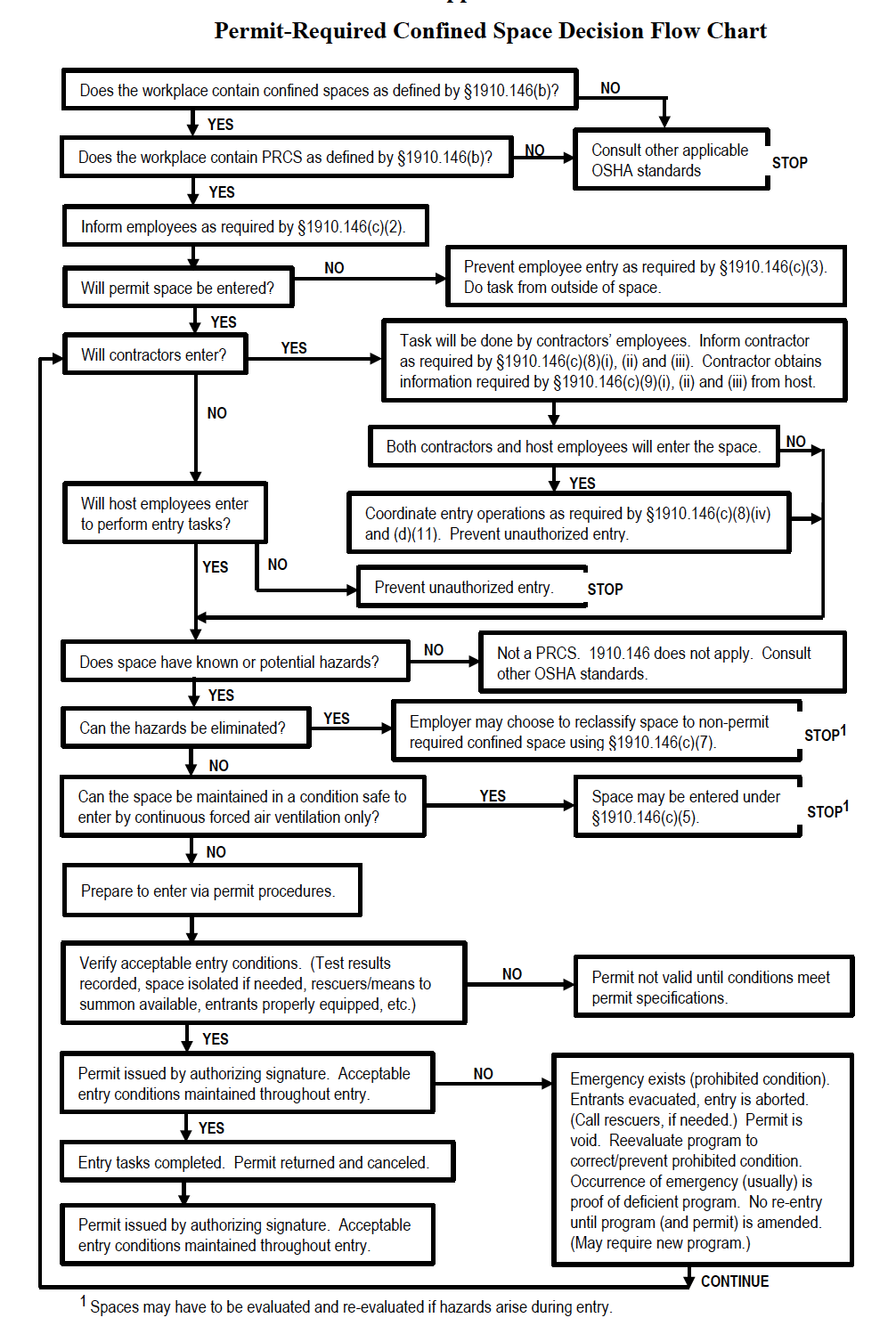
When can a PRCS be reclassified and how must one go about doing it? This is taken directly from an OSHA publication, but what caught my eye is this publication makes it clear that BOTH “reclassification” and the “alternative entry” methods can be used at the same time for the same PRCS! Pay close attention to the very last sentence and you’ll see what I mean.
I proposed this back in June 2019 with my post: Does OSHA’s new PRCS in Construction allow the use of Alternative Entry and Reclassification on the same PRCS?
Here are OSHA’s own words, explain how reclassification can be done…
A permit space that contains ONLY physical hazards may be reclassified as a non-permit space if:
- the physical hazards are eliminated or isolated without entering the space; or
- the physical hazards are eliminated or isolated by entering the space using permit space procedures
Physical hazards include ALL hazards that are NOT atmospheric hazards, including:
- explosives (other than explosive atmospheres);
- mechanical, electrical, hydraulic and pneumatic energy;
- radiation;
- temperature extremes;
- engulfment;
- noise;
- inwardly converging surfaces; and
- chemicals that can cause death or serious physical harm through skin or eye contact (rather than through inhalation).
Example:
A confined space contains electrical machinery that presents mechanical and/or electric shock hazards. If the hazards presented by the machinery are eliminated by deenergizing and locking out the machinery at an electrical panel outside the space, space can be reclassified as a non-permit space as long as the equipment remains deenergized and locked out. If it is necessary to enter the space to deenergize and lock out the machinery, the entry must be conducted pursuant to a full permit program. However, once the machinery is deenergized and locked out, the space may then be reclassified as a non-permit space.
Whenever a permit space is reclassified as a non-permit space, the entry employer MUST DOCUMENT the basis for determining that all hazards in the permit space have been eliminated, through a certification that contains:
- the date,
- the location of the space, and
- the signature of the person making the determination
The certification MUST be made available to each worker entering the space or to that worker’s authorized representative. If any hazards arise within a permit space that has been reclassified as a non-permit space, each worker in the space MUST exit the space. The entry employer must then reevaluate the space and determine how to proceed. If the new hazards are physical hazards that can be eliminated or isolated, the employer can reclassify the space as a non-permit space after that has been accomplished. If the new hazard is an atmospheric hazard that can be made safe for entry by continuous forced air ventilation, the employer can proceed in accordance with the procedures discussed in Chapter 8. In all other situations, further entry can only be made pursuant to a full permit space program.