The federal OSHA standard(s) are not very helpful when it comes to guidance on guarding hot surfaces and this causes many debates during audits, HAZ assessments, and Pre-Start Up Safety Reviews (PSSR). We probably are all aware of the seven (7) feet rule for guarding “fan blades”…
1910.212(a)(5) Exposure of blades. When the periphery of the blades of a fan is less than seven (7) feet above the floor or working level, the blades shall be guarded. The guard shall have openings no larger than one-half ( 1⁄2 ) inch.
The idea is that if the hazard is 7′ or further overhead, we are protected by “distance/proximity” to the hazard. OSHA makes no mention of this concept in their General Guarding standard in relation to hot surfaces, however, there is an OSHA State Plan that provides us with some reasonable requirements for guarding hot surfaces.
NOTE: OSHA does have a 1998 LOI where they discuss their expectations for guarding hot surfaces, but as the LOI points out there really is no guidance in any of those standards for hot surfaces. Here is a GDC citation for unguarded hot surfaces.
So like I always do, I turn to state plans for help. And it just so happens that the WA-OSHA has a nice perspective standard for guarding steam pipes that I have adopted as my engineering standard for hot surfaces.
(emphasis by me)
WAC 296-24-73511 Steam pipes.
(1) You must ensure that all steam pipes or pipes heated by any other means to a sufficient temperature to burn a person (other than coil pipes, radiators, for heating rooms or buildings, or pipes on portable steam engines and boilers) and which are within 7 feet of a floor or platform, if exposed to contact, are guarded with a standard safeguard.
(2) Protection from hot pipes. You must cover all exposed hot pipes within 7 feet of the floor or working platform, or within 15 inches measured horizontally from stairways, ramps or fixed ladders, with an insulating material or be guarded in such a manner as to prevent contact.
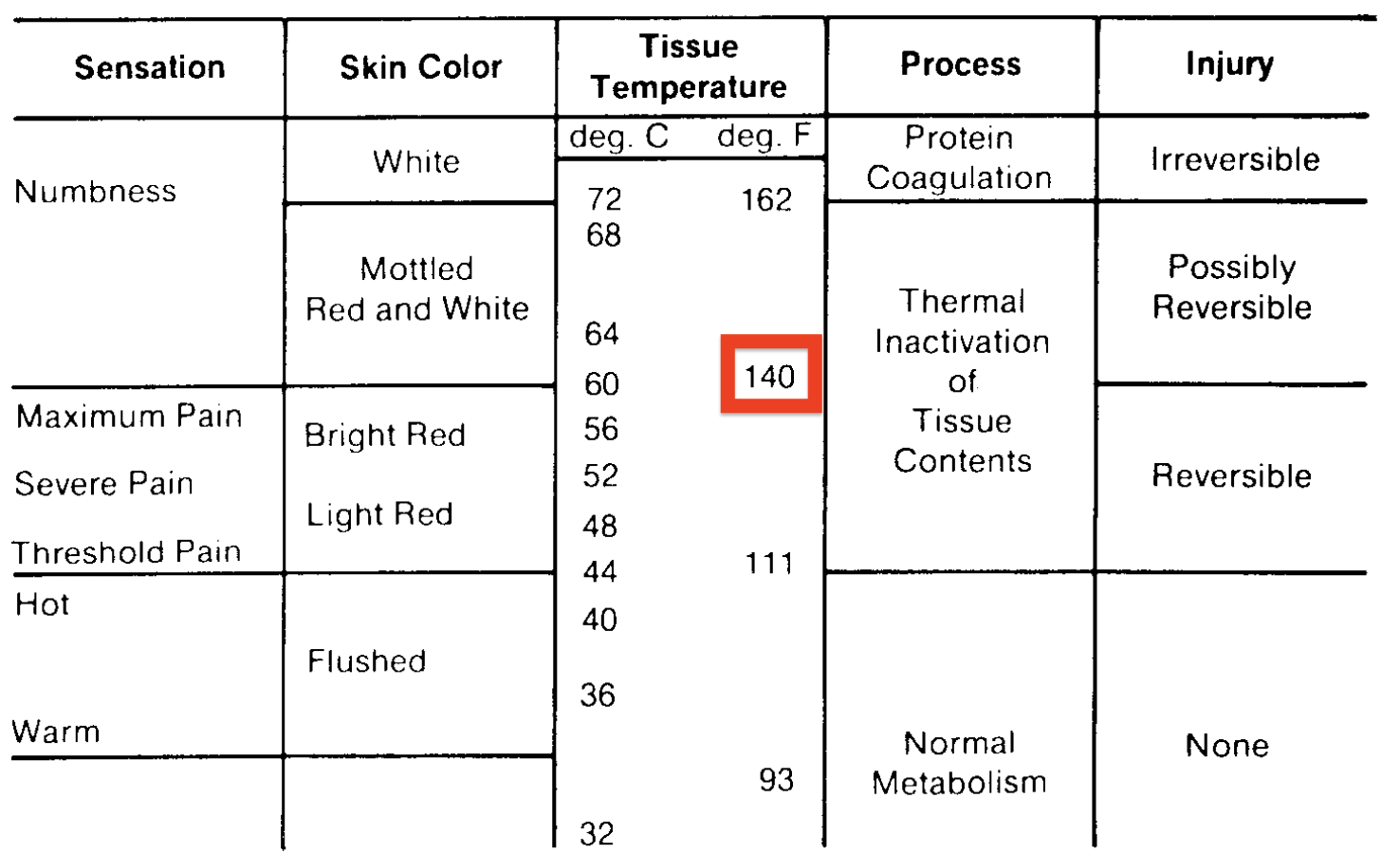
We can see the use of the 7′ rule, but what I like is horizontal distance specifications of 15″. I think that is fair and adequate for a facility to adopt for their design criteria for piping/tubing/hoses that can achieve 140°F or hotter.
But where did this 140°F limit come from? It came from:
ASTM C1055 – 99, FIG. X1.2 Thermal Sensations and Associated Effects Throughout Range of Temperatures Compatible with Tissue Life