
You may have seen this latest and greatest “detection method” in your junk mail, pop-up ads, or in a search of the internet. These tapes work and they work well in my experiences, but as with any product, there are some serious drawbacks that one must understand before using these products. Before I get into specifics, know that the addition of these tapes to your process safety program should be done via a well-executed Management of Change (MOC). This MOC should also cause us to develop an SOP for its application and maintenance and to conduct some training on this new “detection method” (e.g. may require us to update our Emergency Action Plan’s procedures for handling small releases). We may also want to revise our Contractor Safety Orientation so as to be sure our contractors working in, on, and even adjacent to our process have the knowledge of what this tape means and how to report any indicators they may come across in their work. With that said, here are some serious matters to consider when implementing this change to our leak detection methods:
These tapes usually come with a small window of effectiveness, meaning they usually are only good for 6-9 months. This will entail its replacement PER THE MANUFACTURERS’ recommendation. Here is a snapshot from one of the manufacturer’s datasheet showing the 6-month frequency based on process and environmental conditions:
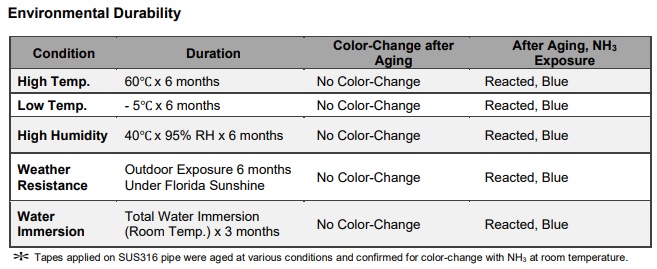
Also, here is their demo video, pay attention at the 1:15-1:20 mark where they specify the tape (NOTE: video is specific to NH3 tape) will work up to 6-months.
All of this means that the “tape” becomes an indicator of a Loss of Primary Containment (LOPC) and thus it belongs in our MI program with its own procedure for applying and removing the tape. We can NOT just apply new tape every six months; we have to remove the old tape first. The manufacturer suggests using alcohol to do so. This may in fact require us to update our HAZCOM program, SDS, and training on the storage and use of this flammable liquid.
These tapes have some very specific STORAGE requirements:
Store in 50-80°F (10-27°C), 25-50% relative humidity; out of direct sunlight.
This means that if the tape is left out in an ammonia machinery/engine room, it would expire very quickly as these rooms are designed to operator well over the 80ºF max storage temp.
But the biggest drawback for me personally is that the tape is NOT very sensitive! Understanding that I can spell NH3 at around 5 ppm, the tape does not indicate a leak until it is exposed to around 220 ppm. Here is a cutout of the NH3 tape spec sheet…(emphasis by me)
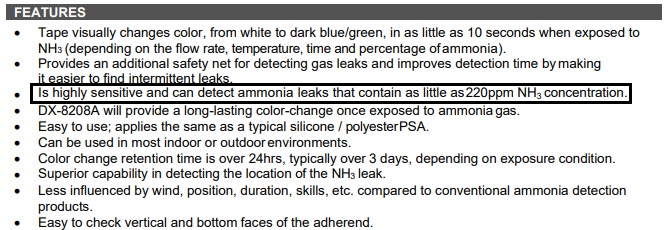
With 50 ppm and 25ppm NH3 in air, no obvious color change can be observed after 16hrs of exposure!
Now think about this… you have a leak inside your process area and all the tape is exposed and changes color from the release. With this tape being part of our process safety management program we would have to replace all pieces of tape BEFORE Start-Up after an emergency shutdown. This could hinder our start-up depending on the resources available to get the tape replaced BEFORE start-up.
Lastly, where do we apply this tape?
I have never seen any process use this tape at all pipe joints – that would be unmanageable, but it is permitted if a facility chooses to do so. The tape is rated for outdoors, but we did not have the best of luck using it is in the south with hot temps combined with high humidity; this was NOT a tape performance issue, it was a tape adhesive issue.
CLICK HERE for one of the manufacturer’s NH3 tape Spec Sheet