
I have several chlorine projects going on and a couple of them are being installed by the same contractor, one of the best contractors in the chemical industry (I wish I could name them by my CA prevents me from listing them as a client or supporter!). They used the pandemic to get everything installed and now we are ready for our post-construction and Pre-PSSR activities, which is when we do our integrity testing on our Cl2 Class I “Gas ONLY” piping. The “gas only” piping is CPVC piping, using “solvent welded sockets”, a very common means to join CPVC and PVC piping. Of course, Pamphlet 6 requires the piping to be installed per ASME B31.3 and this is where things get squirrelly with our CPVC piping…
UPDATED on 5/31/21 with some “unofficial” feedback from The CI Tech Services.
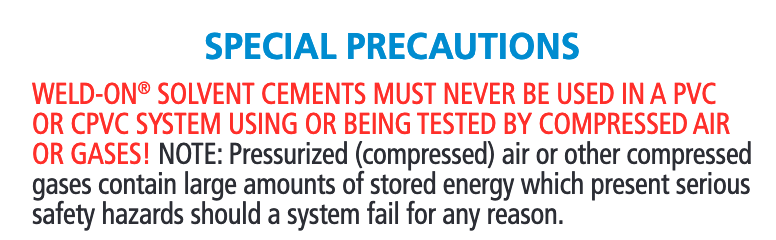
The largest manufacturer of cleaner, primer, and cement has a “newer” (not sure when it was published) manual titled Weld-On Solvent Welding Guide. And it is in this manual, on page 19, they have a “Special Precautions” section and at the top of this section in ALL CAPS RED font they state the following:
(emphasis by me)
As we discussed before, ASME B31.3 gives us two (2) options for pressure testing/leak testing our field joinment methods:
- Pneumatic
- Hydrostatic
In the chlorine processes, we typically did pneumatic using Nitrogen gas as it was clean and left no residue; but this was usually on metal piping and NOT CPVC piping.
But now with the WELD-ON® limitations, we may be locked into Hydrostatic testing, which is doable, we just have to include a means to DRY the pipe after the testing.
Here is what Pamphlet 6 says about hydrostatic testing: (emphasis by me)
|
11.2.1 Hydrostatic Testing New chlorine piping should be hydrostatically tested to one and a half (1 ½) times the maximum pressure to which the system may be subjected. Pressure gauges, relief valves, automatic control valves, and other components which may be damaged should be removed and openings should be blocked off prior to testing. After testing, all moisture-absorbing gaskets and valve packing should be replaced. It is essential that chlorine systems be thoroughly dried prior to being put into service. There are some circumstances under which drying cannot be accomplished or is not practical after hydrostatic testing with water, for these situations the pneumatic or alternate testing methods may be considered. |
|
11.3 DRYING Chlorine piping systems must always be dried before being placed in service. Even if water has not been purposely introduced into the system for hydrostatic testing or cleaning, drying is required because moisture may enter the system from the atmosphere or other sources. Where steam has been used for cleaning, the steaming should be followed by the introduction of dry nitrogen or dry air purge. As a precautionary measure, the user should identify and provide safeguards to prevent the collapse/implosion of piping systems not rated for vacuum service or provided with vacuum relief should cold purge gas be introduced into a system previously heated with steam. Heating the purge gas will aid considerably in the drying process. The temperature should be limited based on the equipment and insulation type, but 200°F (93°C) is typically an acceptable temperature. The purge gas flow should be started at high volume rates to sweep the moisture out of the piping system, and then reduced. This should be repeated while measuring the dew point to allow any residual liquid to evaporate into the purge gas. The system should be dried until all the vent gas streams leaving either are drier than -40°F (-40°C) dew point OR are 10 degrees colder than the coldest chlorine designed to be in the system, whichever is colder. The dew point should be measured at the normal system operating pressure, or reasonably close to the entering purge gas dew point. The purge rates should be at an absolute minimum, allowing adequate time for the purge gas to reach equilibrium when the dew point is taken. Drying using ambient-temperature dry air or nitrogen purge may take an extended period of time. This time can be decreased and the effectiveness increased by the use of a pressure cycling technique. Consideration can be given to using the services of commercial system dehydrators. These vendors normally dry piping and equipment by circulating or purging with large volumes of heated nitrogen. |
UPDATE on 5/31/21
ASTM F441/F441M (which is specific to CPVC and is referenced in B31.3), does not recommend pneumatic testing if it is against the manufacturer’s recommendation.
|
1.2 The products ·covered by this specification are intended for use with the distribution of pressurized liquids only, which are chemically compatible with the piping materials. Due to inherent hazards associated with testing components and systems with compressed air or other compressed gases some manufacturers do not allow pneumatic testing of their products. Consult with specific product/component manufacturers for their specific testing procedures prior to pneumatic testing. NOTE 3- Pressurized (compressed) air or other compressed gases contain large amounts of stored energy which present serious safety hazards should a system fail for any reason. |
|
ASME B31.3 APPENDIX F – GUIDANCE AND PRECAUTIONARY CONSIDERATIONS F345.5 Pneumatic Leak Test F345.5.1 Precautions. Consideration should be given to the risk associated with the release of stored energy and to the establishment of the minimum safe distance between personnel and the equipment being tested. Equations and considerations are available in ASME PCC-2, Repair of Pressure Equipment and Piping, Article 5.1.
FA323 MATERIALS FA323.4 Material Considerations — Nonmetals The following are some considerations to be evaluated when applying nonmetals in piping. See also paras. F323 and F323.1. (a) Static Charges. Because of the possibility of producing hazardous electrostatic charges in nonmetallic piping and metallic piping lined with nonmetals, consideration should be given to grounding such systems conveying nonconductive fluids. (b) Compressed Gases. If nonmetallic piping is used above ground for compressed air or other compressed gases, special precautions should be observed. In determining the needed safeguarding for such services, the energetics and the specific failure mechanism need to be evaluated. Encasement of the plastic piping in shatter-resistant material may be considered. (c) Brittle Piping. If borosilicate glass or other brittle piping material is used, take into account its lack of ductility and its sensitivity to thermal and mechanical shock.
|