A few years ago I was asked to participate in a hazard assessment for a manufacturer who wanted to review the procedure for hydrogen-powered vehicles to be freed of hydrogen gas. I got the feeling very early into this hazard assessment that those in the room knew about an event of some type, but wanted me to walk them through the venting process so they could quietly find their error(s).
I conducted many flaring/venting operations on much larger scales in my time, but this venting, although necessary, may be a tad much for a car dealership to manage. I am guessing this is becoming a major thing for the ramp-up of selling H2 powered vehicles as I found other manufacturers who already have written procedures for this to be done by dealerships.
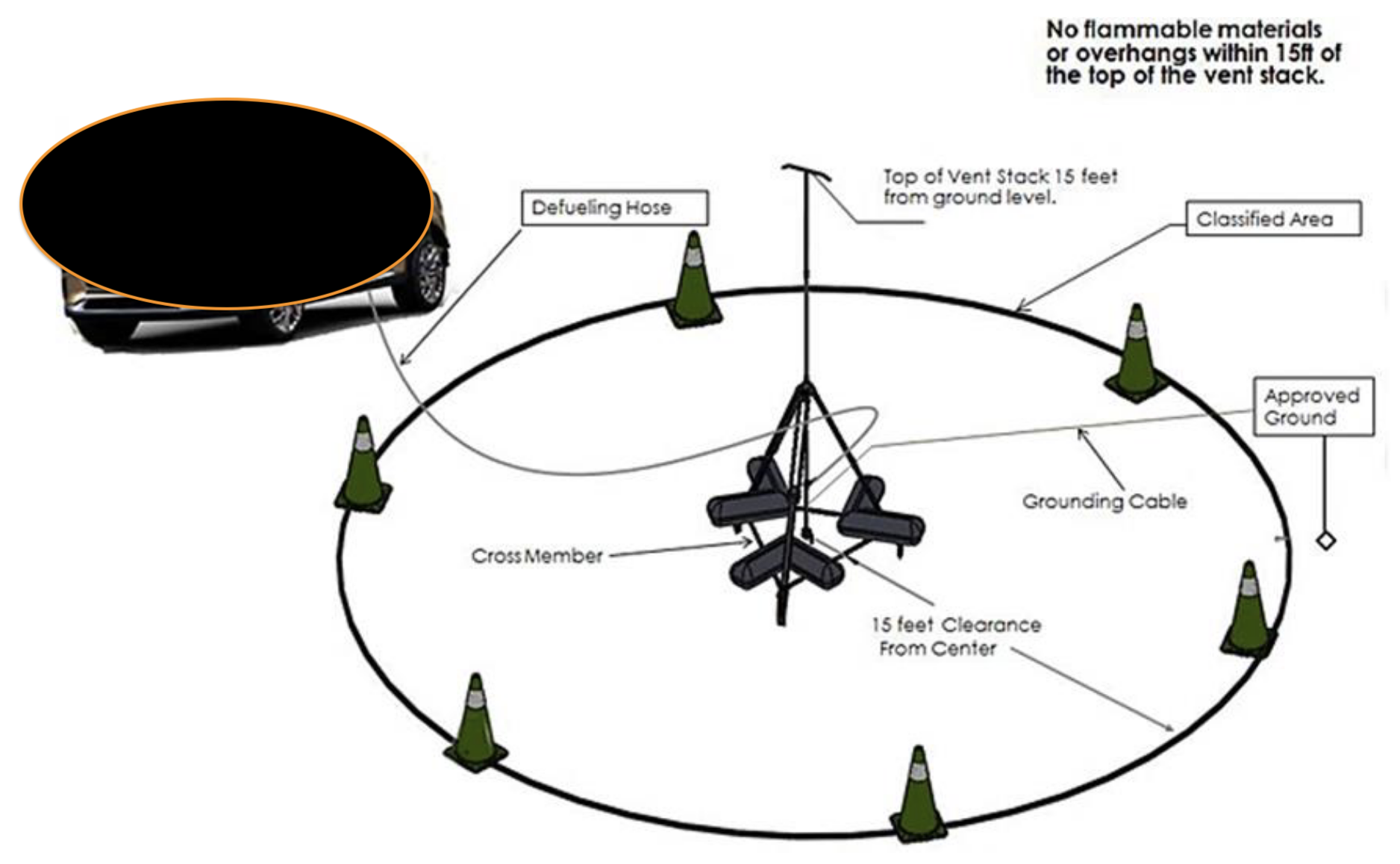
This procedure calls for a 15′ radius around the portable vent assembly which they call the “Hydrogen Gas venting area” (see image below). This 30′ diameter circle MUST be free of all ignition sources, mind you that H2 will most likely ignite during the venting process as its MIE is around 0.07 mJs. But this “gas venting area” MUST be a CONE to the heavens above! In other words, this area MUST be OUTDOORS with NOTHING overhead of the venting area that can trap H2 gas which has an LEL of 3-4%. This means that we out 15′ horizontal radius from the vent stack is important, but more important is WHAT IS ABOVE the vent stack and how far above it should we be free of ignition sources?
NFPA 497, FIGURE 5.9.8(b) Gaseous Hydrogen Storage Located Outdoors requires 15′ above the vent stack point of discharge. The vent stack is 15′ high so we go another 15′ for a total of 30′ high to ensure we have nothing, such as lighting, in our HAZLOC cone.