
A “vent and burn” operation on I-10 in LA
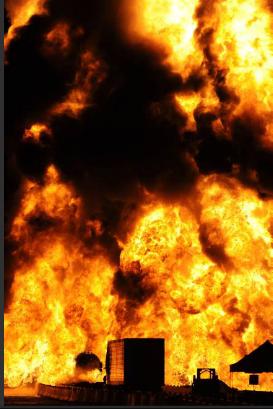
vent burn

TURN UP YOUR VOLUME for this one – the sounds are as telling as the sights!

For those who may not be familar with a “vent and burn” scenario, here are the guidelines from the Frederal Railroad Administration.

This product-removal method involves the placement of explosive charges to cut a hole (or holes) in a tank car tank, allowing the contents to flow into a pit for burn-off. The vent and burn method may be used when:

  • The tank car tank has been exposed to fire resulting in elevated pressure within the tank and possible tank damage;
  • Conditions do not allow the safe transfer, venting, or flaring of the tank car;
  • Site conditions prevent rerailing the damaged tank car (e.g., the terrain does not permit use of cranes or other rerailing equipment);
  • Damage to leaking valves and fittings cannot be repaired; or 
  • The tank car tank has been damaged to the extent that it cannot be safely rerailed and moved to an appropriate unloading point.

The use of the vent and burn method is considered the last viable option for product removal because of its inherent hazards.


To learn more about this technique (this is in NO WAY training you in the technique) CLICK HERE to download the FRA’s Manual on FIELD PRODUCT REMOVAL METHODS FOR TANK CARS.   Another GREAT technical article on the technique can be found at the Transport Dangerous Goods Directorate, Transport Canada.  CLICK HERE to see this article by by D.W. Dibble and Doug Kittle.

A note about what you will see in the video below….

Here are the vent and burn steps from the FRA, which this team followed flawlessly, and can be followed in the video.

  1. Place explosives charges at the highest and lowest points on the damaged tank car.
  2. Place four to six lighted fusees near the mouth of the bum pit, and place a remotely operated incendiary grenade in the bottom of the pit.
  3. Detonate the charge at the highest point on the tank car.
  4. After pressure has been substantially reduced in the tank (as indicated by the sound of reduced venting or reduction of flame), detonate the charge at the lowest point on the tank car.
  5. If the fusees do not immediately ignite the product flowing into the pit, detonate the remotely operated incendiary grenade.

ventandburn

A small directional charge is placed on the transport container at a strategic location in the vapor space; this is the first explosion you will see in the video.  If you look closely, right after the video we can see the isobutane relieving into the atmosphere from the breach point, as well as hear the venting from the breach.  This first detonation is designed to breach the container to relieve all pressure on the damaged container.  About 8 seconds later, we see a second charge (in this event it was on the right hand side of the container) is set to breach the container at the lowest possible (and safest) point on the container to allow the liquid contents to flow to a “burn pool”; you see this as the 2nd explosion that appears to occur lower on the container’s right hand side.  After this second detonation, in a matter of a second or two, the pool of isobutane forms a vapor cloud which is then ignited by several fixed flares around the burn pool; this is the third boom you hear (although not as loud) and the largest one in respects to the wall of fire formed.   The isobutane is then allowed to burn off in a controlled fashion in the burn pool.  You will also notice a flare on a pole that is about 10′ away from the vapor space breach point on the container.  Yes, that is an ignition source to ignite the rapidly expanding isobutane cloud that is now emitting from the breached container; but it is a BACK-UP just in case the second breach does not work.  We would be in a world of hurt with 8,700 gallons of highly flammable isobutane shooting out of it’s container we just blew a hole in if the second breach is unsuccessful!!!!  For my HAZMAT junkies, someone explain why the isobutane venting from the breached trailer is not igniting as it travels past the flare?????  I will give you two hints:  UEL and VP.

Now for this all to work, we need a flammable liquid or gas with a relatively high vapor pressure.  We breach (i.e. vent) the container in the vapor space and lowest point on the container; we have a strong and deliberate ignition source at the burn pool (i.e.burn); thus we call this a “vent and burn” operation.  Then we sit back, protect exposures and let the fire do the rest.  It is a violent operation so sit back and be awed by witnessing one of the more flawlessly done vent and burns we may ever have the opportunity to witness.


VIDEO #1


VIDEO #2

 WAFB 9 News Baton Rouge, Louisiana News, Weather, Sports


Scroll to Top