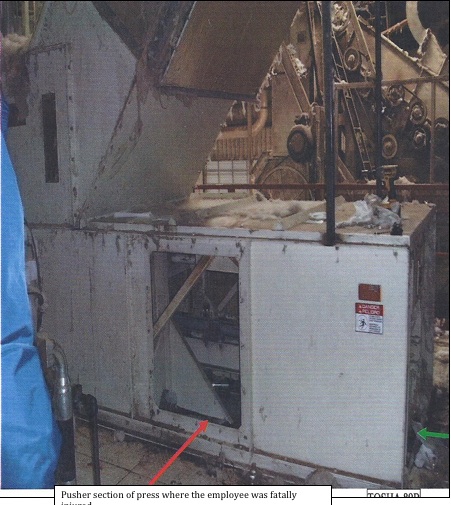
A 57-year-old supervisor was killed while trying to determine why hydraulic oil was leaking from a cotton press machine. The press consists of a hydraulic pusher, tramper and bailer. The pusher and tramper sit on an elevated platform accessed by stairs; the bailers and operator console are located on the lower level. The cotton is blown into the pusher section by air through piping; the pusher pushes the cotton into the tramper section, the pusher retracts, and the tramper comes down to compact the cotton. The tramper rises, and the process is repeated until a proper bale is formed. The victim noticed a steady stream of oil coming from the platform under the pusher section of the press. He told the press operator to shut the press down. He then went upstairs to the pusher section of the press where there was an access door on the right side which is interlocked with the pusher to shut it down when the door is opened. When the access door was opened, the victim still could not determine the source of the leak. He instructed a co-worker to remove the end and side panel of the pusher, but after looking inside, he could not see the leak. He told a co-worker that the only way he would be able to figure out where the leak was located was to operate the pusher. He told the co-worker to go downstairs to the control panel and tell the press operator to turn the press on and operate it. The victim was standing at the side of the pusher when the co-worker left to go downstairs. As instructed by the co-worker through hand signals, the press operator raised the tramper foot in manual mode and then stopped; there was no motion on the machine. The co-worker then gave the usual verbal signal to the victim, yelling “here we go.” He waited 5-10 seconds and heard no response from the victim. Interpreting the lack of response to mean it was clear to proceed, he told the press operator to turn on the pusher. The co-worker heard a yell. He found the victim lying inside the pusher, with the portion of his body from the knees to his feet remaining outside the pusher.
|
Item 1 T.C.A. 50-3-105(1) |
The employer did not furnish employment and a place of employment which were free from recognized hazards that were causing or likely to cause death or serious physical harm to employees in that employees
|
|
Item 2a 1928.57(a)(6) |
Employees were not instructed at the time of initial assignment and at least annually thereafter in the safe operation and servicing of all covered equipment with which employees were or would be involved. |
|
Item 2b 1928.57(a)(6)(iii) |
Instruction to stop engine, disconnect the power source, and wait for all machine movement to stop before servicing, adjusting, cleaning, or unclogging the equipment, was not provided by the employer at the time of initial assignment and at least annually thereafter for employees performing servicing of all covered equipment with which employees are or will be involved. |
|
Item 3 1928.57(a)(7)(i) |
Protection from employees coming into contact with moving machine parts was not provided by the installation and use of a guard or shield or guarding by location. |
|
Item 4 1928.57(a)(11) |
When moving machinery parts presented a hazard during servicing or maintenance, the engine was not stopped, the power source was not disconnected, and all other machine movement was not stopped before servicing or maintenance was performed. |
Citation 2
|
Item 1a 1910.1200(e)(1) |
The employer did not develop, implement, and/or maintain at the workplace a written hazard communication program. |
|
Item 1b 1910.1200(f)(5)(i) |
The employer did not ensure that each container of hazardous chemicals in the workplace was labeled, tagged or marked with the identity of the hazardous chemical(s) contained therein. |
|
Item 1c 1910.1200(f)(5)(ii) |
The employer did not ensure that each container of hazardous chemicals in the workplace was labeled, tagged or marked with the appropriate hazard warning. |
|
Item 1d 1910.1200(g)(8) |
The employer did not ensure that material safety data sheets were readily accessible to the employees in their work area during each work shift. |
|
Item 1e 1910.1200(h)(1) |
Employees were not provided information and training on hazardous chemicals in their work area at the time of their initial assignment and whenever a new hazard was introduced into their work area. |
|
Item 1f TDLWD Rule 0800-01-09-.06(2) |
Employers did not ensure that work areas in which non-containerized hazardous chemicals are generated or produced as a result of the process or operation taking place in such work area contain a sign or placard identifying the hazardous chemicals and appropriate hazard warnings. |
|
Item 1g TDLWD Rule 0800-01-09-.07 |
Employees were not provided annual refresher training and information on hazardous chemicals in their work areas. |
See Photo below