A common misconception is that it is always safe to use compressed air for cleaning off a worker… IT IS NOT SAFE! Even “safety nozzles” which regulate pressure to 30 psi can NOT be safely used to clean the human body. Here are a few little known facts about compressed air and how it is hazardous to workers:
- Compressed air accidentally blown into the mouth can rupture the lungs, stomach or intestines
- Air can enter the navel, even through a layer of clothing, and inflate and rupture the intestines
- Air can also enter the bloodstream, and death is possible if it makes its way to blood vessels in the brain
- Direct contact with compressed air can lead to serious medical conditions and even death
- As little as 12 psi can blow an eye out of its socket
- If an air pocket reaches the heart, it causes symptoms similar to a heart attack. Upon reaching the brain, pockets of air may lead to a stroke
Click Here to download (pdf) one of my presentations on the Hazards of Compressed Air. WARNING!!! some of the images in this presentation are REAL and VERY GRAPHIC! View at your own risk. (Members can obtain an unlocked/nonn-watermarked edition in the Document Library.)
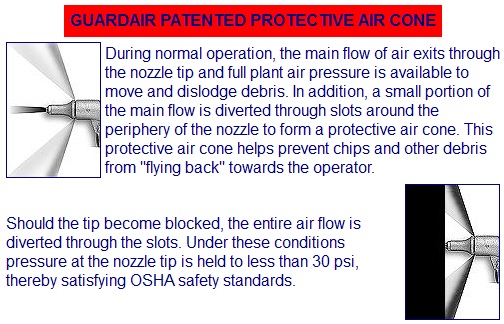
The OSHA phrase “reduce to less than 30 psi” means that the downstream pressure of the air at the nozzle (nozzle pressure) or opening of a gun, pipe, cleaning lance, etc., used for cleaning purposes will remain at a pressure level below 30 psi for all static conditions. The requirements for dynamic flow are such that in the case when dead ending occurs a static pressure at the main orifice shall not exceed 30 psi. This requirement is necessary in order to prevent a back pressure buildup in case the nozzle is obstructed or dead ended. See diagram below for two acceptable methods of meeting this requirement. Also, there is no intent to restrict the diameter of the nozzle orifice or the volume (CFM) flowing from it.

“Effective chip guarding” means any method or equipment which will prevent a chip or particle (of whatever size) from being blown into the eyes or unbroken skin of the operator or other workers. Effective chip guarding may be separate from the air nozzle as in the case where screens or barriers are used. The use of protective cone air nozzles are acceptable in general for protection of the operator but barriers, baffles or screens may be required to protect other workers if they are exposed to flying chips or particles.