In the world of process safety, this is a no-brainer; but in normal manufacturing facilities, the answer can be quite confusing. Bottom line… if your facility has a PSM-covered process (even an RMP Program 2 or 3 process) we are REQUIRED to have an EAP that complies with 1910.38. But when we are not a PSM/RMP facility the answer is much harder to come by…
The purpose of an EAP is to facilitate and organize employer and employee actions during workplace emergencies. An EAP is a written document that includes:
- Escape procedures and emergency escape route assignments.
- Procedures to be followed by employees who remain to operate critical plant operations before they evacuate.
- Procedures to account for all employees after emergency evacuation has been completed.
- Rescue and medical duties for those employees who are to perform them.
- Means of reporting fires and other emergencies.
- Names or job titles of persons who can be contacted for further information or explanation of duties under the plan.
But there is a little-known fact about when a facility MUST have a written EAP. In fact, there are only seven (7) OSHA standards that require us to have an EAP:
- Process Safety Management of Highly Hazardous Chemicals – 1910.119
- Fixed Extinguishing Systems, General – 1910.160
- Fire Detection Systems, 1910.164
- Grain Handling – 1910.272
- Ethylene Oxide – 1910.1047
- Methylenedianiline – 1910.1050
- 1,3-Butadiene – 1910.1051
Sounds simple, right? If our facility falls under one or more of these seven OSHA standards then we are required to have an EAP… case closed… well not quite!
You may have noticed that 1910.157 Portable fire extinguishers is NOT one of the seven (7) standards listed above; however, paragraphs 1910.157(a), (b)(1), and (b)(2) establish options that, if selected, REQUIRE the employer to have an EAP that conforms to 1910.38(a). While the plan is not required directly in the 1910.157
standard, the employer MUST comply with the plan requirements to qualify for the various exemptions provided in 1910.157.
Employers are generally required by 29 CFR 1910 to provide portable fire extinguishing equipment for use in fighting incipient stage fires in the workplace. 29 CFR 1910.157, however, provides alternatives for employers who do not want their employees to fight incipient stage fires in the workplace. Employers who opt for the evacuation of all or most employees to a safe area do not have to comply with certain requirements of 1910.157, depending on the option chosen. These
options are:
- The employer evacuates ALL employees to safety when a fire occurs [1910.157(b)(1)]: Employers who select this option are relieved from compliance with 1910.157 unless a specific standard in part 1910 requires that portable fire extinguishers be provided. If the employer selects this option, compliance with 1910.38(a) and (b) is REQUIRED through 1910.157(b)(1).
- The employer evacuates ALL employees except those designated to use portable fire extinguishers [1910.157(b)(2)]: Employers who select this option need not comply with the distribution requirements of 1910.157(d). This option allows for the employer to distribute extinguishers in a manner such that they are available to the employees designated to fight incipient stage fires. If the employer selects this option, compliance with 1910.38(a) is REQUIRED through 1910.157(b)(2).
- The employer keeps portable fire extinguishers in the workplace but does NOT want employees fighting fires and therefore evacuates the employees to safety [1910.157(a)]: OSHA recognizes that portable fire extinguishers may be required in the workplace by other organizations (e.g., insurance companies, local fire departments, etc.). Portable fire extinguishers that are NOT intended for employee use may still pose a hazard if they are not properly maintained. Employers who select this option must comply ONLY with the maintenance, inspection, and testing requirements in paragraphs (e) and (f) of 1910.157.
Employers who do not select any of these options but instead provide portable fire extinguishers for use by any employee to use in fighting incipient stage fires must
comply with 1910.157 in its entirety. If the employer chooses to comply with ALL of 1910.157, there is NO requirement to comply with 1910.38.
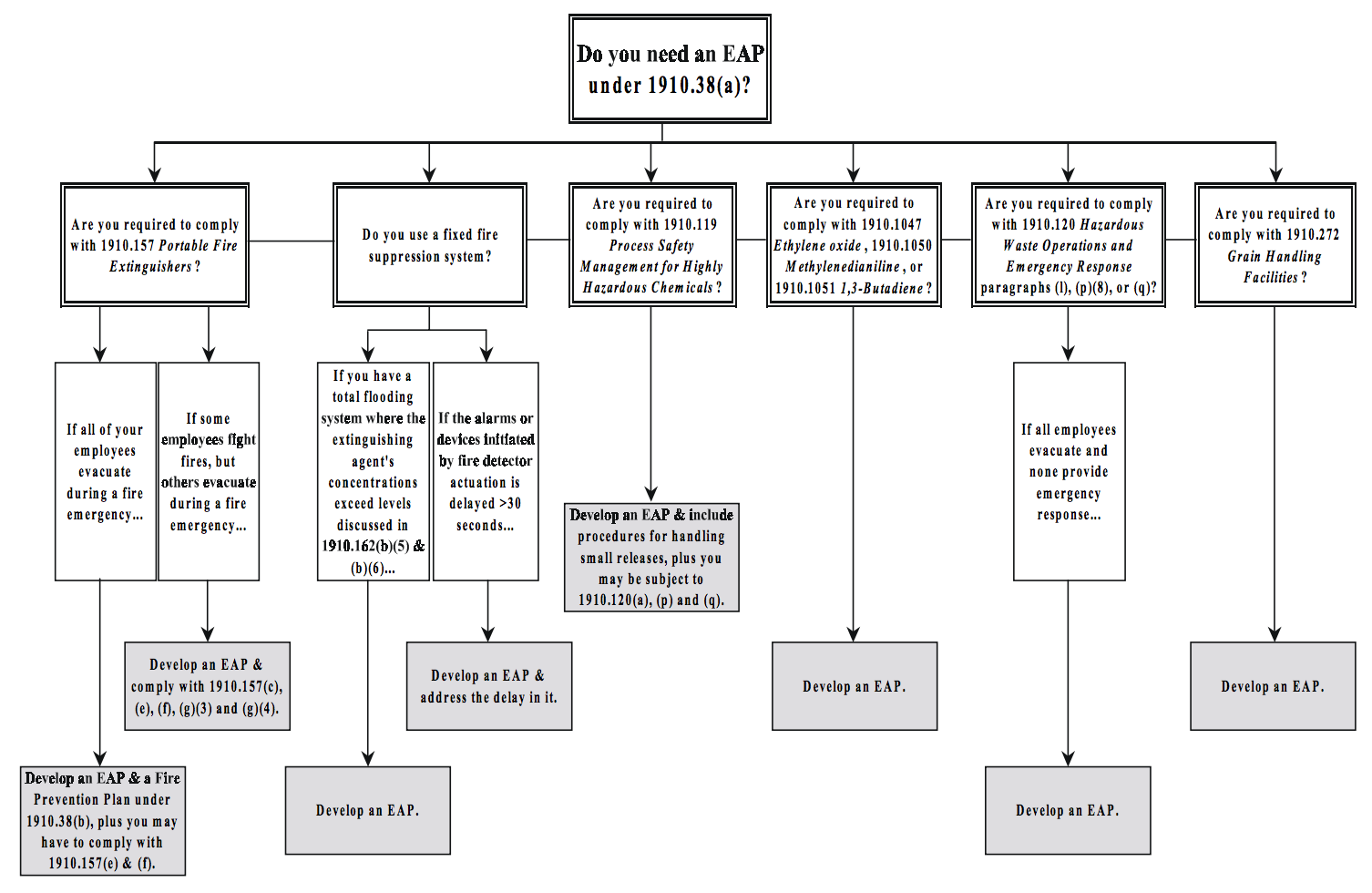
Here is a well done flow chart explaining all the above; however, the plot takes a twist from here…

Source: CPL 2-1.037 Compliance Policy for Emergency Action Plans and Fire Prevention Plans
After following the flow chart you may have also noticed that 1910.120 is NOT one of the seven (7) listed OSHA standards requiring an EAP; however, the flow chart makes mention of the HAZWOPER standard 1910.120. Basically, if we have hazardous materials at our facility and these HAZMATs may require some employees to evacuate, then we are REQUIRED to have an EAP.
OSHA’s Evacuation Plans and Procedures eTool was developed back in 2002 the SAME YEAR as the CPL referenced above. When we use OSHA’s Expert System we get asked a series of questions and depending on how we answer said questions, the “expert system” will tell us we either need an EAP or not. This is a GREAT tool that will answer the $64,000,000 question: Am I required to have an EAP?