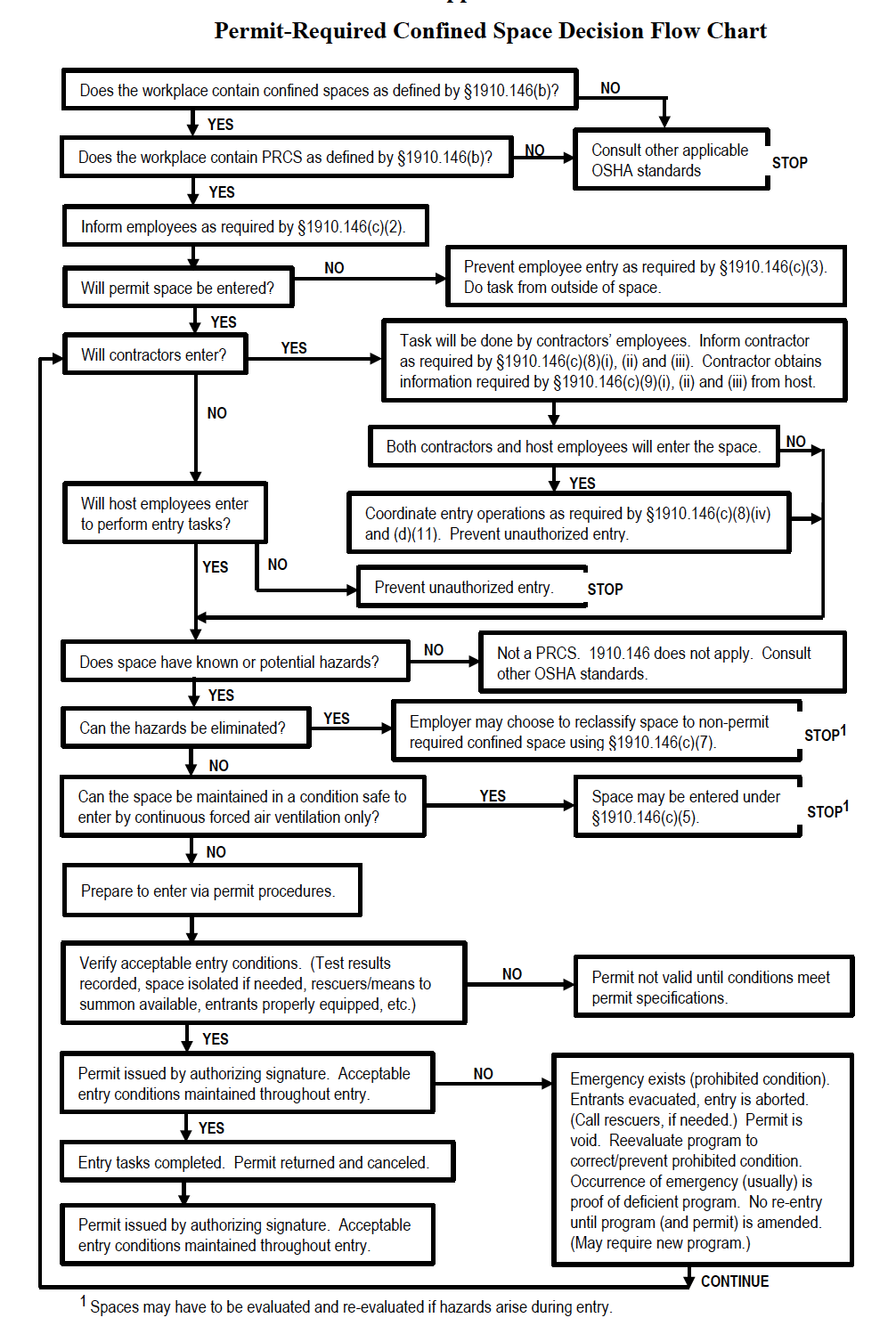
Is an ammonia condenser a PRCS? Some excellent videos show us the outside and inside of an ammonia condenser. Almost all of these condensers will have a similar configuration/design, although some of the newer units have guards inside that separate us from the fan blades. However, with no internal guard separating us from the fan, this space is a WITHOUT a DOUBT a PRCS!
PLEASE note that this video is of a unit that is not hooked to a power source and is void of ammonia gas. I did NOT shoot the video; it is a used equipment company sales video, but it is an excellent look inside a condenser. The good part starts at the 2-minute mark.
Here’s another excellent view from within a condenser. And pay close attention, and you’ll notice the former user of this unit did classify their unit as a PRCS. Also, this video shows how this single unit is actually ONE (1) big PRCS meaning all the fans and pumps would have to be LOTO’ed to enter just one of these compartments.
Here’s another manufacturer’s design: (that is three of the major players in this industry). Notice this one also appears to have NOT been identified as a PRCS by its previous owner. At least there is no DANGER! Sign at the entry portal at the time the video/pictures were taken, and there is no evidence that a sign once existed at the portal. But here is another video of a used condenser for sale, and it is clearly labeled as a PRCS…
So what makes a space a Confined Space (CS)? It is any space that meets ALL THREE (3) criteria:
- Is large enough and so configured that an employee can bodily enter and perform assigned work; AND
- Has limited or restricted means for entry or exit; AND
- Is not designed for continuous employee occupancy.
So let’s see:
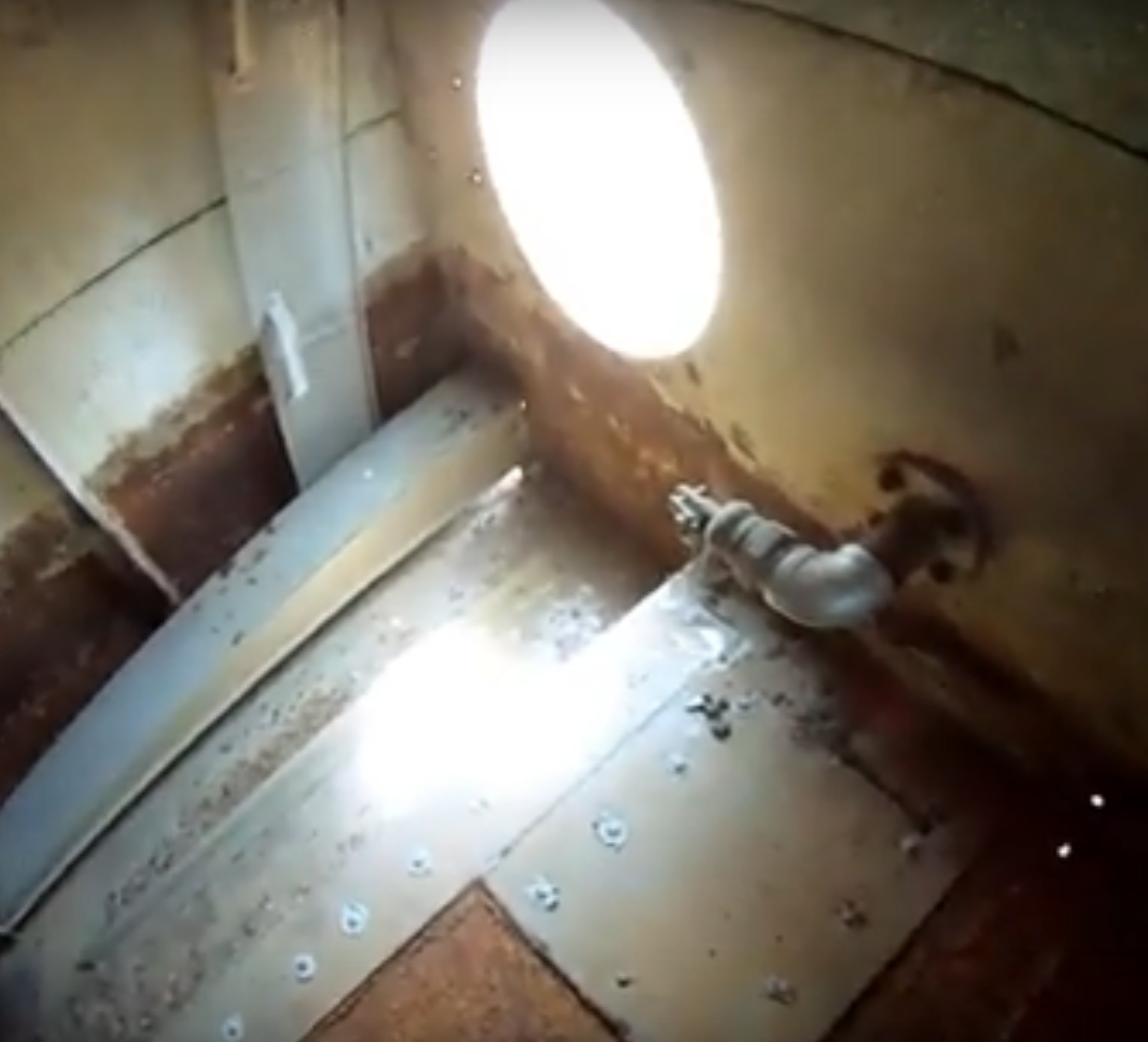
Is that space large enough and so configured that an employee can bodily enter and perform assigned work?
YES, here is a screenshot from within the space, and as can be seen in the video above, the person had no problems moving around with the camera once inside.
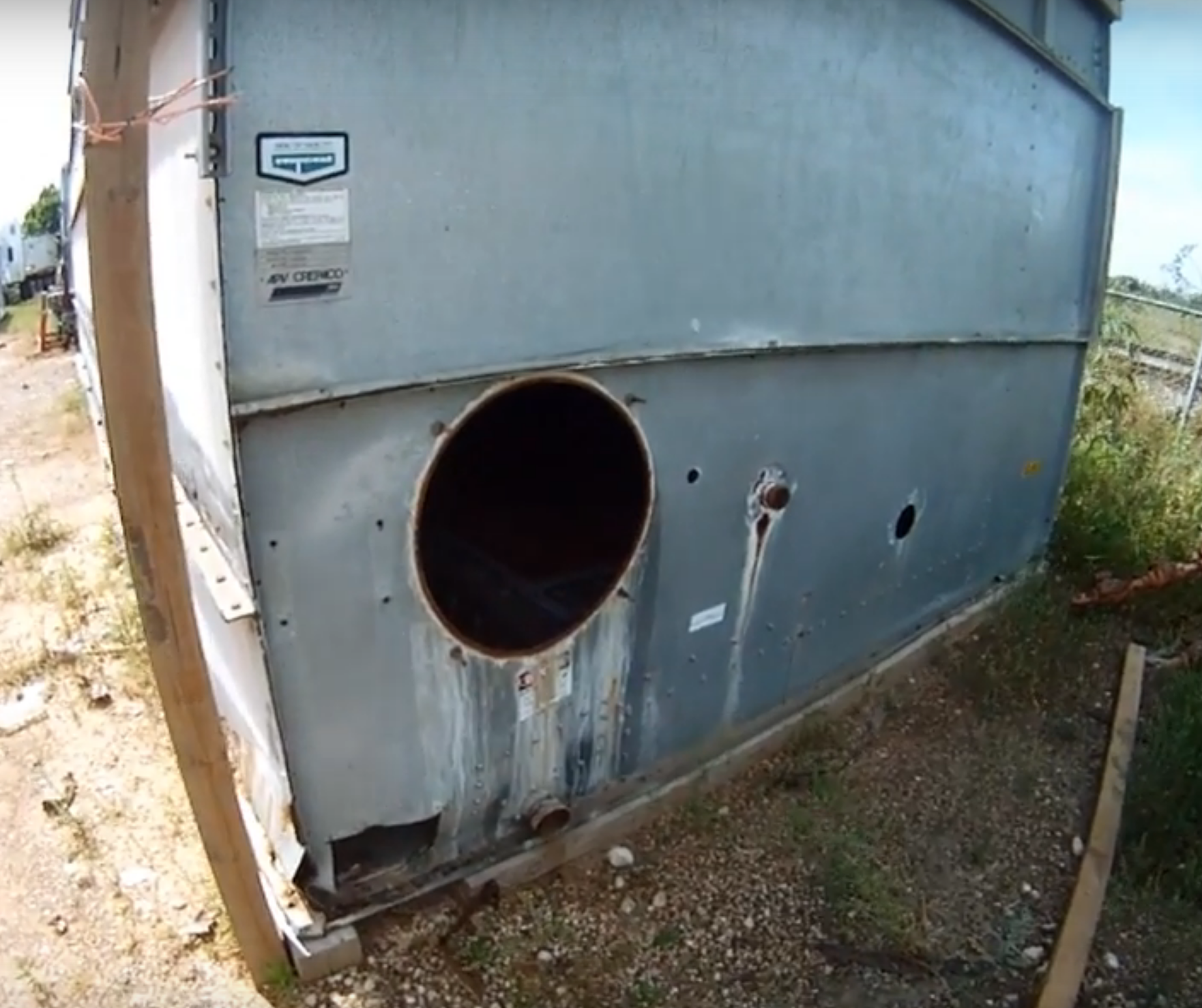
Does that space have limited or restricted means for entry or exit?
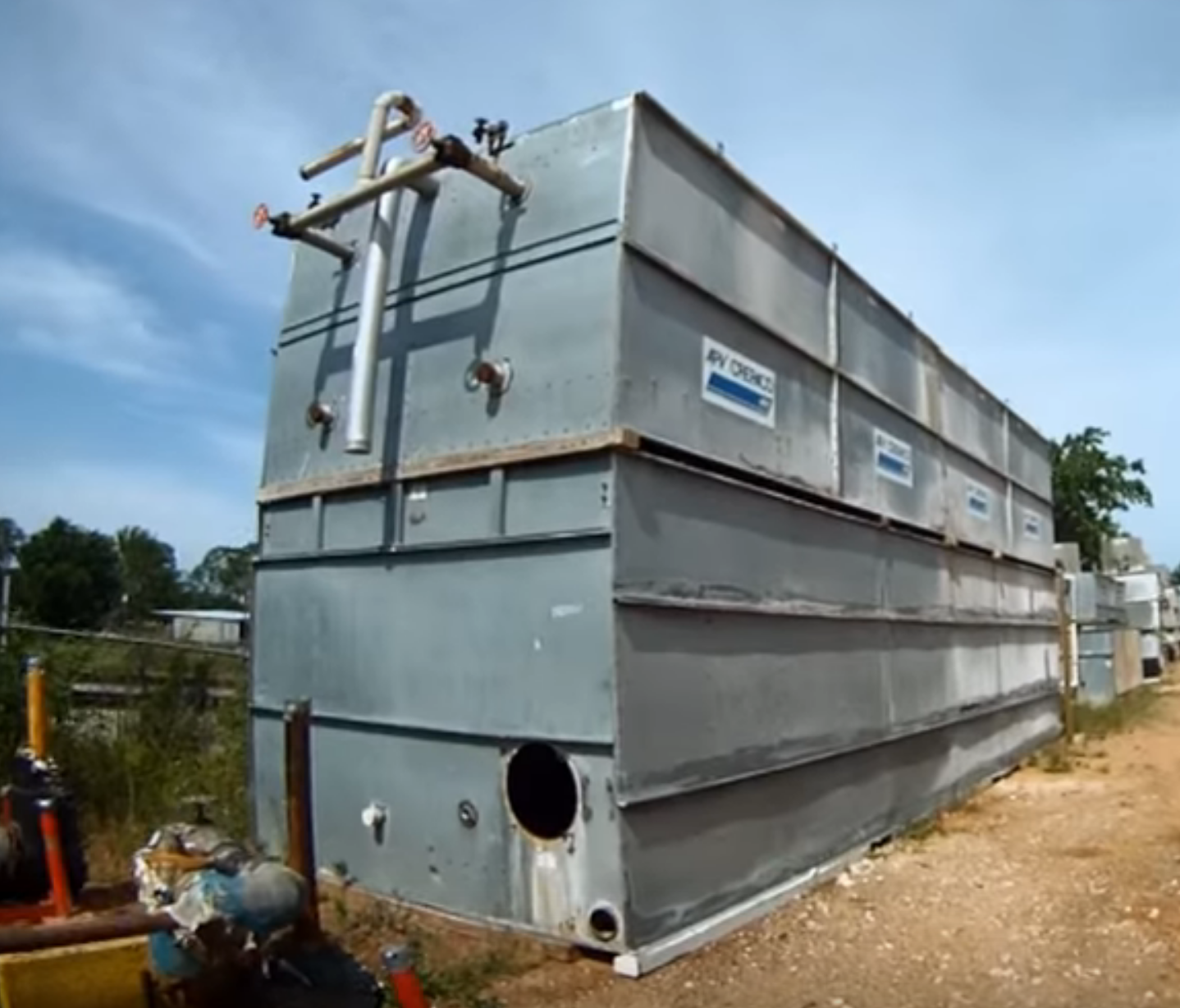
YES, even with the two (or more) openings, BOTH are LIMITED MEANS of egress! Any opening that we have to slide/slither/crawl through is a “limited means of egress” REGARDLESS of how many openings there are.
Was that space designed for continuous employee occupancy?
NO. This space is designed to be an ammonia condenser with water cascading down over the coils and fans moving large volumes of air thru the unit. No rational person can argue that this space was made for “continuous employee occupancy.”
This means our condenser is a CONFINED SPACE, but is it a Permit-Required Confined Space (PRCS)?
Let’s see:
A PRCS is a “confined space” that has one (1) or more of the following characteristics:
- Contains or has the potential to contain a hazardous atmosphere; OR
- Contains a material that has the potential for engulfing an entrant; OR
- Has an internal configuration such that an entrant could be trapped or asphyxiated by inwardly converging walls or by a floor that slopes downward and tapers to a smaller cross-section; OR
- Contains any other recognized serious safety or health hazard.
Leaving out, for now, the discussion regarding the Ammonia in the coils during entry, let’s save that for last; I do NOT believe this Confined Space has
- a material that has the potential for engulfing an entrant, NOR does it have
- an internal configuration such that an entrant could be trapped or asphyxiated by inwardly converging walls or by a floor which slopes downward and tapers to a smaller cross-section; HOWEVER, this CS does
- contain a recognized serious safety or health hazard in that once we have entered the space, we are exposed to an UNGUARDED FAN BLADE(S) and its POWER TRANSMISSION DEVICE (belt(s) and pulley(s)).
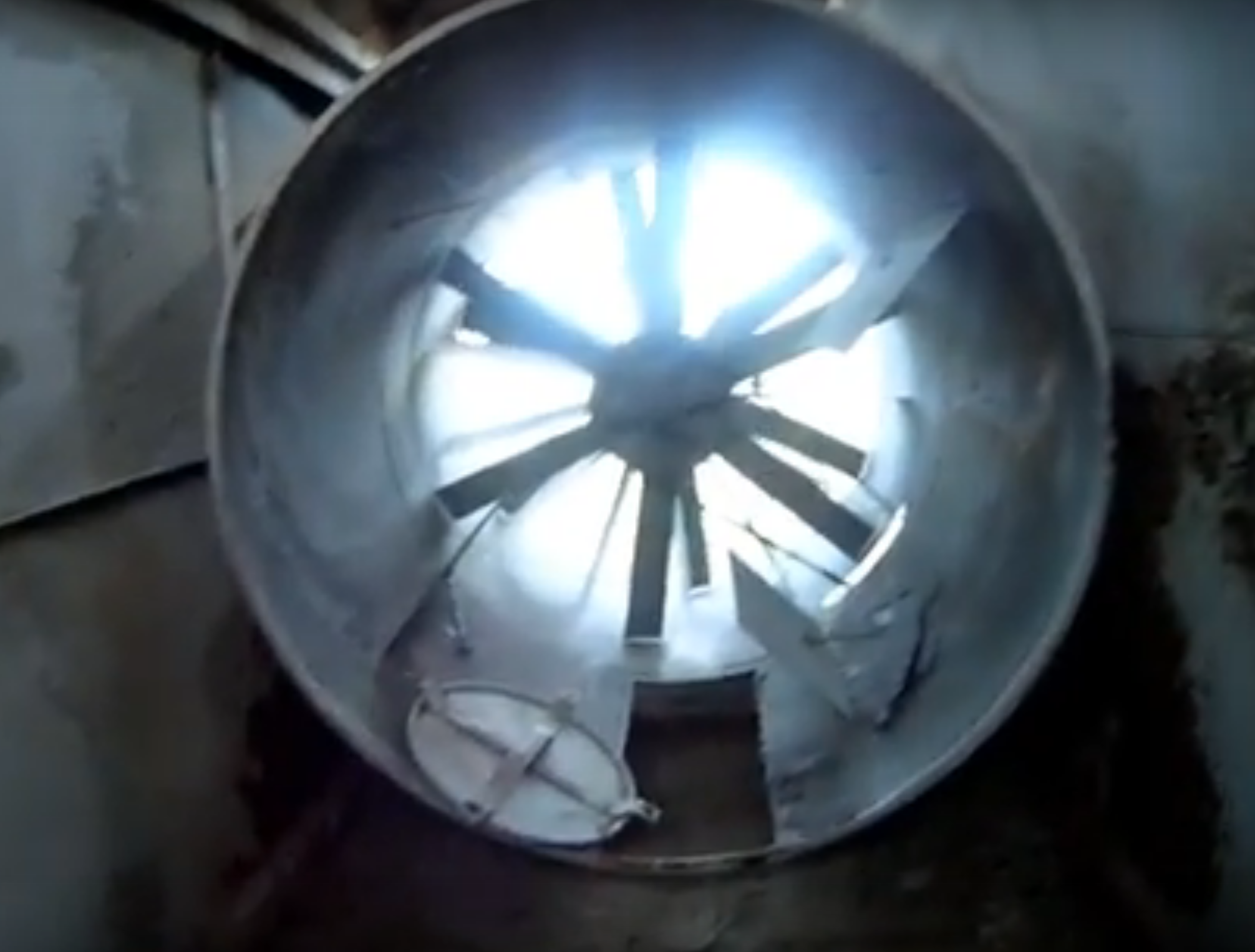
An interesting note, some manufacturers have revised their condenser design(s) and now include a screen (e.g., potentially a guard if the openings are small enough and it is securely attached) separating the entrant(s) from the fan blades and its power transmission device(s). I should also add that some of these units will have a “top fan,” and some people will claim that there is adequate distance between the working space and the top fan blades so that the blades or transmission device do not present a hazard. I do NOT subscribe to that way of thinking in my CS evaluations, as I have never seen a unit large enough that I did not consider “distance to the hazard” significant enough that there would be no exposure to said hazard. But some make the argument (badly flawed, in my professional opinion), so I throw that out there for the sake of fairness in this debate.
With all of this said, condensers MAY QUALIFY for “reclassification” using 1910.146(c)(7), which states:
1910.146(c)(7) A space classified by the employer as a permit-required confined space may be reclassified as a non-permit confined space under the following procedures:
1910.146(c)(7)(i) If the permit space poses no actual or potential atmospheric hazards and if all hazards within the space are ELIMINATED without entry into the space, the permit space may be reclassified as a non-permit confined space for as long as the non-atmospheric hazards remain eliminated.
1910.146(c)(7)(ii) If it is necessary to enter the permit space to eliminate hazards, such entry shall be performed under paragraphs (d) through (k) of this section. If testing and inspection during that entry demonstrate that the hazards within the permit space have been eliminated, the permit space may be reclassified as a non-permit confined space for as long as the hazards remain eliminated.
NOTE: Control of atmospheric hazards through forced air ventilation does not constitute elimination of the hazards. Paragraph (c)(5) covers permit space entry where the employer can demonstrate that forced air ventilation alone will control all hazards in the space.
1910.146(c)(7)(iii) The employer shall DOCUMENT the basis for determining that all hazards in a permit space have been eliminated, through a CERTIFICATION that contains the date, the location of the space, and the signature of the person making the determination. The certification shall be made available to each employee entering the space or to that employee’s authorized representative.
1910.146(c)(7)(iv) If hazards arise within a permit space that has been declassified to a non-permit space under paragraph (c)(7) of this section, each employee in the space shall exit the space. The employer shall then reevaluate the space and determine whether it must be reclassified as a permit space, in accordance with other applicable provisions of this section.
So without discussing the NH3 in the coils, could we LOCKOUT the fan(s) AND the water pump(s) and thus RECLASSIFY this condenser from a PRCS to a Non-PRCS using entry method as prescribed in 1910.146(c)(7)? I think it is possible on many of these units. But now we need to discuss the 800-pound gorilla in the room, which is NH3 in the coils, during entry. Do we have to evacuate the NH3 from the coils to RECLASSIFY this space?
I believe that the NH3 would have to be evacuated from the coils for this space to pose NO POTENTIAL ATMOSPHERIC HAZARD. Some will argue that if the coils have NO flanges or valves (e.g., leak points) within the space, then using the same logic as is used in “classifying hazardous locations” for electrical installations (e.g., NFPA 497). The NH3 would not have to be evacuated from the coils. Yet, if there is a “leak point” within the space that NH3 could leak into the space, the NH3 would have to be evacuated. I believe NFPA 497 methodology was NEVER intended to be applied in this manner. Doing so is asking for severe issues, and I do not like serious issues when dealing with life/death hazards! So yes, I require the NH3 to be evacuated from the coils before I will certify the space as a reclassified NON-PRCS.
But the bottom line, most of these units are Permit-Required Confined Spaces (PRCS)! Even the newer units that I have come across are PRCS. However, the manufacturers will “market” their product as having an “improved means of entry/exit”; these revisions do NOT provide UNLIMITED means of egress. And be very careful calling a “screen” meant to protect the fan blades from objects as a “guard” intended to protect entrants from hazardous exposures to the blades! Some manufacturers have done an excellent job guarding the fans from within, yet most have NOT, and these screens should IN NO WAY be considered a “machine guard” by any stretch of the imagination!
EACH SPACE MUST BE EVALUATED SEPARATELY! I have seen one model from a manufacturer, sitting right next to an older model from the same manufacturer, have a different procedure for reclassification due to a revised design. Still, from the outside, they look almost identical.