
Ammonia Explosion, Mississippi
Leaking ammonia ignited by a gas-fired unit heater exploded at this milk-processing, ice-cream manufacturing plant.
The explosion occurred in a one-story packaging warehouse. The building was constructed of concrete blocks with a roof system of cement fiberboard on steel joists and steel columns. There was no automatic sprinkler protection.
At approximately 7:05 am, the plant superintendent noticed that the high-pressure compressor to the freezers was not operating. At 7:10 am, he returned to the compressor room with a maintenance man. They observed that the pressure gauge on the intermediate cooling system was reading in excess of 150 psi. They could also hear gas escaping in the adjoining warehouse area. The two men immediately began to shut down electrical equipment and notified plant employees to evacuate the building. At approximately 7:15 am, the escaping ammonia exploded. Because the explosion damaged telephone lines, a maintenance man was sent across the street to phone the fire department.
Firefighters ventilated the roof and extinguished the fire using four large handlines. There were no reported injuries to plant personnel or firefighters.
Investigation revealed that a pressure switch failed in the intermediate cooling system. This caused a relief valve on a coil-jacketed tank to open, leaking gas into the warehouse area. This valve was not vented to the outdoors or back into t lower-pressure section of the system. The ceiling-hung gas unit heaters provided ignition.
Loss to the structure and building contents was estimated at $200,000.
Source: Fire Analysis and Research, 1979, “Bimonthly Fire Record”, Fire Journal, September, 13
July 2017 – Explosion, Ammonia Leak At Elk Grove Village Food Supplier
One employee was injured in an explosion caused by an ammonia leak Friday morning at a food supplier facility in northwest suburban Elk Grove Village, and a hazmat crew member was hospitalized for exhaustion. The explosion was reported shortly after 7 a.m. Elk Grove Fire Department officials said crews were working to contain an ammonia leak after the explosion. Fire officials said the explosion also caused a water main break at the facility, sending water flooding into the parking lot. Elk Grove Fire Chief Richard Mikel said ammonia began to leak inside the plant early Friday, and came into contact with a source of ignition, triggering an explosion which blew off part of the building’s façade. About 100 people were working in the plant at the time, and were evacuated to another company building a few blocks away. Four neighboring businesses also were evacuated, affecting about 125 people. A woman who lives nearby said her whole house shook as a result of the explosion. She said it felt like an earthquake. One woman was burned in the explosion, and was taken to Alexian Brothers Medical Center for treatment of non-life-threatening injuries, Mikel said. A hazmat technician also was taken to Alexian Brothers, after suffering exhaustion. Hazardous materials teams stopped the leak around 10 a.m., but Mikel said it could take a several more hours to vent the ammonia vapors in the building and get rid of the liquid ammonia. Mikel said the blast caused extensive damage inside the building, but building inspectors would not be able to assess the damage until the ammonia is vented. Crews were directing the ammonia vapors away from nearby homes. Officials said the ammonia likely was used in the building’s refrigeration system.
March 2016 – FATAL AMMONIA EXPLOSION Two dead in Basque Country ice factory explosion (two workers, 53 and 55, died in a blast caused by an ammonia leak – fire brigade have reported that the explosion and subsequent fire were caused by an ammonia leak – explosion occurred at approximately 14.45 – approximately 60 people are employed by the company, and the fact that only two people died is being attributed to the explosion having happened between shifts)
July 14, 2002 – Ammonia leak spurs blast, blaze at cherry processor – One person suffered minor burns; plant was mostly empty at time
By VANESSA McCRAY, Record-Eagle staff writer
ELMWOOD TOWNSHIP – An ammonia leak in a cherry processing plant in Elmwood Township caused an explosion and fire that gutted the loading dock and mechanical room and collapsed the roof of Cherry Growers, Inc. Elmwood Township Fire Marshal Marc Williams said four employees were in the plant, located at 9940 South Center Highway, when the leak was discovered at 11:30 a.m. Saturday. One of the employees was treated at the scene for minor burns. The other employees were unharmed. Officials do not know what caused the leak. Fire departments from Leelanau, Grand Traverse and Benzie counties responded to the call, as well as the Northwestern Michigan Regional Hazardous Materials Response Team. Officials estimate more than 100 personnel were on site. “What makes this fire different is that there is a large amount of pressurized ammonia, and one has a small leak,” Haz Mat Leader Jim Tuller said. “We are monitoring the air and there is no danger to anyone in Traverse City.” The company is owned by a cooperative of 130 cherry growers. It cans sweet cherries and stores the processed fruit inside a walk-in freezer using ammonia as a coolant. Cherry Growers President Tom Rochford was at the plant Saturday morning and described the incident as “very dangerous.” “Someone yelled, ‘There’s a leak,’ and we evacuated,” Rochford said. “One (employee) went back in to try to shut off the ammonia when it blew up, and we couldn’t find him at first. When we did he was OK.” At 3:30, the plant’s power was cut so the Haz Mat team could enter the building. At that time, Williams said a live fire was still burning through an eight-foot-high stack of cardboard buried under the collapsed roof. An excavator was brought in to remove the rubble so firefighters had access to the flames. Due to the high 80-degree temperature and the head-to-toe-lined Haz Mat suites, each crew stayed inside the building in 20-minute shifts. Tullen estimated each team member lost 15 pounds of water weight throughout the day. Red Cross volunteers were at the site all day, passing out water and serving hot dinners. Leelanau County Disaster Relief Team Director Gayle Egeler said this was by far the biggest effort she has ever been summoned to. “(The fire) also presented a unique challenge because several of the city’s Haz Mat team was carrying a large flag in the Cherry Royal parade. They had just reached 13th Street when the call came in,” Tullen said. “It could have been a lot worse than it was as far as getting the guys out.” Firefighters had put out the blaze and sealed the leak by 8 p.m. Williams said the Haz Mat team made several sweeps of the area and left the plant completely secured. John Stanek, whose father sold the plant to the co-op 12 years ago, was at his house on Lakeview Hills Road when the explosion occurred. “I was sleeping when a friend paged me and asked me if my house was on fire,” Stanek said, adding when he approached the building there were 40-foot flames shooting out from the roof. The plant was built in the early 1970s, and Stanek said it was designed to be almost completely automated. The plant’s self-sufficiency as well as this season’s lack-luster cherry crop were two reasons why the plant was mostly deserted Saturday. Officials are still investigating the fire and assessing the damage. Rochford said the damage to the plant is so extensive he doesn’t think any cherries will be processed there this season. “It looks pretty bad,” Rochford said. “We don’t know yet, but this cherry crop has been decimated, and it (the plant burning down) probably would be worse in a large cherry year. It’s kind of depressing.” Jim Empson not only helped build the plant, but is also one of the its closest neighbors. He said he first worried about his home, but then thought about the tough time this has already been for area cherry growers, who experienced 95 percent crop failure this year. “It just goes to show you that nothing gets so bad that it can’t get worse,” Empson said.
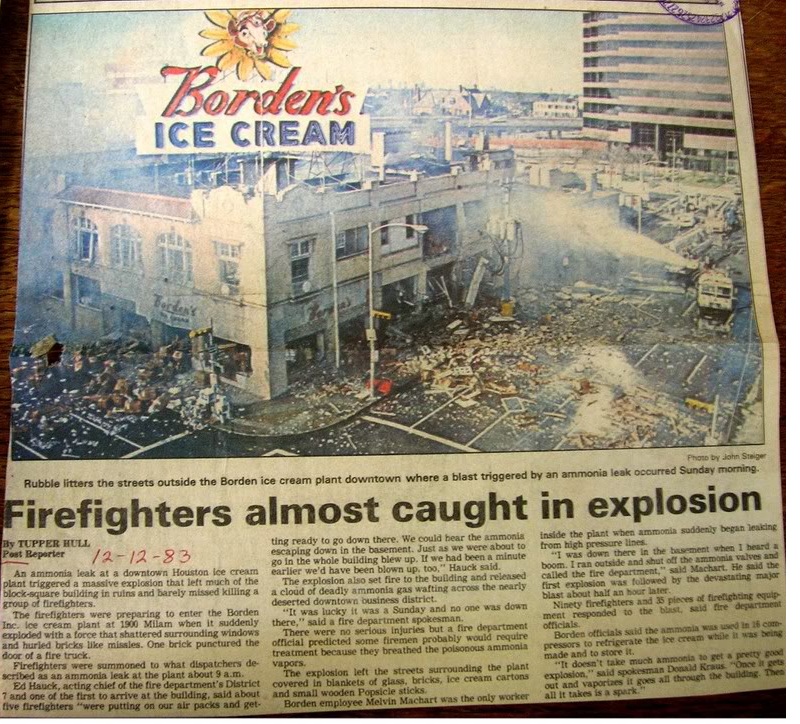
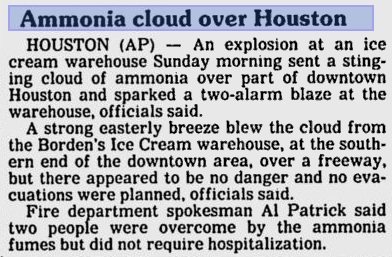
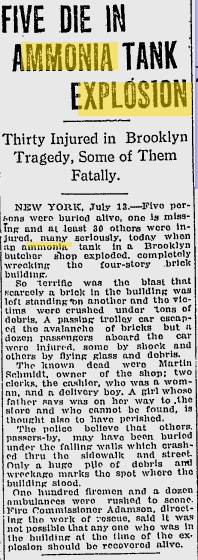
Explosion at Belle Vue: 2 injured between life and death
Tuesday, September 27, 2011, 17:11
An explosion occurred this morning at the Belle-Vue brewery Leeuw-Saint-Pierre. Two people were seriously injured. Their prognosis is engaged. The leak was stopped. An ammonia leak occurred around 8:50 Tuesday when three workers from an outside firm conducted the dismantling of an old installation. ” The ammonia leak comes from a ruptured line , “explained the spokesman of the Brussels fire brigade. “Workers who performed work disked a pipe containing liquid ammonia” . Two people were seriously injured and were taken to the military hospital of large burned-Neder-Over-Heembeek. Their prognosis is involved, officials said. The victims were employed by a company who works in the building. The mayor also mentioned a third victim, slightly injured, but not confirmed by firefighters. By cons, two paramedics were also slightly intoxicated and have themselves been defensive driving to the hospital Erasme Anderlecht, firefighters said Hal.
Explosion blows doors off New Smyrna Beach business
Source: By Jason Wheeler, Volusia County Reporter, Central Florida News 13

NEW SMYRNA BEACH – An explosion at a Volusia County business early Tuesday may have been caused by an ammonia leak, investigators said.
It happened around 3:30 a.m. at a Reddy Ice in the Airport Industrial Park, just south of New Smyrna Municipal Airport. Hazardous materials crews shut down the industrial complex as they cleaned up the scene. The complex has since reopened. According to New Smyrna Beach fire Chief David McAllister, a police officer was conducting his regular beat check Tuesday morning, when he said he smelled the unmistakable odor of ammonia. The officer then drove down Industrial Drive and saw the doors blown off the Reddy Ice building. That’s when he called in the fire department. McAllister said his crews searched the perimeter of the property, but found no massive ammonia cloud or any huge buildup of the gas, though they have smelled it off and on in the area. The fire chief said if there’s a bright spot to all of this, it’s that there are no homes anywhere near this site. It’s strictly an industrial complex. McAllister said he believes crews simply need to go in and shut a valve. They will then let the winds take care of the rest, as far as cleaning out what ammonia may be left in the area. No one was in the building at the time of the explosion, which investigators said apparently happened well before the police officer drove by the industrial park. An engineer and representatives from Reddy Ice have also arrived at the scene to help crews as needed.
How ammonia is used to make ice
Ammonia is a common way ice is produced. In some of Reddy Ice’s facilities, they utilize approximately 38,000 pounds of anhydrous ammonia as a refrigerant for ice manufacturing and storage. Anhydrous ammonia is widely used in industrial refrigeration applications and hockey rinks because of its high energy efficiency and low cost. Liquid ammonia is boiled and vaporizes. Its temperature drops to -27 F and makes the inside of the refrigerator cold. The cold ammonia gas is sucked up by the compressor, and the cycle repeats. Ammonia is used less frequently in commercial applications, such as in grocery store freezer cases and refrigerated displays due to its toxicity. Reddy Ice, a national company with plants in 31 states, according to its website, is the largest manufacturer and distributor of packaged ice products in the United States.


THREE KILLED, 17 INJURED IN LA SAFEWAY PACKING PLANT BLAST. (May 1976)
Vernon (AP) — An explosion that killed three persons and injured 17 at a meat packing plant may have been caused by refrigeration equipment, authorities say. But they do not dismiss the possibility of a bomb. The powerful blast rocked the Safeway meat packing plant in this industrial suburb of Los Angeles on Sunday, and authorities cautiously laid the blame on an ammonia-filled refrigeration system. “But we can’t rule out the possibility of a bomb,” said Capt. Richard Pavlovsky of the Vernon Fire Department.
“With the extensive damage that was done, it is hard to believe that ammonia could have done that. There was nothing at the plant that would explode besides ammonia, so we’re not ruling out anything.” Joining the investigation were federal agents from the Alcohol, Firearms and Tobacco Division. Ammonia clouds billowed from the scene after the blast as gas-masked rescuers moved in and out of the shattered plant, bringing victims to safety. Four firemen, burned by drifting clouds of ammonia, were among the injured, officials said. The blast ripped through the length of the block-long plant, knocking down walls, sending meat-cutting equipment flying and blowing open half-foot-thick steel refrigerator doors. “It (the building) just seemed to be lifted up in the air. Then the doors popped out,” said a Safeway truck driver who arrived at the plant at the time of the explosion. The three dead employes were identified as:
EMIL HORST, 50, no address available.
OLIN MOULTON, 45, of Hacienda Heights.
LEO DOOLEY, 59, of Bellflower.
Battalion Chief Tom Garner of the Vernon Fire Department said the three who were killed were in the meat cooler, “near the point of explosion and caught the worst of it.” Officials aid only four of the injured workers were hospitalized. The others were treated and released, said a physician at the scene. About 30 men were in the plant, and all but six or seven were injured, officials said. Plant employes said 300 people work in the building during the week. Fresno Bee California 1976-05-31
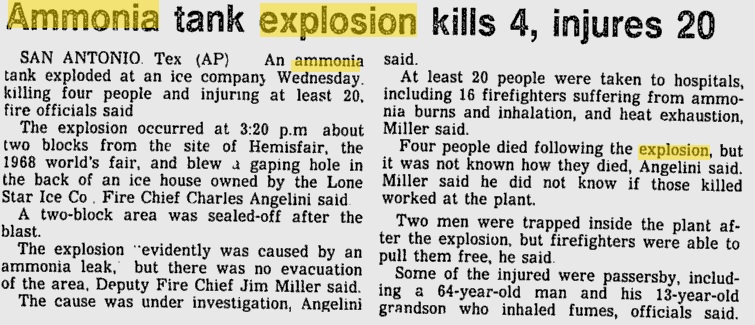
FOUR KILLED IN EXPLOSION @ ICE PLANT; 21 PEOPLE INJURED
(San Antonio, TX Ice Plant Explosion, May 1985)
San Antonio, Texas (AP) Investigators poking through the remains of a gutted ice plant tentatively blamed an ammonia leak for an explosion that killed four people and injured at least 21. Deputy Fire Chief Jim Miller said the blast Wednesday “evidently was caused by an ammonia leak” at the downtown plant, owned by Lone Star Ice and Food Stores and Southern-Hencke. All but one of the injured were treated at hospitals and discharged for ammonia burns or inhalation of fumes, officials said. DELFINO MUNOZ, 31, one of at least 15 firefighters hurt at the explosion site, was held overnight for observation, said Baptist Hospital spokesman Ruben Garansuay. The dead were identified as MACARIO MARTINEZ, 55, of San Antonio; JESUS RIOS ACOSTA, 31, of San Antonio; ASCENCION ORTIZ RODRIGUEZ, 33; and RITO CAZARES, 55, said investigator Eva Hickman of the Bexar County medical examiner’s office “There wasn’t a whole lot to work with,” said Alfred Lozano, an Emergency Medical Service paramedic who witnessed the removal of bodies from the plant. “They were pretty well burned up.” There was no fire at the ice house, but it “looked like a war zone,” said Lone Star district superintendent Dennis Cooper, who arrived five minutes after the explosion had ripped a gaping 40-foot hole in a wall. Cooper said the plant used ammonia pressurized in a piping system as a coolant to make ice. Officials said a pipe apparently gave way in the blast. Authorities sealed off a two-block area surrounding the plant, but did not evacuate residents in the neighborhood just blocks from the site of Hemisfair, the 1968 world’s fair. Allen Lander, an official with the ice company, inspected the plant but said there was no immediate way to determine how the explosion occurred. A company employee who asked to remain anonymous said the explosion “probably was (caused by) a backup in pressure because ammonia isn’t that flammable. They were working with the machine making ice in the back. There weren’t any flammable materials around that would have started it.” Chronicle Telegram Elyria Ohio 1985-05-30
Passaic, NJ Beef Company Explosion and Fire, Nov 1899
Passaic, N. J., Nov. 27.—The plant of the Passaic Beef Company on the Erie Railroad, near the station here, was destroyed by fire yesterday. The fire was one of the worst that this city has ever seen. The building was largely devoted to hold storage, and the firemen were driven back time and again by ammonia fumes which escaped from the tanks and pipes. During the fire the big tank in which the ammonia is compressed blew up, George Mi[ineligible] and George Griffin, employes[sic] of the company, were in the building when the explosion occurred. Both were close to a door and the concussion buried them through it. They were severely bruised. Several firemen were knocked down, but not seriously hurt. The fire started in the smoke room and burned slowly but steadily through the plant. There was a carload of chickens on a side track close to the building, and this was burned. There were about 20,000 pounds of beef in the building, and 2,000 turkeys all of which were consumed. The fire blocked travel on the Erie Railroad for hours, and trains had to be sent by way of Newark from Paterson in order to reach Jersey City. The loss is estimated at between $5,000 and $7,000. This is partly covered by insurance. New Haven Evening Register, New Haven, CT 27 Nov 1899