
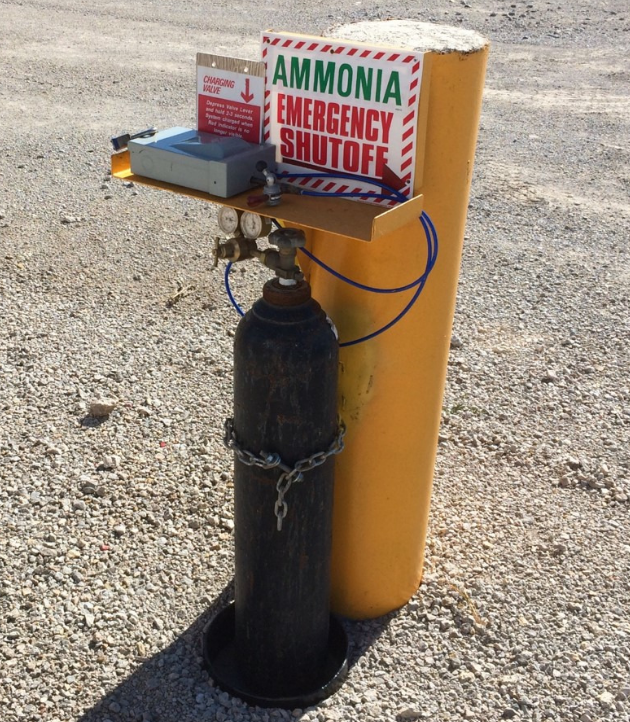
Anhydrous Ammonia Emergency Shutdown for Hose Severance

NH3 ESD

In the past 2-3 years, I have begun seeing Anhydrous Ammonia systems that claim to be built to ANSI K61.1 or CGA 2.1, but somehow these processes do not have the Emergency Shutdown Systems required by these two Recognized and Generally Accepted Good Engineering Practices.  So with the help of the Illinois Fertilizer & Chemical Association, I thought it would be helpful to straighten out the confusion…

(emphasis by me)


CGA 2.1-2014 states:

5.10.8.1

ALL stationary storage installations with a water capacity greater than 4000 gal (15.1 m3) shall have approved emergency shutoff valve(s) or backflow check valves installed in the liquid and vapor fixed piping of the transfer system within 5 lineal ft (1.5 m) or within reasonable distance of where the hose or swivel piping is attached to the fixed piping. This requirement does not apply to fixed piping feeding a process system. The previous emergency shutoff valve(s) or backpressure check valves shall be protected from any possible pull-away-while connected incident between the mobile container and the transfer station. As a result, any break resulting from a pull will occur on the hose or swivel-type piping side of the connection while retaining intact the valves and piping on the plant side of the connection.

Protection from pull-away-while-connected incidents may be accomplished by:

  • Reinforced concrete or reinforced-concrete and structural steel bulkheads or equivalent anchorage-strong enough not to break and massive enough not to be uprooted by the motor vehicle;
  • Use of approved breakaway devices. specifically designed for this purpose: or
  • Use of shear fittings designed to conform to good engineering practices

Protection from pull-away-while-connected incidents is appropriate for all connections to mobile containers. In determining “reasonable distance” protection for persons, property, and the environment shall be addressed.  Such anchorage is not required for tank car unloading.

Approved emergency shutoff valve(s) shall incorporate a reliable actuation system that will close all of the emergency shutoff valve(s) of the piping system on the first attempt in the event of emergency or testing from a remote location.


9 Systems mounted on trucks, semitrailers, and trailers for transportation of ammonia

This section applies specifically to systems mounted on trucks, semitrailers, and trailers (other than those covered under Sections 11 [Systems mounted on farm wagons (implements of husbandry) for the transportation of ammonia] and 12 [Systems mounted on farm equipment (implements of husbandry) for the application of ammonia used for the transportation of ammonia]). Section 5 [Basic Rules] applies to this section unless otherwise noted.

Systems for trucks and trailers for transportation of anhydrous ammonia, in addition to complying with the requirements of these standards, shall also comply, where required, with the requirements of DOT and those of any other regulatory body, which may apply.


9.3.3 Every liquid or vapor discharge opening in each container shall be provided with a remotely controlled internal shutoff valve . For every such opening of LESS THAN 1.25 in (32 mm) National Pipe Taper (NPT), an excess flow valve with a manual shutoff valve may be used instead. The internal shutoff valve may be operated by mechanical means, by hydraulic means, or by air or gas pressure.

NH3 ESD

Source: Illinois Fertilizer & Chemical Association


9.3.3.2  On a container over 3500 gal (13 m3) water capacity, EACH INTERNAL SHUTOFF VALVE SHALL BE PROVIDED WITH REMOTE MEANS OF CLOSURE, BOTH MECHANICAL AND THERMAL, which are installed at the ends of the tank IN AT LEAST TWO DIAGONALLY OPPOSITE LOCATIONS. If the discharge connection at the tank is not in the general vicinity of one of the two locations previously specified, one additional fusible element shall be installed so that heat from a fire in that area will activate the emergency control system . Fusible elements may not have a melting point exceeding 250°F (121 °C).

9.3.4 The requirements of 9.3.3 do not apply to a 1.25 in (32 mm) NPT liquid or vapor discharge opening equipped with an excess flow valve and manually operated shutoff valve installed before October 1, 1984.


Snappy Joes OEM

In all installations, a remote release shall be connected to the latch on all emergency valves at the bulkhead. The remote release has to extend to a place where it can  be easily reached to close the Type N551 valve(s) in the event that an emergency makes the valve(s) inaccessible. The remote release shall shutdown all emergency valves when activated. Remote release activation may be by cable or pneumatic hook-up.

WARNING!  Remote release cables shall be installed so that they will close the Type N551 valve(s) when pulled from the farthest remote location.  Cable shall operate smoothly, over pulleys and/or through conduit. Do not kink cable or run cable around sharp corners. If installed in conduit, keep water out of conduit. Frozen water, dirt or dried mud in the conduit will render the remote release inoperable.  Remote releases used on Type N551 valve shall not:

(a) be made from plastic or fiber rope;

(b) have any kind of fusible link which could melt and prevent the cable from pulling the Type N551 latch.

To provide a remote release, aircraft cable can be connected to the short looped cable on the valve and run to the remote release point over pulleys or through conduit. Adjust the cable so that minimal pull is required to close the emergency valves.

Scroll to Top