
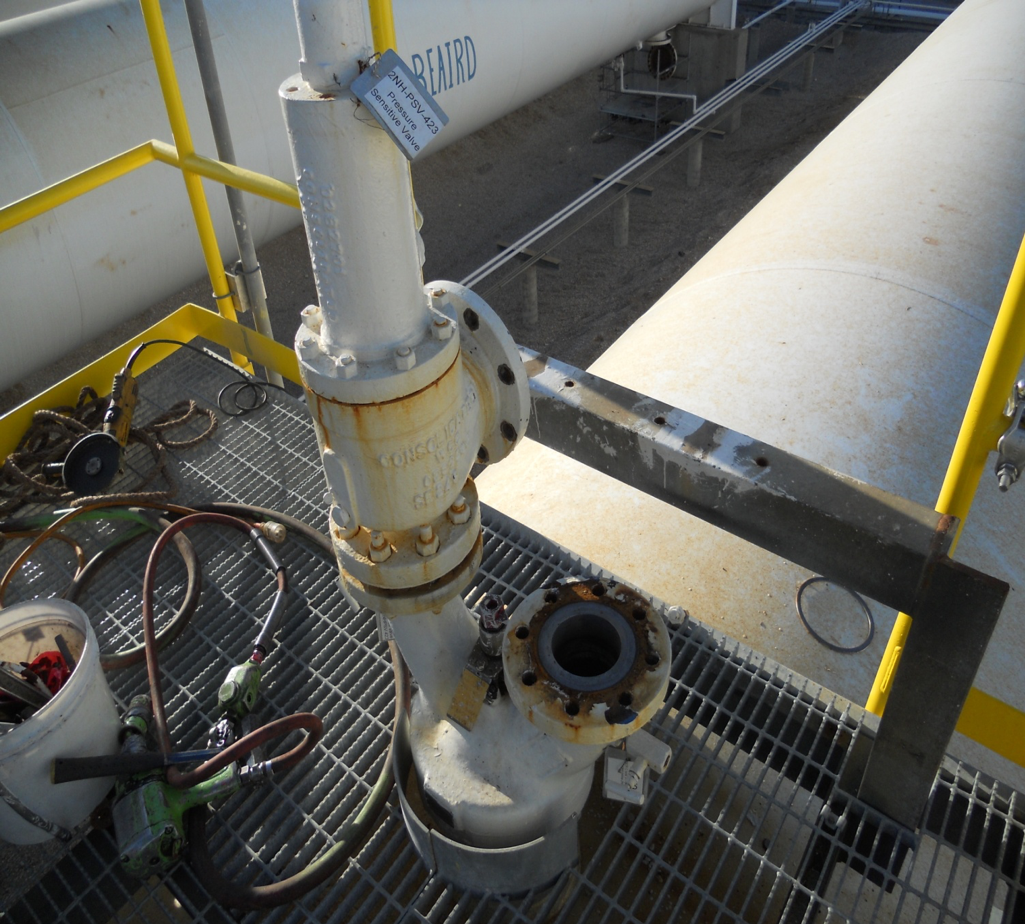
An ammonia storage tank was taken out of service for its 10-year non-destructive examination. After the tank was purged and opened, two (2) contractors were removing two (2) relief valves for their 5-year inspection and tests. The two (2) relief valves are 8 bolt flanged connected to a wye piping fitting equipped with a selector valve (as shown in the picture to the left). The selector valve is used to select one of the relief valves in-service. In addition, the wye is fitted with a 1/2” bleed valve between the relief valve(s) and the selector valve, which vents to atmosphere.
The two contract employees had removed one of the safety relief valves and were in the process of breaking the flange on the second relief valve by using a cut off wheel to remove the flange bolts. The contract employee was lying down on the platform while cutting the 5th flange bolt when trapped ammonia gas escaped through the cracked flange. The ammonia gas contacted the contractor’s face shield, which was approximately two feet from the flange. The contract employee inhaled ammonia gas and had exposure to his face and eyes, which caused severe irritation. The second contract employee was exposed to the ammonia gas as he was located downwind from the escaping ammonia. However, the second contract employee did not experience any irritation or difficulty breathing as a result.