
Anhydrous Ammonia Tank Catastrophic Failure

Potchefstroom South Africa

Potchefstroom South Africa

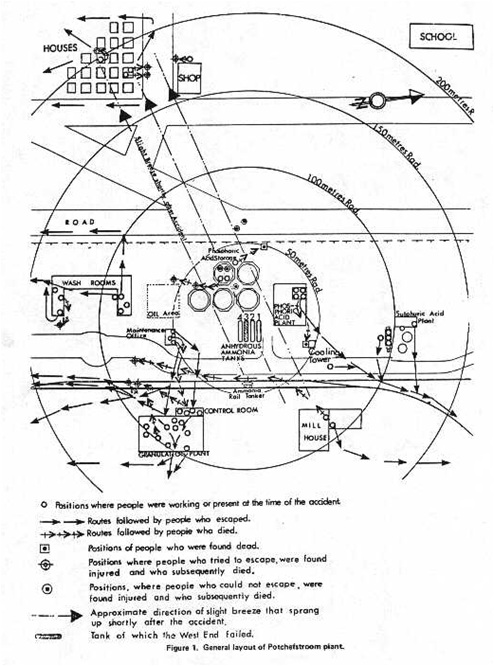
On July 13, 1973, in Potchefstroom, South Africa there was an anhydrous ammonia accident involving a catastrophic failure of a pressurized ammonia storage tank that instantaneously released 38 tons of anhydrous ammonia into the atmosphere. Eighteen people died and an unknown number were injured. A visible cloud extended about 1,000 feet wide and about 1,400 feet downwind; all deaths occurred within 600 feet of the release point.

The Incident

A large crack developed on one head of a horizontal pressure vessel.  The leaking ammonia chilled the steel near the crack (from ambient to -28 deg F), which caused the crack to immediately spread into a 4 ft. diameter gaping hole. 38 tons of anhydrous ammonia were lost instantaneously from the vessel and associated piping.

The Consequences

Eighteen people died from a lethal dose of anhydrous ammonia and fourteen of 350 plant workers died. Thirty workers were within 250′ of the vessel.  Four of the fatalities occurred in a nearby residential area 500-600′ from the failed vessel.  In all sixty-five workers required medical treatment.

The tank traveled horizontally and impinged on nearby tanks.  As the tank lost momentum there was considerable flashing (17%).  No ammonia liquid appeared to be pooling on the ground (no rain-out) and the initial cloud was 500′ in diameter by 65′ high.

Reasons For Failure

Hot work had been performed on the vessel prior to placing it back into service after some repair work.  The vessel was NOT stress relieved after the welding repairs were completed and the vessel had NOT been stress relieved during initial fabrication!!!!  The vessel materials of construction were also not rated for -28°F service.  This allowed the small crack to easily spread to a much larger crack, leading to the catastrophic failure.

Potchefstroom South Africa

Source:  HLonsdaleAmmonia Tank Failure — South Africa, Vol. 17,Ammonia Plant Safety, AIChE, 1975, pp. 126–131.

Lessons Learned

  • Most pressure vessels require stress relieving.
  • Vessel should be stress relieved after hot work.
  • Select materials for worst case temperatures (hot & cold).
  • Residential area too close to fence line.
Scroll to Top