
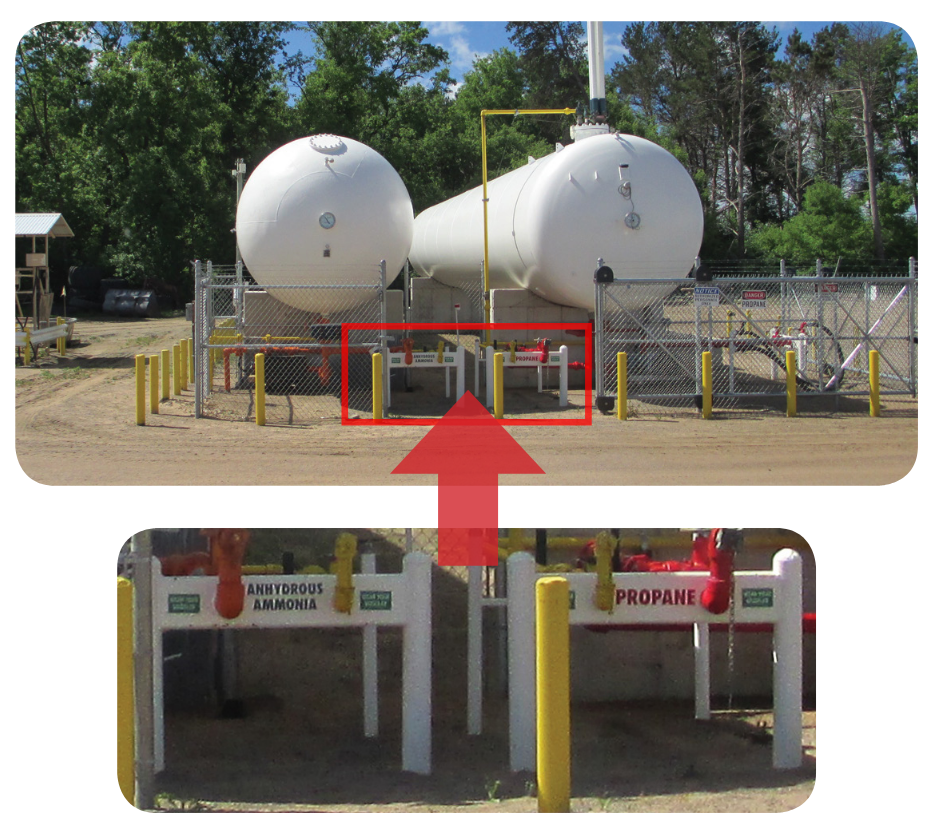
 This is another Wrong Chemical – Wrong Tank incident in which Anhydrous Ammonia (NH3) was off-loaded to Propane Storage Tanks.
Two 30,000-gallon propane tanks, each at 70% capacity, were additionally filled to 85% with NH3.
Similar plumbing on BOTH transport and storage tanks made the transfer possible, as both propane tanks shared common piping, had galvanized fittings, and were clearly labeled as “PROPANE”.
Chemical and Physical Properties
Propane and NH3 are immiscible liquids (liquids that don’t dissolve in each other). Although small amounts of NH3 will dissolve in large amounts of propane, and vice versa, a layering of liquids will occur if large quantities are involved. NH3 being heavier will form a liquid layer on the bottom with propane above. The vapor pressure of propane and ammonia in a closed container is NOT the average of, but the SUM of the partial pressures of each. Table 1 shows the relationship between the temperature and vapor pressure of these two compounds in a closed container.
TABLE 1. Temperature versus vapor pressure of a large quantity MIX of NH3 and propane.
| Temperature (ºF) | Vapor Pressure (psi) |
| -30 | 5 |
| -20 | 14 |
| -10 | 26 |
| 0 | 39 |
| 10 | 56 |
| 20 | 75 |
| 30 | 97 |
| 40 | 122 |
| 50 | 152 |
| 60 | 186 |
| 70 | 224 |
| 80 | 268 |
| 90 | 317 |
| 100 | 371 |
Propane pressure relief valves will open when the internal pressure reaches 250 psi. This corresponds to a propane/NH3 temperature of around 70ºF. Propane alone will pressurize to 250 psi at a temperature near 120ºF.
Reactivity
NH3 is corrosive to brass, copper and galvanized components/fittings. When these components/fittings come in contact with NH3 liquid or vapor, the metal will corrode and will fail. Therefore, if NH3 is improperly added to a propane tank, liquid or vapor from both compounds could escape uncontrolled into the environment. Incompatible components/fittings exposed to NH3 are compromised and must be disposed of immediately.
Remediate
Flaring the propane/NH3 mixture is the preferred disposal choice. A remote location is necessary to maintain public safety. If possible, choose a site distant from roads and residences.
A vapor flare can be used to burn propane from the tanks. Vapor flares may take weeks to complete in cold weather, but a much shorter time in warmer weather. Be aware that auto-refrigeration and a pressure drop will occur if the release of vapor to the flares causes a significant liquid temperature drop. Flaring directly from the storage tank is acceptable provided that all components/fittings are compatible and can be done safely.
A liquid flare will greatly accelerate the flaring process.
Prevention
Ensure appropriate signage and proper color coding are on transfer areas, plumbing, and each tank. Situate tanks in separate areas if possible or if tanks are adjacent, switch plumbing to opposite ends to prevent accidental mixing of NH3 and propane. Anyone working with these materials should maintain awareness about the hazards and response to prevent a release or incident.
Make sure all handlers and users of NH3 and propane are trained and competent in “tank identification”. Practice emergency response steps before an incident happens.
CLICK HERE for the Minnesota Department of Agriculture Fact Sheet (PDF: 47 KB / 2 pages)