
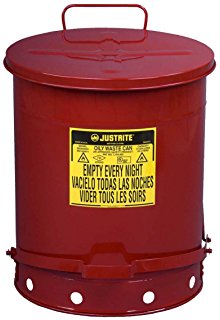
 Well, since I am writing about it, you have probably already know the correct answer. But where does this requirement originate? OSHA Standard(s), OSHA’s General Duty Clause, EPA standards, or…
Yep, you guessed it – the International Fire Code (IFC). Granted, the IFC is not heavily enforced BEFORE accidents, but most states have adopted the IFC wholly or in some revised form (i.e., “revised code”). So here is what I’m talking about…
304.1 Waste accumulation prohibited. Combustible waste material creating a fire hazard shall not be allowed to accumulate in buildings or structures or upon premises.
304.1.1 Waste material.
Accumulations of wastepaper, wood, hay, straw, weeds, litter or combustible or flammable waste or rubbish of any type shall not be permitted to remain on a roof or in any court, yard, vacant lot, alley, parking lot, open space, or beneath a grandstand, bleacher, pier, wharf, manufactured home, recreational vehicle or other similar structure.
304.1.2 Vegetation.
Weeds, grass, vines or other growth that is capable of being ignited and endangering property, shall be cut down and removed by the owner or occupant of the premises. Vegetation clearance requirements in urban-wildland interface areas shall be in accordance with the International Wildland-Urban Interface Code.
304.1.3 Space underneath seats.
removed – not relevant to the discussion
304.2 Storage.
Storage of combustible rubbish shall not produce conditions that will create a nuisance or a hazard to the public health, safety or welfare.
304.3 Containers.
Combustible rubbish and waste material kept within or near a structure shall be stored in accordance with Sections 304.3.1 through 304.3.4.
304.3.1 Spontaneous ignition.
Materials susceptible to spontaneous ignition, such as oily rags, shall be stored in a listed disposal container. Contents of such containers shall be removed and disposed of daily.
Storage of combustible rubbish either indoors or outdoors must be approved by the fire code official. Combustibles should be accumulated in NONCOMBUSTIBLE CONTAINERS, such as metal trash cans with tight lids, steel barrels or steel dumpster bins, which should be removed from the site regularly. The use of plastic waste containers “should be discouraged” (quote from the AHJ) due to the extremely high fuel content of such materials, which can sometimes be several times the fuel content of the waste material they contain. Such containers could, under fire conditions, cause rapid fire spread and overtax sprinkler systems, where installed. This section mentions public health as well as safety and welfare, indicating concern over retention of decomposing organic waste as well as flammable and combustible materials.
Disposal containers, often called “waste cans” or “oily rag cans,” (as shown above) used for storage of materials that might auto-ignite as a result of the spontaneous combustion process MUST be TESTED and LISTED for that use by a RECOGNIZED TESTING LABORATORY or agency and MUST BEAR A LABEL showing that they have been tested, along with the name of the testing agency.
Such containers are most commonly round and generally available in sizes ranging from 5 to 40 gallons (19 to 151 L). They are equipped with a manual or foot treadle-operated lid that opens to a MAXIMUM angle of 60 degrees (1.05 rad) and closes by GRAVITY. These containers are designed to prevent continuing combustion of the contents if ignition occurs. Container design includes features that keep the can body containing waste from coming into contact with combustible surfaces of walls or floors. UL 32 provides further information on the construction, testing, and listing of these containers.