
I will encourage each of you to pull the “owner’s manual” for your LEVEL A suits and spend 30 minutes reading it. My days in LEVEL A’s are nearly behind me at this stage of my career, but I just can’t let it go completely, so I recently received my new LEVEL A from my favorite provider (who will remain nameless). I thought I had this all figured out over the past 20 years of using and caring for my LEVEL A suits until I read my NEW “owner’s manual”! There are some very significant needs that may be a surprise to some; however, the biggest issue I have is that now I am forced to spend an additional $37 to purchase ASTM F1052, “Standard Test Method for Pressure Testing Vapor Protective Ensembles” as the manufacturer no longer provides annual pressure testing procedures and merely REQUIRES their suit be tested to this RAGAGEP. And I might add, the manufacturer does NOT mention 1910.120 Appendix A as an alternative – which is a FREE alternative! I know it is chump change for such a critical function, but that is not the ONLY change that will INCREASE your costs of utilizing LEVEL A suits. Here are some more “maintenance” items that may need to be incorporated into your PPE program…
NOTE: Italicized text is quoted from the manual, and all bolded text is my emphasis
Shelf-Life
XXXXXX garments may be used as long as they pass a full visual inspection. In addition to the visual inspection, Level A garments
must pass the ASTM F1052 inflation test. All XXXXXXXXX chemical protective garments may contain materials, including gloves and closures for which there is no specific storage life data available. It is suggested that garments be labeled and retired to “Training Use Only” after 5 years after receipt by the purchaser.
Exhaust Valve Replacement Schedule
The diaphragm in each exhaust valve (each Level A suit has two (2) valves) MUST be replaced by the end user every two (2) years from date of manufacture. Instructions on purchasing replacement exhaust valve diaphragms can be found on-line at XXXXXXXXXX.com or by contacting XXXXXXXX Customer Service at 800-XXX-XXXX. Instructions for replacing the exhaust valve diaphragm can be found in the XXXXXX Personal Protection Instruction Manual for Universal Pressure Test Kit. (Another purchase that is now required)
Decon??? Not anymore!
Here are the statements found throughout my manual for my new suit REGARDING its REPEATED USE…
XXXXXXXX garments are designed for limited-use applications – they can be worn until damaged, altered or contaminated. If the garment is contaminated during use, it must be discarded. If the garment is damaged during use, retreat immediately, undergo field decontamination, and then discard the garment. It is the responsibility of the safety professional having responsibility over usage of the garment to determine whether the suit has been contaminated or be safely re-used.
You can clean garments that are soiled but NOT (emphasis added by me) contaminated with hazardous substances.
Field Decontamination
The purpose of field decontamination is to allow you to doff the garment without being harmed by contaminants on the garment surface. Field decontamination does not make a garment safe for re-use. If you suspect or know that a garment has been contaminated, it MUST (emphasis added by me) be discarded after field decontamination.
If you know or suspect that a garment has been contaminated with hazardous radioactive or chemical materials:
-
- Use water and mild dishwashing liquid to field decontaminate the garments prior to doffing.
- Do not use oxidative, corrosive or reactive decontamination solutions to remove known or suspected chemical or radioactive contaminants.
- You must discard the garment after field decontamination.
- Do not use a garment that has been chemically or radioactively contaminated for training.
3. If the garment has been chemically exposed or is suspected to have been exposed, thoroughly clean the garment using household dishwashing liquid and soft brushes, followed by thorough rinsing in water. Do not re-use a garment with known or suspected chemical contamination.
Retire XXXXXXX garments from service if any of the following criteria are met:
-
- Garment fails to pass inspection.
- Vapor-protective garment fails the inflation test.
- Garment is altered, abraded, cut, torn, punctured, or otherwise, and in any way, breached.
- Garment has had prolonged exposure to intense heat and/or ultraviolet light.
- Garment has been contaminated which is determined by responsible end-user knowledge of use and exposure.
- Garment has been decontaminated with an oxidative, corrosive or reactive decontamination agent.
Pressure Tests (No longer just an annual requirement!)
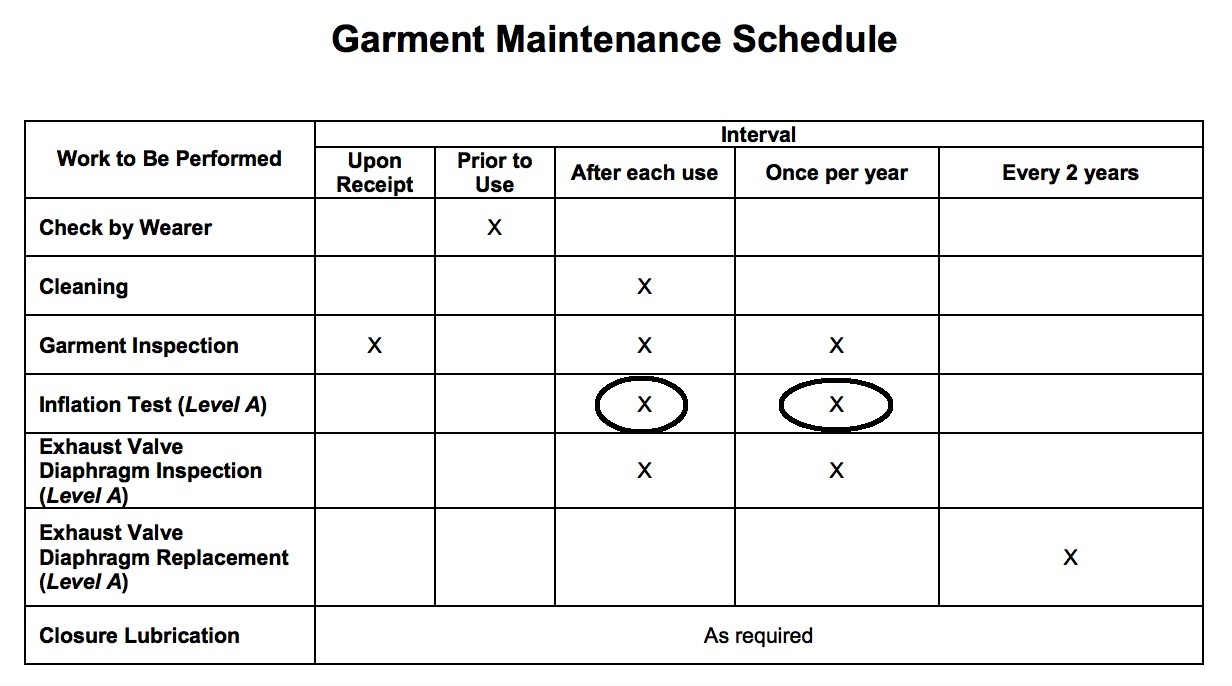
Subject Level A garments to an inflation test during each garment inspection. As part of the inflation test, the exhaust valve diaphragms must be removed. Replace these exhaust valve diaphragms every two years from the date of suit manufacture. Outside this schedule visually inspect the exhaust valve diaphragms. Use a magnifying glass to look for cracks or deterioration. Replace damaged or deteriorated diaphragms. Instructions for replacing the exhaust valve diaphragm can be found in the XXXXXX Personal Protection Instruction Manual for Universal Pressure Test Kit. (purchased separately)
The manual calls for these inspection frequencies:
You must inspect all XXXXXXX garments at the following times:
1. Immediately upon receipt from the supplier
2. Before it is placed in service to be worn.
3. After a garment is worn and before the garment is placed in service to be worn again. Do not use contaminated, damaged or altered garments.
4. Annually.
Inspection determines if the performance of the garment has been compromised. Perform the first inspection as soon as you receive the garment. This ensures that no damage occurred during shipping. Inspect your garment before wearing, especially if the garment has been worn before. Do not use contaminated, damaged or altered XXXXXXX garments. Inspect stored garments once a year.
Conduct inflation tests according to ASTM F1052, “Standard Test Method for Pressure Testing Vapor Protective Ensembles”. A copy of the standard may be obtained for a fee from ASTM (www.ASTM.org) or by calling (610) 832-9585.
Never wear garments that have not been fully inspected and in the case of Level A garments, pressure tested prior to use.
So buyer/user beware, things are ALWAYS changing in the PPE field and thus our PPE programs, including our inspection/testing procedures, MUST change with them. The suit I purchased is the top-of-the-line suit and comes with these restrictions. Some of these requirements may not be entirely new, but things have certainly changed in the past five years since I purchased my previous suits!