
With the recent tragedy in Boston, MA involving an anhydrous ammonia (NH3) fatality the internet is buzzing with discussions about what level of PPE is needed to SAFELY respond to an uncontrolled release of NH3. The accident in Boston involved an ammonia refrigeration process inside an enclosed building without adequate ventilation (based on the levels of NH3 the first entry team encountered). The first arriving engine company from BFD (which has an ISO rating of 2) attempted to enter the building for rescue of a missing employee using their turnout/bunker gear and SCBA. They were turned away due to the high levels of NH3 they encountered and two (2) FF’s were treated for skin injuries they received in their attempt. A Level III HAZMAT was declared and the HAZMAT team entered the building donned in LEVEL A ensembles and were able to reach the already deceased employee. One might imagine that this type of tragedy would convince many over to becoming “believers” of LEVEL A and NH3, but some of the discussions I have had with responders just amazes me. Here we have FIRST HAND accounts of an uncontrolled NH3 release (liquid release) and responders receiving injuries (not life threatening) because of the level of their PPE and yet many still want to believe that LEVEL B with just a few more strands of duct tape is all that is needed. I like to remind those non-believers once again of an OSHA LOI from all the way back in 1991 that helps us see what OSHA’s expectations are…
NOTE: in 1991 the IDLH of NH3 was 500 ppm – it is NOW 300 ppm, but the same logic would apply.
Question 4. At what parts per million (ppm) level of exposure would you expect a person responding to an ammonia leak to use a level A suit?
Generally, we would expect emergency responders to respond in level A suits to unknown concentration levels and levels at or above one half the “Immediate Danger to Life and Health” (IDLH) level. The IDLH level for ammonia is 500 ppm and one half that level is 250 ppm. However, ammonia is an inhalation hazard at 1000 ppm and not a skin absorption hazard. Ammonia begins to effect moist skin at exposures greater than 10,000 ppm (1%) (mild irritation) and at concentrations greater than 30,000 ppm (3%) a stinging sensation is observed. Therefore, the general procedure of using level A equipment at 1/2 the IDLH may be unduly conservative for ammonia exposures. For ammonia, it may be more appropriate to respond in level A gear to exposures of 1/2 the threshold for skin irritation, or 5000 ppm.
CLICK HERE for this LOI
So here we see that OSHA recognizes the need for respiratory protection and skin protection at DIFFERENT levels. Although I would argue with the statement that “ammonia is an inhalation hazard at 1000 ppm”, this is a true statement but the actual level at which it BECOMES a hazard is considerably LOWER, as even the IDLH level is 300 ppm. I do agree with their skin hazard level of 5,000 ppm. But as an emergency responder, we are more often than not entering an UNKNOWN CONCENTRATION! With that said, and the fact that ammonia vapor is virtually INVISIBLE up to about 5,000 ppm; hence if we can SEE NH3 VAPOR we should be in a LEVEL A suit for that first entry!!!
Should the BFD have called for the HAZMAT before their attempted rescue donned in turnout/bunker gear? I will not second guess their decision as they thought they were attempting a rescue and FF’s are trained to take these risks; but in hind sight I wonder what their response critique will say about the two injuries received by entering an atmosphere over 5,000 ppm using turnout/bunker gear. I was a little concerned with some of the discussion in the video I posted last night with four HIGHLY EXPERIENCED and TRAINED fire/hazmat professionals stating they wanted their turnout gear because of ammonia’s ability to ignite and burn. Listen folks, there are serious limitations in the ability to accurate sample ammonia atmospheres above 10,000 ppm and because of this limitation we need to seriously consider limiting our responses into a hotzone that contains greater than 10,000 ppm of NH3. This is because the ONLY way we can safely be in this type of NH3 atmosphere is inside a LEVEL A suit – which most suits provides ZERO protection for a flash fire. (NOTE: there are overlays designed for these flammable hazards, but I do NOT recommend them except for the very experienced responder). So turnout/bunker gear should NEVER be considered as a level of PPE for a response to a NH3 release into the Hot Zone when we have a visible cloud, coupled with the NO GO level of 10,000 ppm to ensure we are not present in a flammable atmosphere of NH3 while donned in a LEVEL A. (Please see my article regarding the LEVEL A fatality in a NH3 incident)
So let me end by saying… if we can see this – LEVEL A is the necessary level of protection…
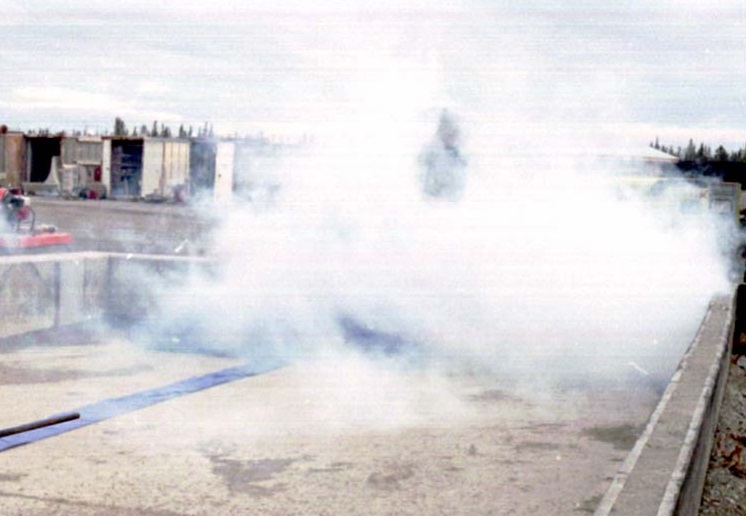
Source: Source: Alaska’s Department of Environmental Conservation
CLICK HERE to see their very nicely done NH3 release presentation