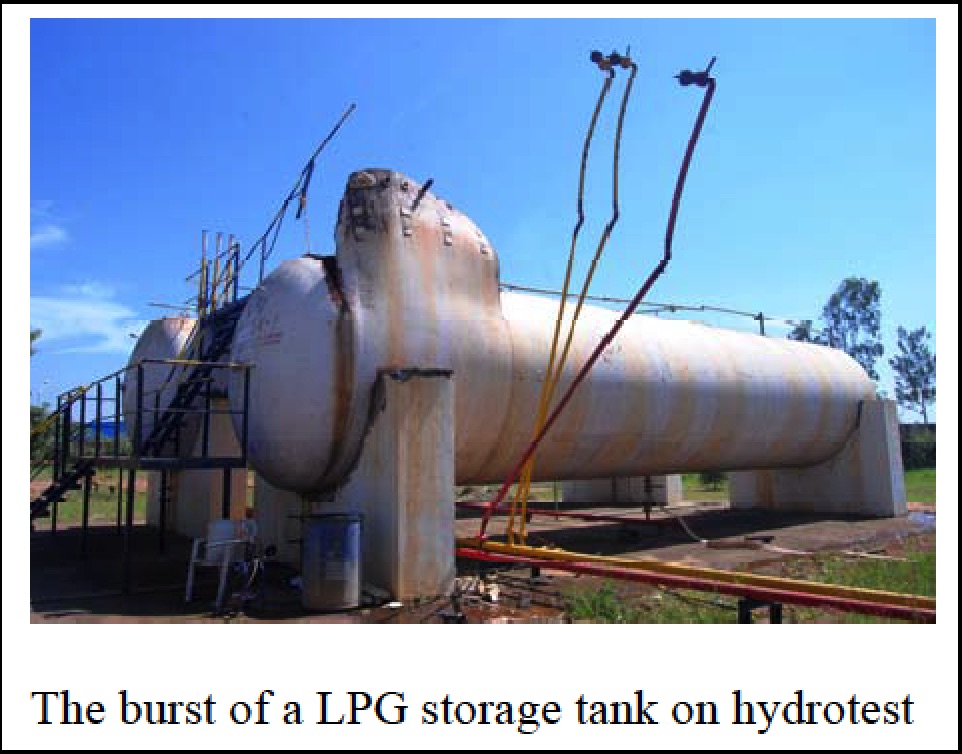
I have posted numerous fatal accidents that occurred during the pressure testing of piping and pressure vessels. Although hydrostatic testing involves less energy release should something fail vs. using pneumatic pressure, the hazard(s) are still HUGE and must be respected. This incident involved a propane bullet built in 1994 and placed into service in 1996, so do not think this was some ancient pressure vessel that had seen its better day! The catastrophic failure occurred during a hydrostatic pressure test after its MI inspection. A worker who was checking flanges for leaks was killed when the top of the vessel failed, striking the worker. Excellent photos with a great analysis…

The pressure vessel was fabricated in 1994. The vessel had been in service since 1996. Annual inspections were being done as per government regulations. A competent certified agency is authorized to perform the hydro test. The vessel had burst out at the time of the hydro test. The energy stored was so high that there was a loss of life during the inspection of flange leaks. Usually, the pressure gets released instantly at the beginning of the crack. Here, the stored energy was sufficient to cause a fracture to high magnitude.
Findings
- The cracked edge of the shell indicated a brittle failure.
- The stub in the failed area was seen to have swollen. This is an indication that the vessel was over-pressurized. See photos 2 & 4.
- Pressure gauges are to be mounted only after seeing the free issue of water. At times dirt can enter into the pressure gauge, and indicated pressure can go wrong. This is a possibility for over-pressurization. We encountered a package boiler yielding under over-pressurization during a shop hydro test about 20 years back on this cause.
- The hydro test procedure adopted was wrong. The vessel volume is 100000 liters. No vents were envisaged during the hydro test. It could be possible that the blanking of flanges was done first. The air must have only been released via the pressure gauge stub at the dished end. This vent would not have been sufficient. When water was filled and overflowed through the pressure gauge stub, the pressure gauge would have been fitted. The remaining air that got trapped above must have undergone compression during the hydro test. The energy absorbed for compressing air is much more than water since water is not compressible ( as compared to air). The energy would go for temperature rise at the top of the vessel, where the air was trapped. Even water temperature rises considerably during hydro when the air is trapped. The energy transferred must have led to the weakening of the vessel at the top by heating & by molecular activity. Possibly, this led to the vessel bursting at the top section. Moreover, the lifting lug location could be the place of crack initiation.
- The Hydro test procedure should have been done as per the written procedure. The procedure outlined in drawing no BCL/DPE/01 is right.
- There is no thinning of the metal anywhere along the failed edge. It is not a ductile failure. This means the vessel had turned brittle already. This would happen at LPG tanks are subject to low temperatures (particularly during winter) as the vessel would turn cold during the gas withdrawal process.
- It is possible that the vessel was cold at the time of the test/water filled was cold.
- Checking thickness cannot identify whether the shell plate has turned brittle or not. Ultrasonic flaw detection was required. The crack seemed to have been present near the lifting lug area. The lifting lug seemed so small that even while handling at the shop, the crack would have developed at HAZ of the weld.
- SA 516 Gr 70 in normalized condition has better strength at low temperatures. It was possible that the material was not normalized. Its impact strength might not have been proven at the lowest possible service temperature. The IS 2825 code may not address the special requirement for low-temperature service. It is possible that the shell plate is not normalized.
- There are specific code requirements for low-temperature service. ASME section VIII calls for impact test requirements. These might not have been demanded as per IS 2825 code. At the time of fabrication, the code regulations might not have been sufficient to address low-temperature service requirements.
What do we need to learn from this incident?
- Cold water cannot be used for hydro tests. In winter, the hydro test must be done in the daytime. Water temperature must be above 30 deg C (86F).
- An air venting arrangement is a must.
- Pressure gauges must be calibrated before use. Standard test gauges are to be used. At least two pressure gauges are required.
- Hydrotest should be done under supervision. The personnel are not to be allowed during hydro tests. At many construction sites, we see this is not followed.
- The relief valve is required at the pump’s discharge so the pressure can be reduced immediately.