
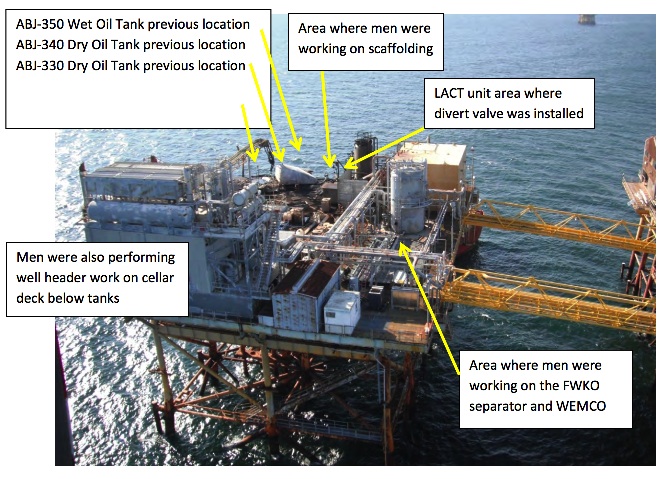
The Bureau of Safety and Environmental Enforcement (BSEE) has released the panel investigation report into the November 16, 2012 HOTWORK explosion and fire that occurred on an offshore platform. The explosion and fire resulted in the tragic deaths of three (3) workers, serious injuries to others, and the discharge of pollutants into the Gulf of Mexico. The investigation panel found these deaths were caused by a number of decisions, actions, and failures by the operator of the platform and contractors retained by the operator while conducting construction operations. The investigation found that the explosion and fire occurred when hydrocarbon vapors ignited while a contractor was welding on the incoming pipe segment to the wet oil tank. The ignition started a chain reaction that caused the wet oil tank and two connected dry oil tanks to explode. These explosions caused the three (3) tanks to separate at their bases, launching the wet oil tank and the first dry oil tank into the Gulf of Mexico and blowing the second dry oil tank into the air. The second dry oil tank then struck the platform crane and landed back on the WD 32 E platform. The hydrocarbons in all three of the tanks were released onto the platform and into the Gulf of Mexico. The hydrocarbons on the platform subsequently ignited, starting a fire on the platform. The report concludes that BSEE safety regulations were not followed, and accordingly BSEE will proceed with appropriate enforcement actions. And there’s more…
Two contract workers were found to be missing immediately following the explosions and the fire. There was evidence that one contractor died immediately following the explosion, and that another died as a result of injuries he sustained in the explosion and fire. On November 23, 2012, at the Baton Rouge Hospital, a third contractor also died as a result of the injuries caused by the explosion and fire. A number of other workers sustained serious injuries. The explosion also created an oil sheen approximately one half-mile by 200 yards in the Gulf of Mexico that resulted from the discharge of some of the hydrocarbons contained in each of the tanks that were blown off of the platform. The Panel identified a number of decisions and actions by the platform operator and its contractors that led to the ignition of hydrocarbon vapors during the welding work near the wet oil tank. The Panel found that there was both a failure to comply with welding requirements (30 CFR § 250.113) and adherence to basic safety management tenants:
- Conducting “hot work” without taking proper safety precautions. Platform Operator had a documented procedure that was to be followed prior to conducting “hot work” (which includes welding). Those procedures include the inspection of the work area, the use of gas detectors, and other precautions. The Panel found no evidence that any such precautions were taken.
- Failure to ensure proper communication among contractors and to establish an effective safety culture. Platform Operator engaged multiple contractors to conduct different construction operations at the WD 32 complex. Platform Operator and its contractors failed to communicate about operations, hazards, risks, and safety precautions.
- Failure to isolate hydrocarbons inside the wet oil tank. At the time of the incident, no one had taken steps to install any type of device that would ensure that the area where the welding was being conducted was properly protected from possible contact with hydrocarbons. The Panel found that contract workers proceeded with the welding work based on a faulty assumption that appropriate safety measures had been taken, including purging all necessary piping of hydrocarbons.
- No worker invoked his “stop work” authority despite apparent anomalies. The Panel found no evidence that any of the workers on the WD 32 E platform on November 16, 2012, exercised stop work authority. According to witness statements, a number of these workers consistently worried about losing their jobs if they raised safety concerns.
- Failure to identify hazards associated with construction operations. The Panel found that there was inadequate planning for the work to be conducted on November 16, 2012. The Panel found no evidence that the Platform Operator or any of its contractors conducted a job safety analysis or prepared a hot work permit that covered the actual work to be performed.
CLICK HERE (pdf) for the full report