
11/22/2017 UPDATE – Nice write-up Dap-1 Ammonia Tank Explosion: Safety and Security Concerns in Chemical Process Plant in Bangladesh
Two DAP officials found guilty – an engineer and the general manager of the plant were found responsible for the accident. The accused have been found guilty of negligence in duty as they did not inspect the safety of the factory or repair damaged portions. A tank containing 340 tonnes of ammonia exploded at the Di-ammonium Phosphate factory.
A large amount of ammonia gas was released around 10 PM on August 22, 2016, due to an overpressure event of a 10-year-old 500-ton atmospheric refrigerated ammonia storage tank at a Di-ammonium Phosphate plant. The facility had two 500-ton tons of ammonia tanks that supplied ammonia to a process. The tank which failed was partially full, containing 325 tons of anhydrous ammonia at the time of the incident. It was ripped completely from its base, went airborne, and landed about 35 ft away (see photo below – notice the two investigators standing to the left of the tank for a size comparison). Consequently, a huge gas cloud was formed and dispersed into the air. The ammonia gas spread over several kilometers, leaving nearly 250 people sick after inhaling the ammonia gas. Fifty-two of them required hospitalization.
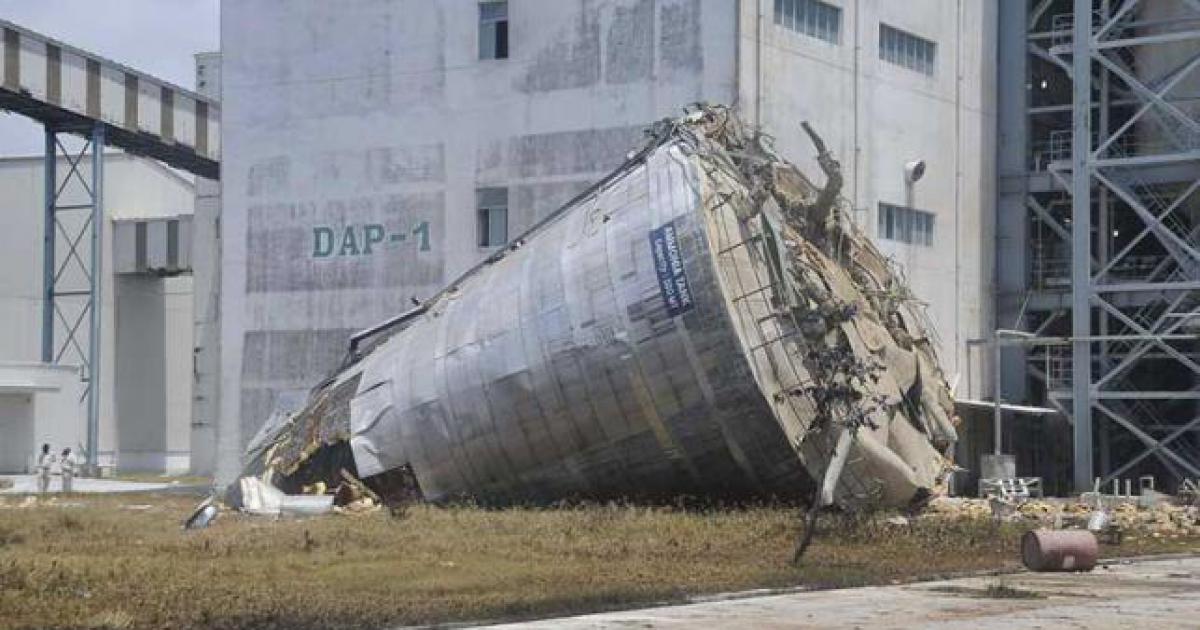
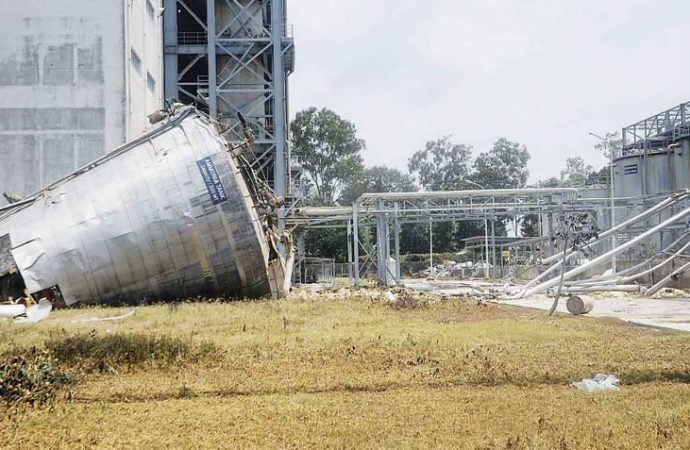
When asked, the managing director of DAP Fertiliser Ltd, admitted that the accident has caused one of the reserve tanks to move about 50 feet away from its original position. “There are a total of three reserve tanks in the two plants of the fertilizer company. The larger tank contains 5000 tons of ammonia while the other two tanks contain 500 tons of ammonia each,” the MD said adding that the damaged reserve tank only crossed its 10 years of 25 years of economic life.
Process Description: Liquid anhydrous ammonia, phosphoric acid, and sulfuric acid are used as raw materials which all are toxic and corrosive. The process includes a controlled reaction of phosphoric acid with ammonia, where the hot slurry is then cooled, granulated, and sieved.
Firefighters were trying to mitigate the ammonia cloud by water spray, dissolving ammonia into the water. Based on a published report, the concentration of ammonia gas was recorded 600 PPM in the adjacent area after five (5) hours of the incident occurring which was still far beyond tolerable level or threshold limit value (TLV) and even over the IDLH of 300 ppm.
An investigator has stated the safety valves and four other essential instruments, which were necessary to prevent the failure of the storage tank had been out of operation for a long time. The District Magistrate has said they had found fault on the part of the factory management. He also corroborated that the five safely instruments – safety valves, pressure transmitter, condenser, vent, and flare had not been functional.
A 10-member committee formed by Bangladesh Chemical Industries Corporation (BCIC) has submitted a preliminary report on the incident. Although the BCIC chairman did not disclose the report, sources said, the report blamed negligence and mismanagement as the prime cause of the accident.
See more at: http://dailyasianage.com/news/29517/bcic-investigation-blames-negligence-for-gas-leakage#sthash.Sr5x83N2.dpuf
Source: CLICK HERE to see the editorial
CLICK HERE for the news story
Source #2: http://www.theindependentbd.com/printversion/details/58103