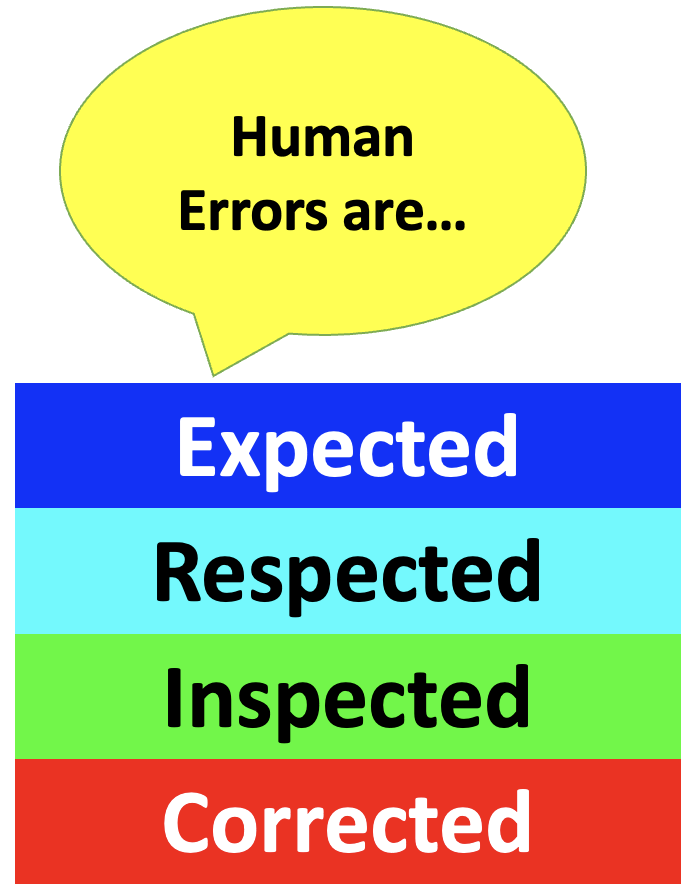
There are only two (2) different types of HUMAN FAILURES:
- ERRORS (Inadvertent)
- NON-COMPLIANCE (VIOLATIONS) (Deliberate)
A HUMAN ERROR is an action or decision that was not intended, involved a deviation from an accepted standard, and led to an undesirable outcome.
A NON-COMPLIANCE (VIOLATION) is a deliberate deviation from a rule or procedure.
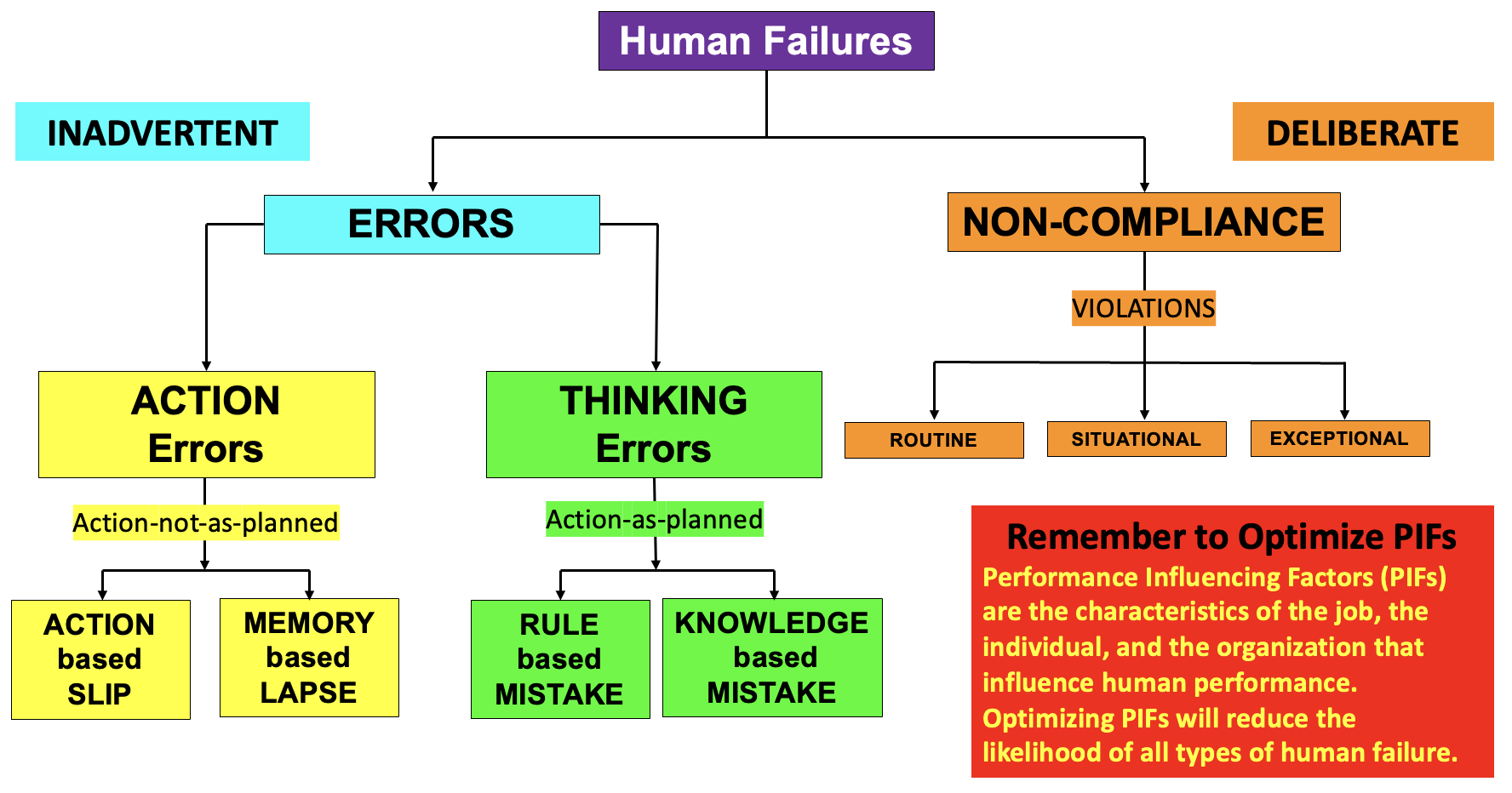
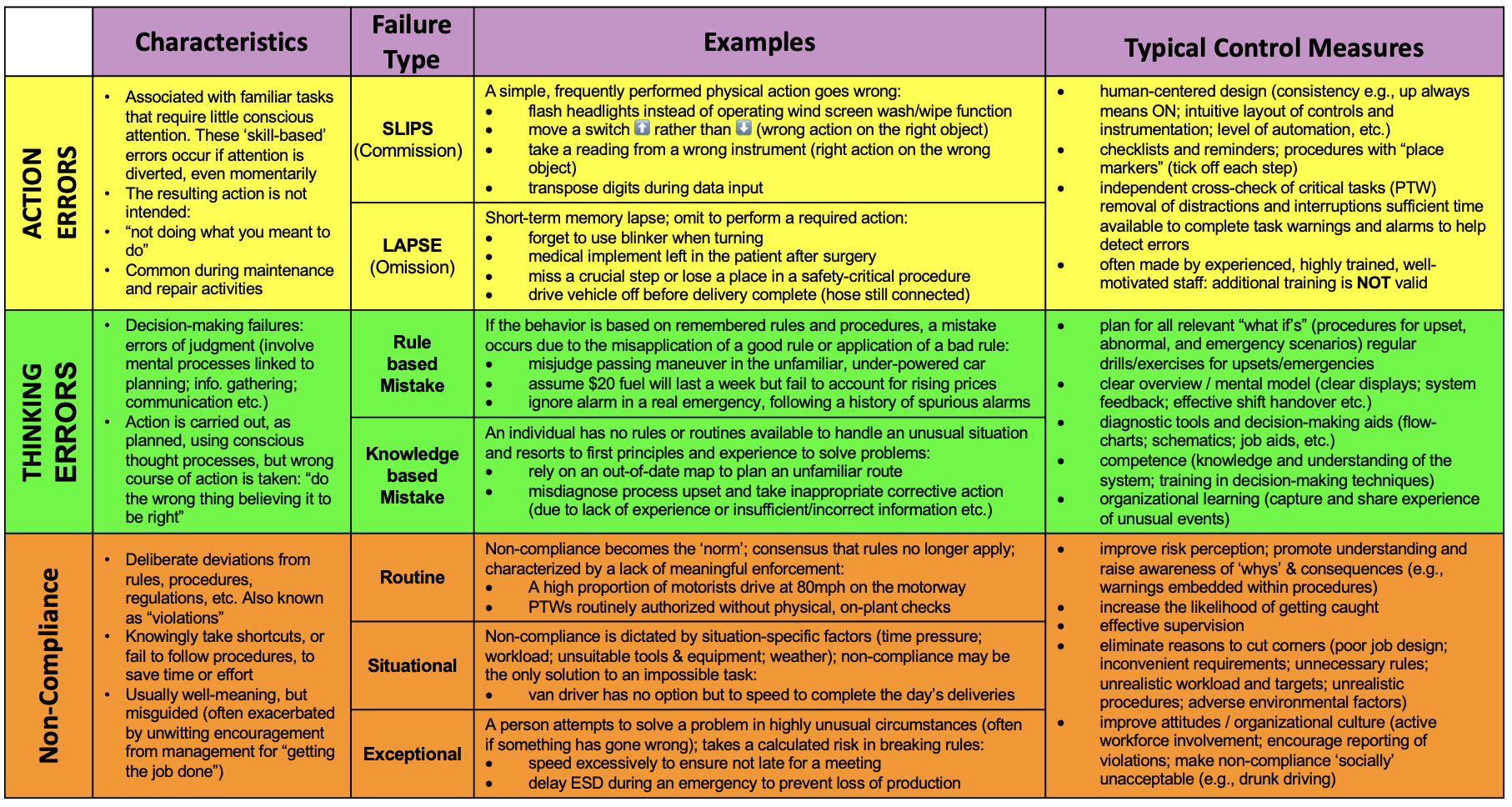
HUMAN ERRORS fall into three (3) categories:
- Slips,
- Lapses, and
- Mistakes
SLIPS and LAPSES occur in very familiar tasks which we can carry out without much need for conscious attention. These tasks are called “skill-based” and are very vulnerable to errors if our attention is diverted, even momentarily. Driving a car is a typical “skill-based” task for many of us. SLIPS and LAPSES are the errors that are made by even the most experienced, well-trained, and highly motivated people. They often result in omitted steps in repair, maintenance, calibration, or testing tasks. We need to be aware of these types of errors and try to design equipment and tasks to avoid or reduce their occurrence. We can also try to increase the opportunities to detect and correct such errors. It can be useful to make everyone aware that SLIPS and LAPSES exist and to consider them during accident investigations.
SLIPS are failures in carrying out the actions of a task. They are described as “actions-not-as-planned”. Examples would be picking up the wrong component from a mixed box, operating the wrong switch, transposing digits when copying out numbers, and misordering steps in a procedure.
Typical SLIPS might include:
- performing an action too soon in a procedure or leaving it too late;
- omitting a step or series of steps from a task;
- carrying out an action with too much or too little strength (e.g., over-torquing a bolt);
- performing the action in the wrong direction (e.g., turning a control knob to the right rather than the left, or moving a switch up rather than down);
- doing the right thing but on the wrong object (e.g., switching the wrong switch); and
- carrying out the wrong check but on the right item (e.g., checking a dial but for the wrong value).
The following is an example of a SLIP causing an accident:
Two similarly named chemicals were manufactured at a chemical plant in batch reactions. Each required the presence of an inorganic base to maintain alkalinity to prevent exothermic side reactions. Development work was in progress, which involved altering the various ratios of chemicals in each reaction. A chemist, in calculating the quantities of inorganic base required, inadvertently transposed the figures (a typical SLIP). As a result, one reaction was carried out with only 70% of the required base, and an exothermic side reaction resulted. The subsequent explosion destroyed the plant. The system was not designed to cope with a runaway exothermic reaction. There was no system for checking the calculations.
LAPSES cause us to forget to carry out an action, lose our place in a task, or even forget what we intended to do. They can be reduced by minimizing distractions and interruptions to tasks and by providing effective reminders, especially for tasks that take some time to complete or involve periods of waiting. A useful reminder could be as simple as a partially completed checklist placed in a clearly visible location for the person doing the task. We may be able to eliminate some of these lapses through better design of equipment or tasks.
An experienced truck driver had virtually completed filling his vehicle from a bulk tank of flammable liquid when a nearby telephone rang. After ignoring it for some five minutes he closed the various valves on the installation and went to answer it. On returning to the vehicle, he drove away having forgotten that he had not disconnected the tanker hose from the installation. Fixed pipework from the installation fractured, and approximately one ton of material was lost. The installation was not fitted with a drive-away protection device.
MISTAKES are a more complex type of human error where we do the wrong thing believing it to be right. The failure involves our mental processes, which control how we plan, assess information, make intentions, and judge consequences.
Two (2) types of MISTAKES exist:
- Rule-Based and
- Knowledge-Based
RULE-BASED MISTAKES occur when our behavior is based on remembered rules or familiar procedures. We have a strong tendency to use familiar rules or solutions even when these are not the most convenient or efficient.
An operator was very familiar with the task of filling a tank. He expected the filling procedure to take about 30 minutes. However, on this occasion, the diameter of the pipe entering the tank had been enlarged, and the tank was filling much more rapidly than he anticipated. He ignored the high-level alarms, assuming that the tank could not be full so quickly. The tank overflowed. Improved communications would have alerted the operator to the changes that had been made to the pipe.
In unfamiliar circumstances, we must revert to consciously making goals and developing plans and procedures. Planning or problem solving needs us to reason from first principles or use analogies. Misdiagnoses and miscalculations can result when we use this knowledge-based reasoning.
The investigation following a major tunnel collapse found that the organization had relied on one person’s experience as a control measure. However, the nature of the method of working meant that this person had no reliable instrumentation for detecting when the tunnel was becoming unstable. Relying on ‘experience’ was actually relying on the knowledge-based reasoning of the ‘expert’ and was not an effective control method to prevent a serious collapse, given the unpredictable nature of the event. The expert needed more reliable instruments to carry out this work.
Inexperience and lack of information
The kinds of errors described above typically occur with experienced and trained people. It is important to remember that human errors often occur if a person is not experienced or does not receive the correct information, such as knowledge of potential hazards. The following example shows this.
A man was killed while removing the lid of a 45-gallon drum using a burning torch. He had not been told that the drum contained flammable residues. The drum exploded when the heat was applied.
Lack of understanding often arises through a failure to communicate effectively. Shift handovers are a particularly vulnerable time for communication failures.