
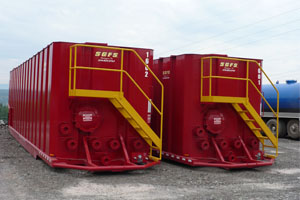
 This article is overdue, as many businesses use these mobile tanks for almost anything on the planet! Unfortunately, these mobile storage tanks are NOT designed for everything on the planet. Without getting into materials of construction concerns and compatibility issues, I want to touch on my biggest concern: using these mobile tanks in some flammable or combustible liquid service.
Let’s start with one of the most common issues – the GROUNDING of the tank. These days with all the environmental requirements, these tanks are almost always set up within a temporary containment basin. These basins are made of heavy-duty flexible material, and they WILL ACT AS AN INSULATOR. Thus, the tank will NOT be grounded. We must install an actual ground rod and PROPERLY attach the tank to the ground rod. Even with this grounding being done properly, there is a little hidden hazard inside the tank… epoxy liner! Many of the newer frac tanks are built with an epoxy liner to reduce corrosion. These tanks get used for a wide variety of materials, so manufacturers started using epoxy to line the inside of the tanks. They work great for their intended purpose, but they act as an insulator and PREVENT any static charge that the flammable liquid may have built up from reaching “ground.” In basic terms, the epoxy is an INSULATOR and insulates the static charge from reaching the ground.
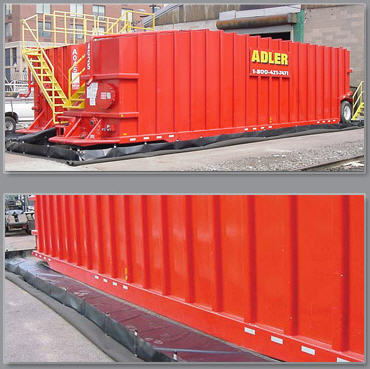
The next issue is tank design. There are several fundamental code requirements for flammable liquid tanks (NFPA 30 and 29 CFR 1910.106) that these frac tanks just do not meet. At the very least, we should always thoroughly check the items noted below to ensure that the frac tank is designed and set up properly but don’t be surprised when you find the frac tank is incapable of meeting all of these requirements.
1) 1910.106(b)(1)(iii)(a)(1) states that these frac tanks intending to hold flammable liquids have to be built to one of the following codes:
- Underwriters’ Laboratories, Inc., Subjects No. 142, Standard for Steel Aboveground Tanks for Flammable and Combustible Liquids, 1968;
- No. 58, Standard for Steel Underground Tanks for Flammable and Combustible Liquids, Fifth Edition, December 1961; or
- No. 80, Standard for Steel Inside Tanks for Oil-Burner Fuel, September 1963.
- American Petroleum Institute Standards No. 650, Welded Steel Tanks for Oil Storage, Third Edition, 1966.
- American Petroleum Institute Standards No. 12B, Specification for Bolted Production Tanks, Eleventh Edition, May 1958, and Supplement 1, March 1962;
- No. 12D, Specification for Large Welded Production Tanks, Seventh Edition, August 1957; or
- No. 12F, Specification for Small Welded Production Tanks, Fifth Edition, March 1961.
Tanks built per these standards shall be used only as production tanks for storing crude petroleum in oil-producing areas.
Ask your supplier for documentation showing their tanks were constructed to one of these standards, and listen to the crickets chirp! I will admit there are a few companies specializing in oil and gas that can provide this documentation, but often they strike out on the next several requirements discussed below.
2) 1910.106(b)(2)(iv)(a) states that atmospheric storage tanks shall be adequately vented to prevent the development of vacuum or pressure sufficient to distort the roof of a cone roof tank or exceed the design pressure in the case of other atmospheric tanks, as a result of filling or emptying, and atmospheric temperature changes. Most of these frac tanks are atmospheric tanks; many are emptied using a vac truck. Remember that a flammable liquid tank is permitted to have only one opening, its vent, meaning that propping the manway open will not cut it. Yes, it may prevent the tank from being sucked in, but with the open manway, it is also going to release a lot of flammable vapor.
3) 1910.106(b)(2)(iv)(b)(3) requires that the normal vent(s) be sized either in accordance with API 2000 (1968) or other accepted standards; or shall be at least as large as the filling or withdrawal connection, whichever is larger but in no case less than 1.25-inch nominal inside diameter. Be sure to check the vent size and then compare that size to the inlet pipe size. You may be puzzled as to why the inlets and outlets are so large, and the vent is often smaller. REMEMBER… cracking open or having the manway fully open is NOT a SAFE (or complaint) option. Also, 1910.106(b)(2)(iv)(d) states that if one of these tanks has more than one fill or withdrawal connection and simultaneous filling or withdrawal can be made, the vent size shall be based on the maximum anticipated simultaneous flow.
Let me also mention Class IA flammables here… PLEASE DO NOT use a frac tank to capture a Class IA flammable, even if the MIXTURE contains a small percentage of the Class IA!!!!
4) 1910.106(b)(2)(v)(a) states that every aboveground storage tank shall have some form of construction or device that will relieve excessive internal pressure caused by exposure to fires. Keeping in mind that sitting in an earthen dike with knee-high grass and inside a secondary containment system uses hoses that are often not “attached per design,” there is a real risk of these tanks being exposed to an external fire. Even if it is a truck parked next to it catching fire… These tanks have fire risks, and they need the proper emergency vent. I have yet to come across a frac tank with a fire vent. It would be almost impossible for the manufacturer to design this, as they have no idea what we will put into the tank.
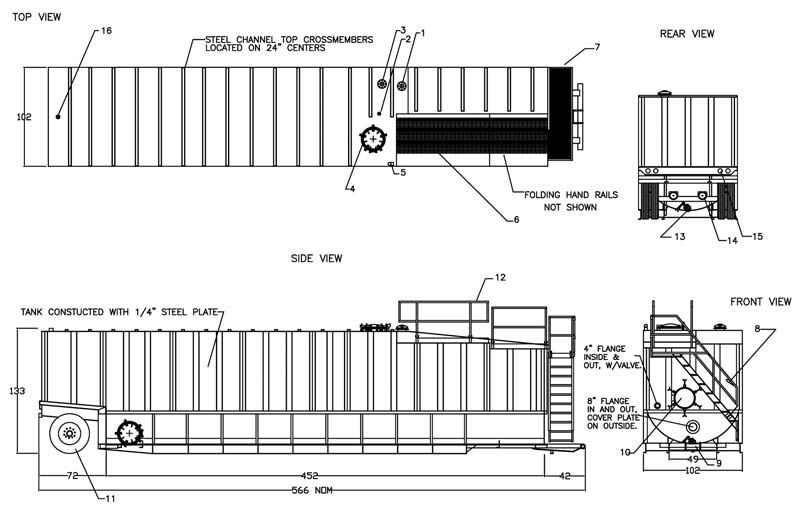
5) 1910.106(b)(2)(vi)(b) states that where vent pipe outlets for tanks storing Class I flammable liquids are adjacent to buildings or public ways, they shall be located so that the vapors are released at a safe point outside of buildings and not less than 12 feet above the adjacent ground level. Now you do not need to get your tape measure out, but you can get the dimensions of the tank (e.g., the height) from the spec sheet (like the one below) and then eyeball how long the vent pipe is. I have not found one that reaches 12′ high; some have been close, but even the larger frac tanks limit their height so they can fit into tight areas, and most do not exceed 10′-11′ and I can assure you, if the tank does have a vent pipe that sticks up a foot higher than the top of the tank, it has a life expectancy of about one project!
PLEASE NOTE: Do NOT place a frac tank on top of an earthen dike just so that the vent would be 12′ high. Most earthen dikes are NOT designed to see this type of load placed upon it, and it can cause serious damage to the dike wall.
6) 1910.106(b)(2)(vii)(c)(1) states where protection of adjoining property or waterways is accomplished by retaining the flammable liquid around the tank by means of a dike, the volumetric capacity of the diked area shall not be less than the greatest amount of liquid that can be released from the largest tank within the diked area, assuming a full tank. The capacity of the diked area enclosing more than one tank shall be calculated by deducting the volume of the tanks other than the largest tank below the height of the dike. This is an EASY check, as just look on the frac tank for the volume size (remember we MUST assume the ENTIRE volume of the tank – regardless of how much is intended to be put in the tank). Next, find the tag on the temporary dike. It is usually on one of the corners. Just ensure the dike volume is larger than the frac tank(s) sitting inside it. But all of this is most likely going to be mute, as 1910.106(b)(2)(vii)(c)(3) requires the walls of the diked area to be of earth, steel, concrete or solid masonry and be designed to be liquid tight and to withstand a full hydrostatic head. I have yet to see a secondary containment setup meet these construction requirements.
NOTE: you will have to ask an environmental professional why facilities require their frac tanks to be placed within a secondary containment system that is most likely already sitting in a large containment system. I have seen some facilities claim the primary containment system as their sole containment. Still, the vast majority of facilities require the frac tank to be within its own containment system, regardless of where it is positioned.
7) 1910.106(b)(2)(viii)(e) states for Class IB and Class IC liquids other than crude oils, gasoline, and asphalts, the fill pipe shall be so designed and installed as to minimize the possibility of generating static electricity. A fill pipe entering the top of a tank shall terminate within 6 inches of the bottom of the tank and shall be installed to avoid excessive vibration. 1910.106(b)(2)(viii)(f) states filling and emptying connections that are made and broken shall be located outside of buildings at a location free from any source of ignition and not less than 5 feet away from any building opening. Such connection shall be closed and liquid-tight when not in use. The connection shall be properly identified.
So as you can see, tanks that are used for flammable liquid service have some fairly stringent and specific requirements. If a frac tank can meet these requirements, then by all means, it can be used safely for flammable liquids. But on the other hand, having a tank that does not meet just one of the requirements above could put workers and facilities at unnecessary risk. Any project, regardless of size that will be utilizing a frac tank should receive a thorough environmental, health, and safety review before being placed into service. These tanks play a vital role in the refining and petrochemical industries, but they must be used properly and SAFELY!