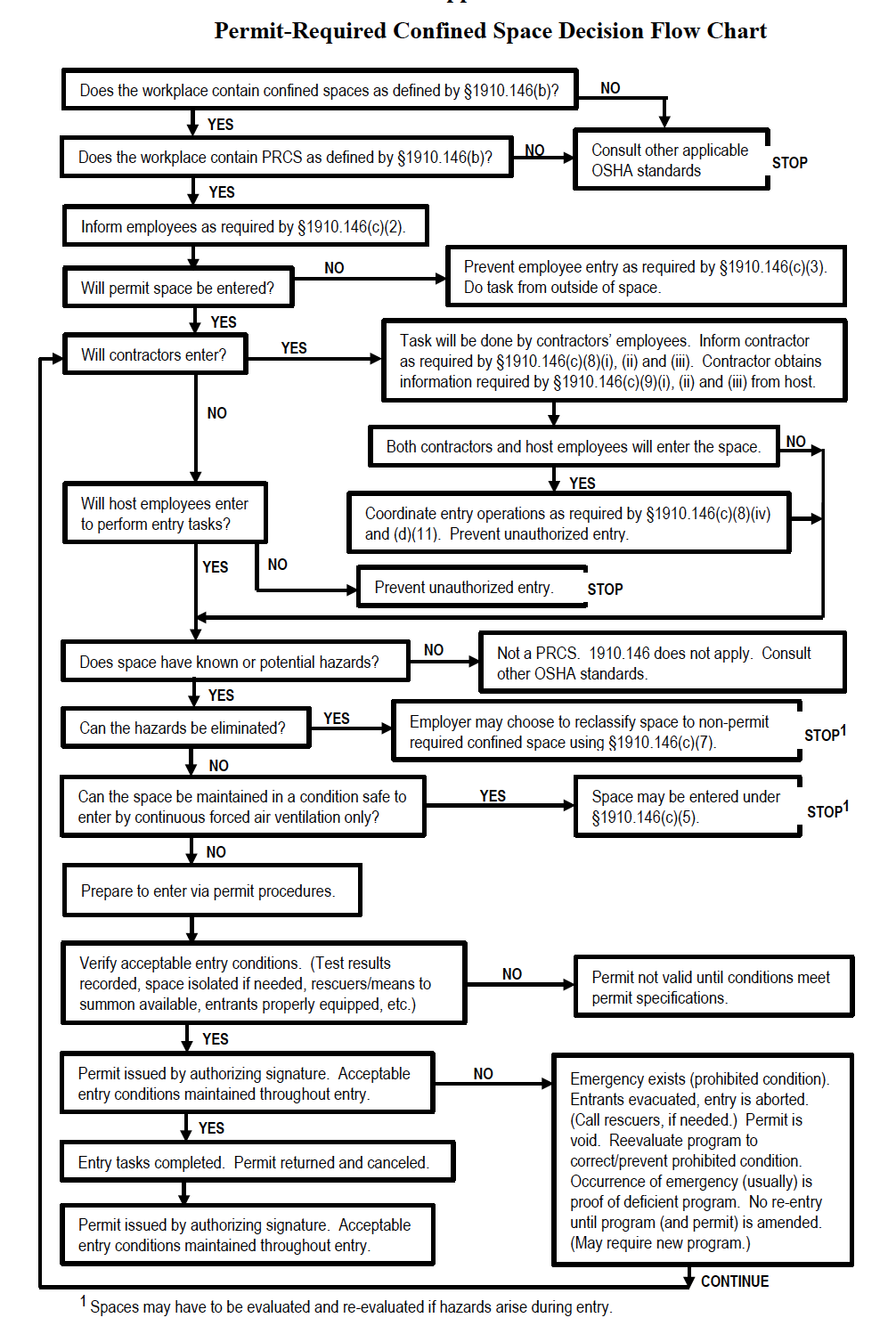
In many industries where the heating or cooling process comes into play, the process will probably have some type of heat exchanger or condenser. In large-volume processes, these units can be enormous; easily large enough to bodily enter and do assigned work. But many of these units may not get identified as a Permit-Required Confined Space (PRCS) during the site evaluation because of their design; however, every once and a while, these units have their “tubes/bundles” pulled and thus, we go from a “nothing space” to a PRCS that needs a Danger Sign and a different energy isolation plan. Let me explain…
Earlier this year, we were working on a turnaround and encountered a serious situation involving work on a tube and shell heat exchanger. This exchanger was only to be opened up and have its “tubes shot,” which means the tube bundle would stay in place. But after identifying several tubes that had failed, engineering decided to pull the bundle so they could get a better idea of what was happening. Before the tube bundle was pulled, the open vessel was NOT even a CS and therefore not a PRCS, as it looked something like this:
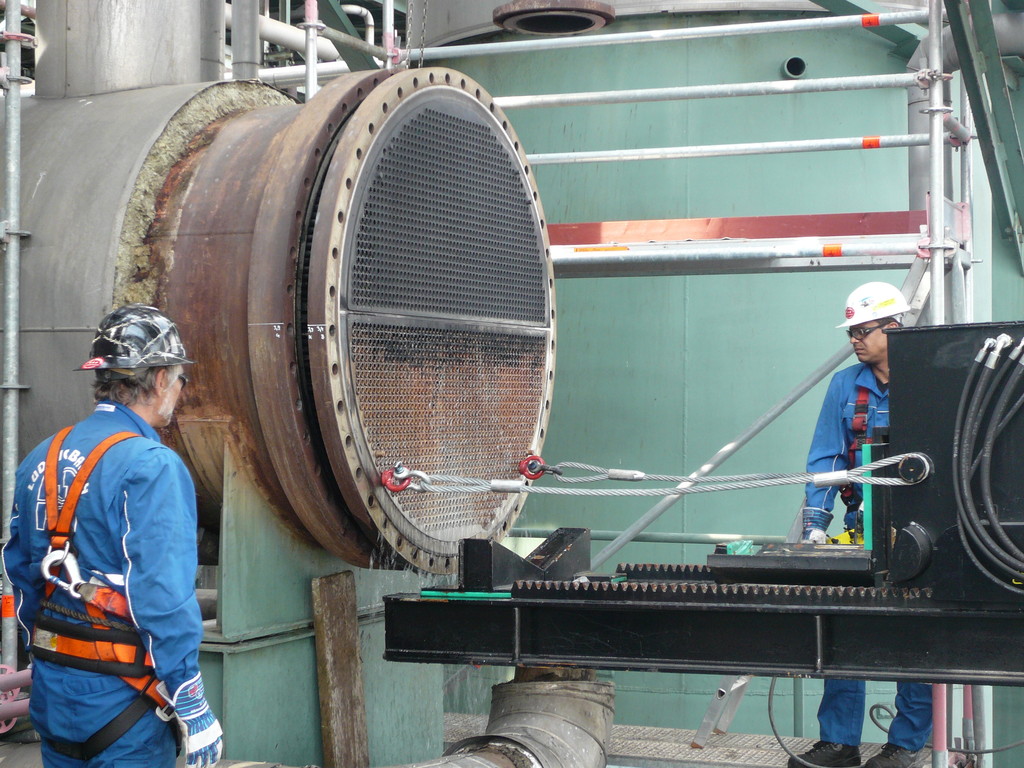
NOTE: this is NOT the actual vessel; these workers were NOT associated with this incident.
So that everyone understands, this vessel is a PSM-covered piece of equipment, and therefore to remove the head (e.g., open this vessel), a line break/equipment opening permit has been issued. In order to issue this type of permit, the facility required an energy isolation plan for the scope of work and a LOTO permit (which had been issued).
I came across this project just before the head was removed, and we (me and the contractor supervisor) walked down the permits and energy isolation plan. For a line break/equipment opening permit, the energy isolation plan involved some single valve isolations. These single valve isolations are not normally allowed during normal conditions (e.g., the unit operating); however, with the entire unit down and “drained”, the facility can request a variation for energy isolation, and one was granted on this occasion for single valve isolation(s). I took no issue with the energy control plan for the line break/equipment opening permit, and the work proceeded without any issues. I moved on to my next walk-down and field audit.
Later that day, I walked by the same project, and something caught my eye and stopped me in my tracks. The scope of this project apparently had changed drastically, and I wanted to verify that the safe work practices and permits reflected this change in scope. The most significant change was that this tube and shell heat exchanger had its tube bundle removed and we have a contractor inside the shell!! The vessel now looked more like this:
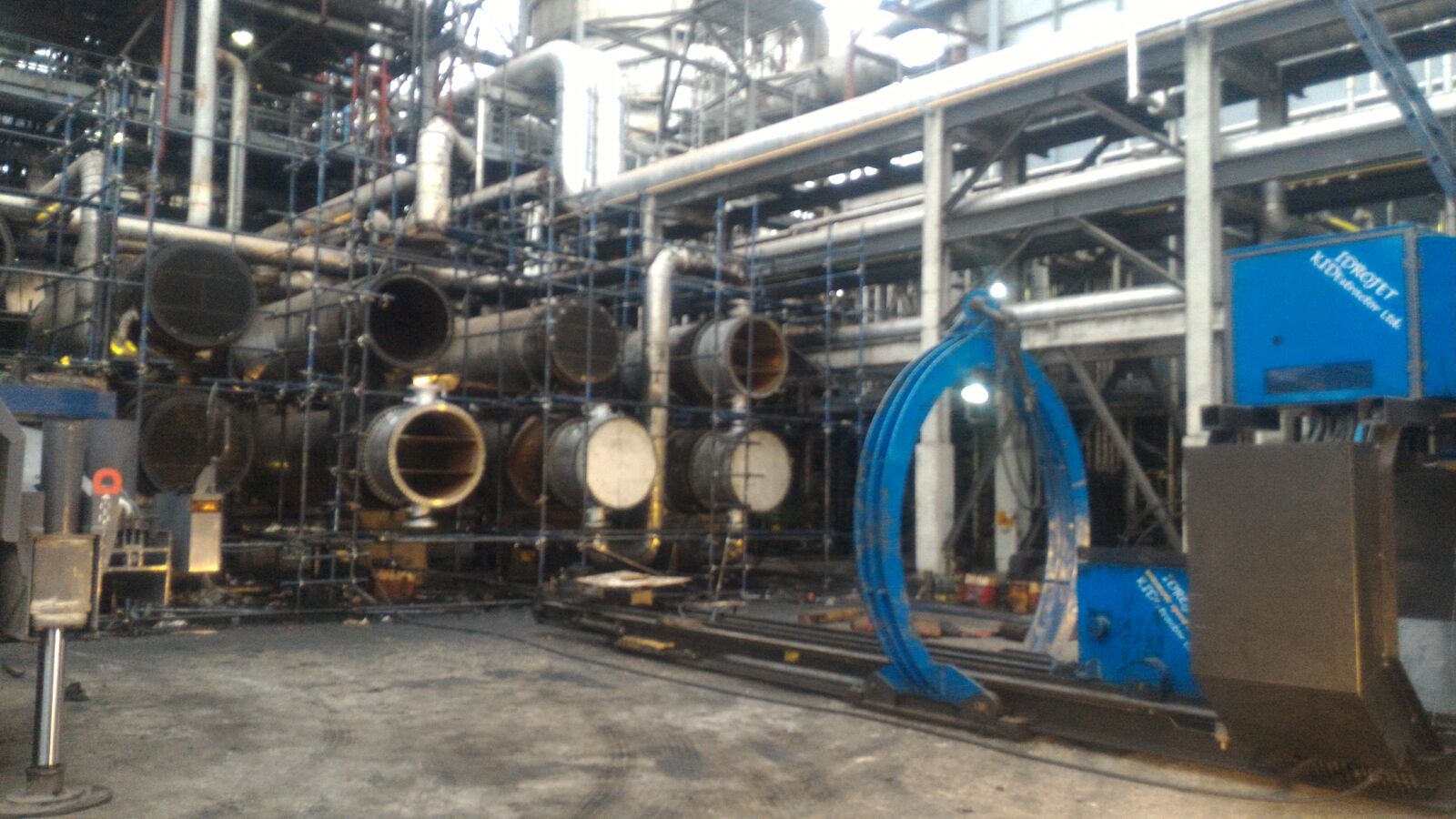
NOTE: this is NOT the actual vessel and these workers were NOT associated with this incident.
Here we can see the exchangers that have their bundles in place and the ones that have had their bundles removed. It is obvious that when the bundle is in place, the shell can NOT be entered, and therefore we do not have a CS; however, once the bundle is pulled out, the shell instantly becomes a PRCS. We can see the three (3) exchangers that have had their bundles pulled, and I think everyone can agree that we now have (as shown above) three (3) newly created PRCSs.
As I approached the worksite, most of the workers were quick to remind me that I had already “bothered them” and that, and I quote… “Nothing has changed from when you were here earlier.” That comment from the contractor foreman made me fear the worst. I asked to see the “entry permit” for the worker inside the shell. The contractor foreman quickly pulled one from his back pocket, as he was the “entry supervisor” (another deviation from normal practices allowed during turnarounds when the entire unit is down and drained). The permit was all filled out correctly except for one really critical area – energy isolation. The energy isolation plan had NOT been modified from the earlier line break/equipment opening permit to match the PRCS Entry that was now part of the scope of work. At this facility, when it comes to PRCS entry there are NEVER any allowed deviations! The contractor supervisor seemed a tad agitated since I was the one who had walked down the energy isolation earlier and given it a “thumbs-up”. But what he did not understand was that the energy isolation plan we walked down earlier was ONLY ACCEPTABLE for a line break/equipment opening, in which single valve isolation is permitted when the entire unit is down; however, even with the entire unit down and drained, an entry into a PRCS (which was created when the bundle was pulled) requires the pipes/lines/ducts/hoses/tubes attached to the space to be isolated using one of three means:
- Double Block and Bleed
- Blinding/Blanking
- Disconnect and misalignment
For the earlier scope of work, the energy isolation methods used were under the “unit down” variance, and the scope of work at that time was only (not making light of this task) a “line break/equipment opening”. As soon as the tube bundle was pulled, the shell became a PRCS, and this required, at a MINIMUM, a DANGER sign be posted at the entry portal. This was not done.
Next, operators allowed the contractor supervisor to be the entry supervisor, which was allowed since the unit was down and it was his employees who would be entering the space. But neither the operators, engineers overseeing the project and who changed the scope of work, nor the contractor supervisor recognized that the energy isolation that permitted them to remove the head from the exchanger safely was NOT going to be enough to meet the energy isolation needs for a safe entry into the shell.
After some discussion with the contractor supervisor, lead operator, unit supervisor, and a Sr. Engineer, it was agreed that the shell was entered without proper energy isolation, which led to a full PSM investigation. Over the next two shifts, the operators isolated the shell for vessel entry, and the unit supervisor issued a company PRCS entry permit. And while the shell was being isolated, the entry portal was barricaded off, and a Danger sign was posted.
Bottom line… when the scope of work changes, it is a very good possibility that the permit(s) will need to change, as well as the energy isolation plan. A review of other exchanger projects found that when the original scope of work included an entry into the shell, the energy isolation plan matched the scope of work. In this exchanger and one other earlier in the week, neither had “entry” as part of their original scope of work; however, for one reason or another, the scope changed, and an entry took place with improper energy isolation plans. The facility took swift action in ending the variance that allowed contractors to issue entry permits under any situation, completed a PRCS entry stand down (ending all entries, canceling all entry permits and reclassifications), and retrained everyone BEFORE they could be associated with energy isolation and/or permitting a PRCS, as well as requested the company to examine its turnaround practices of allowing safety variances associated with life-critical safe work practices such as LOTO, PRCS Entry, line break/equipment opening, Hot Work, etc.