
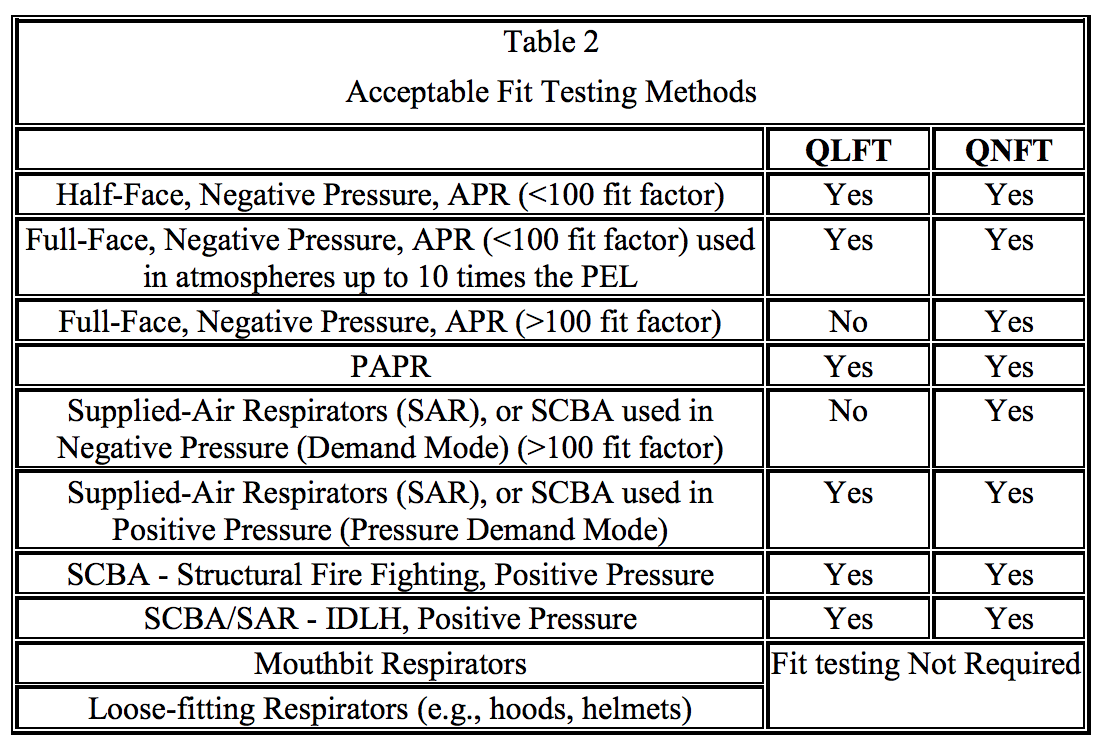
Fit testing is required for ALL employees using negative or positive pressure tight-fitting respirators, where OSHA requires such respirators or where the employer requires the use of such a respirator. A fit test is NOT required for voluntary users or escape-only respirators. (NOTE: SCBA’s are NOT escape-only respirators.) The fit test must be performed before the respirator is used in the workplace and a fit test must be done at least annually and whenever a different respirator facepiece is used or a change in the employee’s physical condition could affect respirator fit. But what type of fit test is needed: Qualitative or Quantitative?
Qualitative Fit Testing (QLFT) may be used to fit test negative pressure air-purifying respirators if they will only be used in atmospheres less than 10X’s the PEL since existing evidence only validates the QLFT protocols listed in Appendix A of the standard to identify respirators that achieve a fit factor of 100. For greater concentrations, Quantitative Fit Testing (QNFT) MUST be used.
Quantitative and qualitative OSHA-accepted fit test protocols are in Appendix A of the standard. When quantitative fit testing is used, all full-facepiece respirators MUST meet or exceed a fit factor of 500, while quarter- and half-mask respirators must meet or exceed 100. For all positive pressure, atmosphere-supplying respirators, either qualitative or quantitative fit testing may be used.
While atmosphere-supplying respirators are fit-tested in the negative pressure mode, these respirators are most often used as positive pressure respirators in the
workplace. Positive pressure atmosphere-supplying respirators that pass the QLFT or QNFT fit test may be used at the higher protection factors assigned to these respirators. See Table 2 for a summary.
Fit testing negative pressure respirators
Per paragraph 1910.134(f)(6), negative pressure air-purifying respirators that are qualitatively fit tested can ONLY be worn in atmospheres up to 10X’s the exposure limit, as long as this is BELOW the IDLH. Passing a qualitative fit test method is equivalent to achieving a fit factor of 100 by a quantitative fit test method (NOTE: Half-mask respirators must achieve a fit factor of 100 to pass a quantitative fit test.) The fit factor of 100 includes a safety factor of 10 and equates to the assigned protection factor (APF) of 10. Full-face air-purifying respirators can be fit-tested qualitatively; however, they can NOT be worn in atmospheres with contaminant concentrations greater than 10X’s the exposure limits.
- According to page 1225 of the preamble to the OSHA Respirator Standard, the fit factor achieved by qualitatively fit testing negative pressure air-purifying respirators is limited to 100. The preamble’s explanation is: “This limitation is based on the fact that the existing evidence only validates the use of qualitative fit testing to identify users who pass the QLFT with a respirator that achieves a minimum fit factor of 100. Dividing the fit factor of 100 by a standard safety factor of 10 means that a negative pressure air-purifying respirator fit tested by QLFT cannot be relied upon to reduce exposures by more than a protection factor of 10. The safety factor of 10 is used because protection factors in the workplace tend to be much lower than the fit factors achieved during fit testing; the use of a safety factor is a standard practice supported by most experts to offset this limitation.”
- Therefore, qualitatively fit tested half mask and full face negative pressure, air-purifying respirators can NOT be worn in concentrations greater than 10 times the occupational exposure limits (OELs).
- To wear full-face air-purifying respirators in atmospheres up to their assigned protection factor of 50, they must be quantitatively fit tested and achieve a fit factor of at least 500, which includes a safety factor of 10.
Demand type atmosphere-supplying respirators
Demand airline respirators and demand open-circuit SCBA (self-contained breathing apparatus) used for entering hazardous atmospheres are no longer manufactured. However, the same fit testing policy for negative pressure air-purifying respirators would apply to negative pressure atmosphere-supplying respirators if they were still being used. For instance, a full-face demand SCBA must be quantitatively fit tested, with a passing fit factor of at least 500, to be worn with a higher APF of 50, and a full-face demand SCBA that is qualitatively fit tested only has an APF of 10.
Fit testing positive pressure respirators
Tight-fitting, positive pressure respirators, including PAPRs shall be fit tested in the negative pressure mode (fit tested as negative pressure air-purifying respirators). This can be accomplished by either temporarily converting the facepiece, per manufacturer’s instructions, into a negative-pressure air-purifying respirator or by using a “surrogate” negative-pressure facepiece with sealing surfaces and materials that are identical to the wearer’s positive-pressure facepiece. In other words, if the facepiece sealing surfaces and materials are indistinguishable from the positive pressure respirator facepiece, then the negative pressure, the air-purifying respirator can be worn as a surrogate during fit testing.
For industrial use, including firefighting, OSHA permits positive pressure respirators to be either qualitatively or quantitatively fit-tested. Fit testing positive-pressure respirators is to ensure there is no gross leakage in the facepiece seal. Positive pressure half mask and full face respirators that are quantitatively fit tested shall pass with a minimum fit factor of 100 and 500, respectively. Individuals may wear positive-pressure respirators up to the assigned protection factor of the respirator after passing either qualitative or quantitative fit testing.
From OSHA’s Preamble:
… in the case of full facepiece negative pressure respirators, the Agency has established that an APF of 50, as opposed to ANSI’s APF of 100, is currently acceptable. In this regard, all but one of the substance-specific standards with APFs for full facepiece negative pressure respirators set an APF of 50. In addition,
the existing respirator rule and its supporting preamble require that quantitative fit testing of full facepiece negative pressure respirators must achieve a fit factor of 500 when employees use them in atmospheres in excess of 10 times the PEL; this requirement assumes a safety factor of 10. Therefore, based on a fit factor of 500, such respirators are safe to wear in atmospheres up to 50 times the PEL.