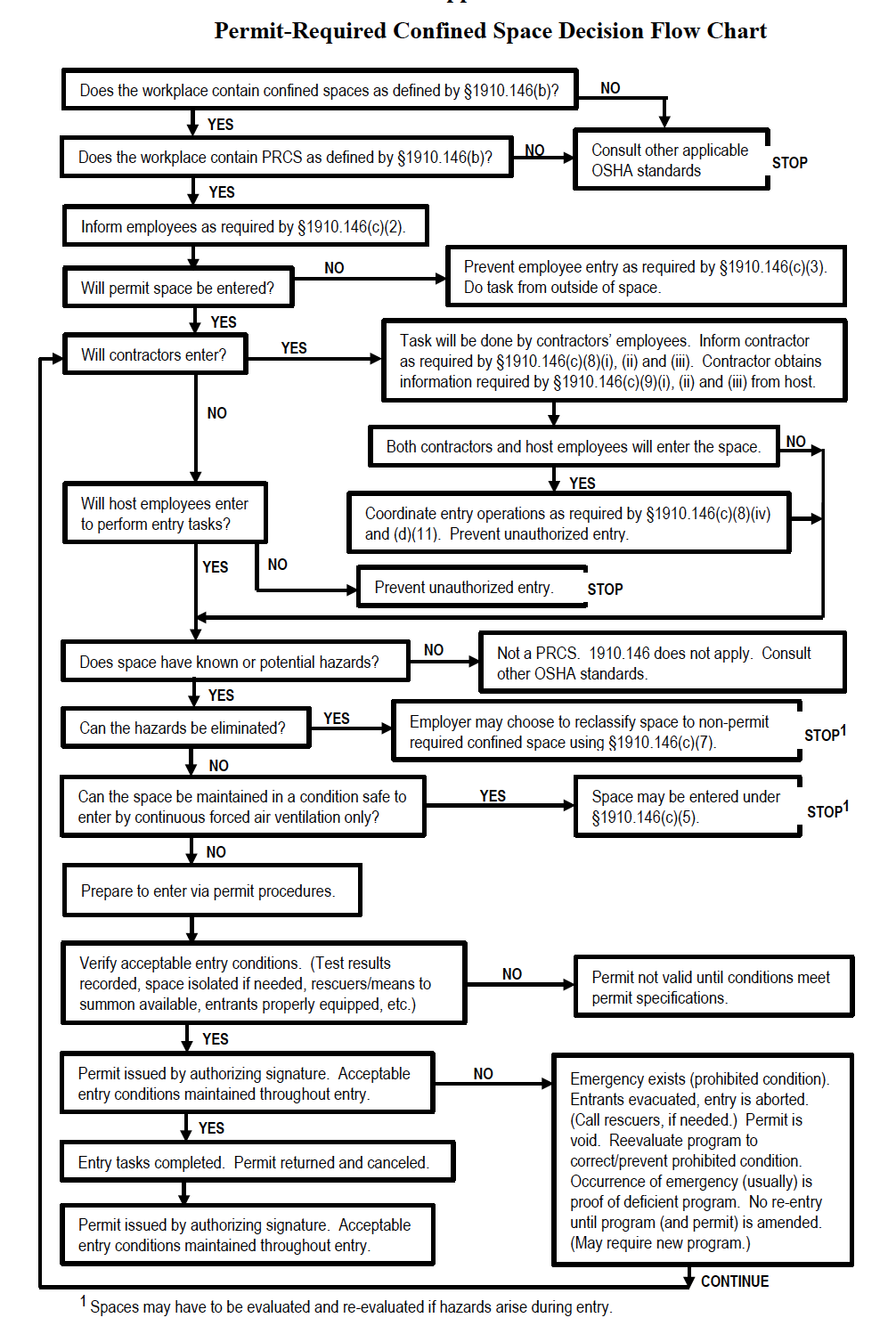
In both their General Industry and Construction Confined Space Standards, one of OSHA’s criteria for a “Confined Space” is that the space is “not designed for continuous employee occupancy.” These six (6) words seem to cause much confusion on both ends of the CS debate. I have seen it misused to claim a space is a CS, and I have seen it misused to claim a space is not a CS, and therefore it was not a Permit-Required Confined Space (PRCS). I hope to convince you that “not designed for continuous employee occupancy” really does mean what it says!
First, we have OSHA’s 1995 LOI, which does an excellent job of explaining “not designed for continuous employee occupancy“…
The proposed rule (F.R., Vol. 54, No. 106, June 5, 1989, pg. 24089) provided the initial clarification of OSHA’s intent on this subject when we stated “In addition, OSHA proposes paragraph (b)(10)(iii) to make it clear that the work areas covered by this standard are unsuitable, by nature for continuous employee occupancy, because those spaces were created to contain such things as degreasers, sawdust, and sewage, not to accommodate people.”
In the preamble of the final rule (F.R., Vol. 58, No. 9, January 14, 1993, pg. 4478), OSHA discusses comments sent to the docket and the slight differences between our definition of confined space and that of the American National Standards Institute (ANSI) definition. Although the distinction between the “primary function” (ANSI) and the “design” (OSHA) of a space may seem inconsequential, OSHA believes that the final rule’s definition properly places the focus on the design of the space, which is the key to whether a human can occupy the space under normal operating conditions. Thus, if a space is truly designed for human occupancy, then the primary function of the space is irrelevant.
My litmus test is simple…
Was the space DESIGNED AND CONSTRUCTED for housing workers continuously? If the answer is “no,” then the space meets the criteria of “not designed for continuous employee occupancy.” The key concept here is “DESIGNED for continuous employee occupancy.” This is far different than a space that may allow a person to enter but was NEVER intended for a person to occupy the space continuously. The preamble to OSHA’s General Industry PRCS Standard reflects this by stating…
If, when the space was originally designed or subsequently redesigned, the designer took into consideration that humans would be entering the space and provided for the human occupancy (such as: provided ventilation, lighting, sufficient room to accomplish the anticipated task, etc.), then the space would be designed for employee occupancy.
So with all of this said, is a crawl space within a building a Confined Space? My position – most of these “crawl spaces” would ABSOLUTELY be a CS; however, it may not contain hazards that would make it a Permit-Required Confined Space (PRCS) which would then require us to meet either 1910.146 or 1926.1201-.1213. This important distinction seems to get lost in the safety community – we can enter a CS every day without having to comply with either standard because there is NO HAZARD PRESENT that makes it a PRCS. So going into a crawl space within a building could be a simple entry and exit, if there are NO HAZARDS PRESENT that would make the CS a PRCS, such as atmospheric hazards (even potential atm hazards), engulfment hazards, configuration hazards, or other recognizable serious safety and health hazards.
OSHA has addressed the “crawl space” question in their FAQ for the newer Confined Spaces in Construction standard, which came from a Litigation Settlement over the new OSHA standard.
The following Frequently Asked Questions (FAQs) clarify the scope of the standard, as well as how the standard will apply to attics, crawl spaces, basements, and other potential confined space or permit-required confined space exposures that may occur during the course of residential construction work.
So the next time we are doing a CS Assessment, and we ask ourselves, was this space “designed for continuous employee occupancy,” the answer should be based on the actual PURPOSE and DESIGN of the space. If the space does not have the type of ventilation one would expect for a space to occupy personnel or the lighting is such that a person would need to carry in supplemental lighting. It is safe to say that space was NOT designed for continuous employee occupancy.