
CO2 Basement fatality at theater production (TN-OSHA)

CO2Basement

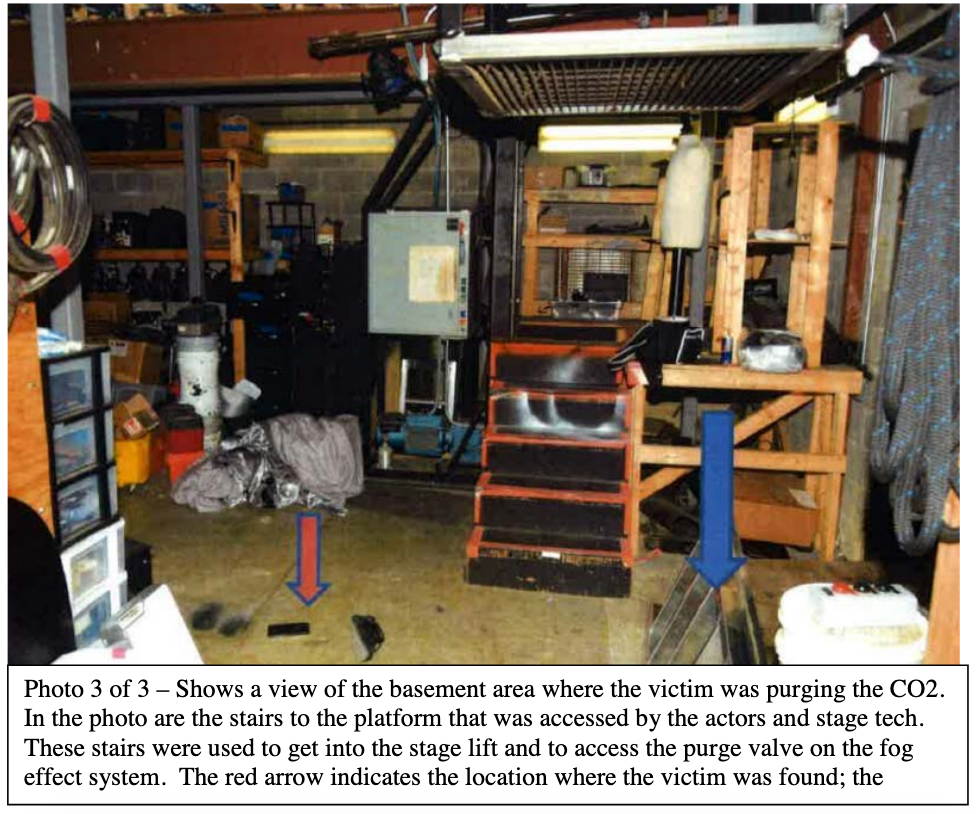
A 38-year-old male employee was fatally injured when he became exposed to an oxygen deficient atmosphere.    The victim, a Stage Technician, was an employee of a live show theater company and was responsible for venting cold liquid carbon dioxide (fog) onto the stage.  The CO2 would give a large cloud to mask the actor being lowered through the stage, on a device called a toaster/actor stage lift,  to the basement below. 
CO2Basement

As it became time for the fog effect on stage, the stage Manager missed the cue, and the victim was not responding on the radio when the  Stage Manager called for him.  At this point, another employee was instructed by the  Stage Manager to go down into the basement to get the victim.  When the employee went into the basement, he found the victim convulsing down on the ground near the back of the basement next to the toaster/actor stage lift.   Three employees were taken to the hospital; two employees were released early the next morning and the victim was admitted and died four days later.  The investigation concluded that the employer installed an MVE Carbo-Max 750 high flow bulk CO2 tank in the basement.  The basement was below grade and did not have alarms or monitoring equipment to warn the employees of high  CO2 levels or low oxygen levels. The employer had a purge valve installed on the fog effect CO2 system that was in the basement and had the CO2 purged into the basement. The employer instructed the victim to vent the CO2 into the basement to charge the system with cold  CO2  prior to release, which normally only takes 20  seconds. The employer also advised the victim that the fog effect was not strong enough during the previous night’s performance and told him to make sure the CO2 system that produces the fog effect was fully charged and ready when needed.  The victim had several duties, which required him to be upstairs and downstairs several times during a short period.  Due  to  the  employer talking to the victim and the fact that he was not downstairs until right before the fog effect  was  needed,  it  is  most  likely  that  the  victim started  purging  the  CO2  from  the  system  14  minutes before the cue for the fog effect so that he could make sure the system had cold CO2 and was ready for the fog effect when needed. The victim had purged the CO2 into the unventilated basement for approximately  14 minutes filling the basement area with CO2 and creating an oxygen deficient atmosphere. Also, based on information gathered, it appears he had purged half of the liquid  CO2 into the basement, which was approximately  300  pounds.  Several other employees exposed themselves knowingly to the oxygen-deficient atmosphere to rescue the downed victim, becoming victims themselves, because they were not properly trained in the hazards of CO2 and proper emergency response.

 CO2dewers CO2stagevent 


Citation(s) as Originally Issued

A complete inspection was conducted at the accident scene. Some of the items cited may not directly relate to the fatality.

Citation 1 Item 1, TCA 50-3-105(1) The employer did not furnish employment and a place of employment which were free from recognized hazards that were causing or likely to cause death or serious physical harm, including asphyxiation to employees.In that employees were exposed to elevated carbon dioxide atmosphere hazards and oxygen deficient atmosphere hazards from improper storage and use of carbon dioxide cylinders:
a) Employees were exposed to an asphyxiation hazard from purposefully purging carbon dioxide (CO2) piping into an unventilated work area (basement);
b) Employees were exposed to an asphyxiation hazard from potential CO2 collecting in an unventilated work area (basement) when releasing CO2 to create low roll fog stage effect and when releasing CO2 during actor stage lift operation;
c) Employees were exposed to an asphyxiation hazard from potential unintentional CO2 release (leaks) from an MVE Carbo-Max 750 HF storage container located in the basement below the stage; and
d) Employees were exposed to an asphyxiation hazard from potential unintentional CO2 release (leaks) from four CO2 storage containers located on the North and South sides of the stage.

Among other methods, one feasible and acceptable abatement method to correct this hazard is to store all liquid carbon dioxide storage vessels outside the building and pipe the carbon dioxide in as needed, to install gas detection and alarm systems for general monitoring and notifying building occupants of a carbon dioxide gas release. Where all liquid carbon dioxide storage vessels are stored indoors or below grade areas, to post carbon dioxide warning signs where all liquid carbon dioxide storage vessels are stored indoors or below grade areas, and to run venting lines from the liquid carbon dioxide storage vessel to the outside of the building and vent or purge the tank to the outside of the building. (As Referenced in National Boiler Inspection Code NB12-0304, Part 1, Supplement 3: Installation of Liquid Carbon Dioxide Storage Vessels S3.2 General Requirements, S3.4 Gas Detection Systems, S3.5 Signage, and S3.6 Valves, Piping, Tubing, and fittings: Safety Relief/Venting Lines.)

Citation 1 Item 2a, 1910.120(q)(1) The employer did not develop and implement an emergency response plan to handle anticipated emergencies prior to commencement of emergency response operations. In that, the employer had not developed and implemented an emergency response plan when employees responded to an uncontrolled release of carbon dioxide.

Citation 1 Item 2b, 1910.120(q)(3)(iv) Employees engaged in emergency response and exposed to hazardous substances presenting an inhalation hazard or potential inhalation hazard, did not wear positive-pressure self-contained breathing apparatus until such time that the individual in charge of the incident command system determined through the use of air monitoring that a decreased level of respiratory protection would not result in hazardous exposures to employees.In that, the employer did not require employees to wear positive-pressure self-contained breathing apparatus while the employees were responding to an uncontrolled release of carbon dioxide in an oxygen deficient atmosphere.

Citation 1 Item 3, 1910.134(d)(1)(iii) The employer did not identify and evaluate the respiratory hazard(s) in the workplace; including a reasonable estimate of employee exposures to respiratory hazards and identification of the contaminant’s chemical state and physical form. When the employer was unable to identify or reasonably estimate the employee exposure, the employer did not consider the atmosphere to be IDLH. In that, the employer did not evaluate employee exposure to carbon dioxide concentrations and oxygen-deficient atmospheres when carbon dioxide (CO2) was purposefully purged from CO2 piping into an unventilated work area (basement), nor did the employer consider the atmosphere to be immediately dangerous to life and health (IDLH).

Citation 1 Item 4, 1910.212(a)(1) One or more methods of machine guarding was not provided to protect the operator and other employees in the machine area from hazards such as those created by point of operation, ingoing nip points, rotating parts, flying chips, and sparks. In that, the employer did not provide guarding to prevent employees from getting into the equipment stage lift shaft and being crushed during operation. Citation 1 Item 5 l910.219(f)(3)Sprocket wheels and chains which were seven (7)feet or less above floors or platforms were not enclosed. In that, the sprocket wheels and chains used to lift and lower the actor stage lift known as the toaster were not properly guarded.

Citation 1 Item 6a, 1910.1200(e)(1) The employer did not develop, implement, and/or maintain at the workplace a written hazard communication program which describes how the criteria specified in 29 CFR 1910.1200(f), (g), and (h) will be met. In that, the employer did not have a written hazard communication program in-place at the time of the inspection.

Citation 1 Item 6b, 1910.1200(f)(10) The employer did not ensure that workplace labels or other forms of warnings were prominently displayed on the container or readily available in the work area throughout each work shift. In that, the labeling on the MVE Carbo-Max 750 HF liquid carbon dioxide storage vessel located in the basement was not prominently displayed.

Citation 1 Item 6c, 1910.1200(h)(1) Employees were not provided effective information and training on hazardous chemicals in their work area at the time of their initial assignment and whenever a new hazard that the employees had not been previously trained about was introduced into their work area.In that, the employer did not provide hazard communication training on the chemicals the employees were working with or could be exposed to in an emergency.

Citation 2 Item 1 1910.28(b)(11)(ii) Each flight of stairs, having at least 3 treads and at least 4 risers, was not equipped with stair rail systems and handrails.In that, the employer had stairs leading from the basement floor to the platform for the actor stage lift and did not have stair rail systems in place.

Citation 2 Item 2 1910.157(c)(1) Portable fire extinguishers were not mounted, located and identified so that they were readily accessible without subjecting the employees to injuries. In that, the employer did not identify the fire extinguisher that was located in the basement.

Citation 2 Item 3 1910.305(b)(1)(ii) Unused openings in boxes, cabinets, or fittings were not effectively closed. In that, the disconnect for the Show Motion actor stage lift had a one-inch opening that was not effectively closed.

Scroll to Top